

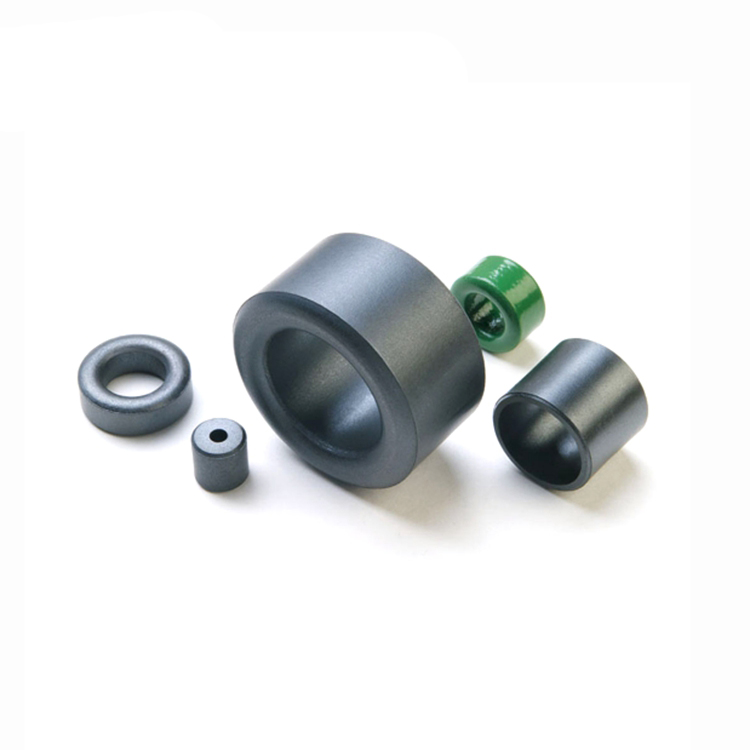

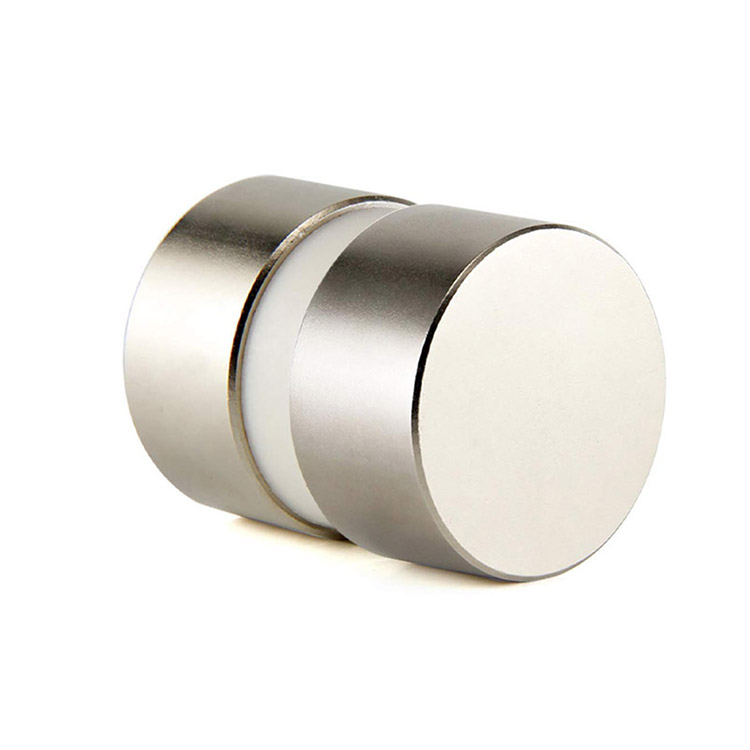
Neodymium disc magnets
Speakers, whether in headphones, car audio systems, or home entertainment setups, rely on the interaction between electrical currents and magnetic fields to produce sound. Speaker magnets play a crucial role in this process. Here’s how they work together:

Basic Speaker Operation:
A speaker consists of several components, including a diaphragm (usually a cone or dome), a voice coil attached to the diaphragm, and a neodymium disc magnet.
When an electrical signal (audio signal) is applied to the voice coil, it creates a fluctuating magnetic field around it according to the signal’s waveform.
This magnetic field interacts with the fixed magnetic field produced by the speaker magnet, causing the voice coil (and attached diaphragm) to move back and forth rapidly.
The movement of the diaphragm creates changes in air pressure, producing sound waves that correspond to the original audio signal.
Role of Speaker Magnets:
The magnet in a speaker is typically a permanent magnet, often made of materials like ferrite or neodymium disc magnet.
It provides a stable magnetic field against which the fluctuating magnetic field of the voice coil interacts.
The strength and characteristics of the magnet influence various aspects of speaker performance, including sensitivity, efficiency, and frequency response.
Neodymium magnets, being stronger for their size compared to ferrite magnets, are often used in compact speaker designs where space is limited, such as in headphones and portable speakers.

Types of Speaker neodymium disc magnet:
Ferrite Magnets: These are commonly used in speakers due to their relatively low cost and stable magnetic properties. They provide sufficient magnetic strength for most speaker applications.
Neodymium neodymium disc magnet: Neodymium magnets offer higher magnetic strength compared to ferrite magnets, allowing for smaller and more efficient speaker designs. They are particularly favored in compact and high-performance speaker systems.
Speaker Design Considerations:
The size, shape, and material of the magnet influence factors such as the speaker’s magnetic flux density, efficiency, and frequency response.
Engineers carefully select and design speaker magnets to achieve desired performance characteristics while considering factors like cost, size constraints, and power handling capability.
In summary, speaker magnets play a vital role in the operation of speakers by providing a stable magnetic field against which the fluctuating magnetic field of the voice coil interacts, ultimately producing sound. The choice of magnet type and design is crucial in achieving optimal speaker performance for various applications.
-What role do magnets play in electroacoustic devices ?
-What impact does magnet performance have on sound output quality?
-What kind of magnets should be used in speakers of different qualities?
Today, Understanding Magnet Emperor will come and explore speakers and speaker magnets with you.
The core component responsible for producing sound in audio equipment is the speaker, commonly known as the speaker. Whether it is a stereo or a headset, this key component is indispensable neodymium disc magnet. The speaker is a transducer device that converts electrical signals into acoustic signals. The performance of the speaker has a great impact on the sound quality. If you want to understand speaker magnetism, you must first start with the sound generation principle of the speaker.
The sound principle of the speaker
The side view of the speaker below can help us understand the basic structure of the speaker. Speakers are generally composed of several key components: T iron, magnet, voice coil and diaphragm.
So how do speakers produce sound? We all know that a magnetic field will be generated in an energized wire. The strength of the current affects the strength of the magnetic field (the direction of the magnetic field follows the right-hand rule).
When the AC audio current passes through the coil of the speaker (i.e., the voice coil), according to the above principle, there is A corresponding magnetic field is generated, which interacts with the magnetic field generated by the magnet on the speaker neodymium disc magnet. This force causes the voice coil to vibrate in the speaker’s magnetic field with the intensity of the audio current. The diaphragm of the speaker and the voice coil are connected together. When the voice coil and the diaphragm of the speaker vibrate together, they push the surrounding air to vibrate, and the speaker produces sound. As shown in the picture below, this is the principle of horn production.
Effect of magnet performance on speaker sound output quality
In the case of the same magnet volume and the same voice coil, the performance of the neodymium disc magnet has a direct impact on the sound quality of the speaker:
The greater the magnetic flux density (magnetic induction intensity) B of the magnet, the stronger the thrust acting on the sound membrane.
The greater the magnetic flux density (magnetic induction intensity) B, the greater the power, and the higher the SPL sound pressure level (sensitivity). Headphone sensitivity refers to the sound pressure level that the headphone can emit when a 1mw, 1khz sine wave is input into the headphone. The unit of sound pressure is dB (decibel). The greater the sound pressure, the greater the volume.
Therefore, the higher the sensitivity, the smaller the impedance, and the easier it is for the headphones to produce sound.
The larger the magnetic flux density (magnetic induction intensity) B, the lower the overall quality factor Q value of the speaker. Q value (quality factor) refers to a set of parameters of the speaker damping coefficient neodymium disc magnet, where Qms is the damping of the mechanical system, which reflects the absorption and consumption of energy in the movement of each component of the speaker. Qes is the damping of the power system, which is mainly reflected in the consumption of electric energy by the voice coil DC resistance; Qts is the total damping, and is related to the above two as Qts=Qms*Qes/(Qms+Qes).
The larger the magnetic flux density (magnetic induction intensity) B, the better the transient state. Transient can be understood as “fast response” to signals, with relatively high Qms. Headphones with good transient response should respond immediately as soon as the signal comes neodymium disc magnet, stop abruptly when the signal stops, and never be sloppy. For example, the transition from the leader to the ensemble is most obvious in drum music and larger-scale symphonies.
How to choose speaker magnets
There are three main types of speaker neodymium disc magnet on the market: alnico, ferrite and neodymium iron boron:
Alnico was the earliest magnet used in speakers, such as horn speakers (called tweeters) in the 1950s and 1960s. Generally made into internal magnetic speakers (external magnetic speakers are also available). Its disadvantages are low power, narrow frequency range, hard and brittle, and inconvenient processing. In addition, cobalt is a scarce resource, and the price of alnico is relatively high. From a cost-effective perspective, there are relatively few speakers that use alnico.
Ferrite is generally made into external magnetic speakers. The magnetic properties of ferrite are relatively low and a certain volume is required to meet the driving force of the speaker. Therefore, it is generally used in larger audio speakers. The advantage of ferrite is that it is cheap and cost-effective; the disadvantage is that it is larger, has less power, and has a narrow frequency range.
The magnetic properties of NdFeB are far superior to those of Alnico and ferrite, and it is currently the most commonly used magnet in speakers, especially high-end speakers. Its advantages are small size neodymium disc magnet, high power and wide frequency range under the same magnetic flux. Currently, HiFi headphones basically use this type of magnet. The disadvantage is that the material price is higher because it contains rare earth elements.
Several factors to consider when choosing speaker magnets
First of all, it is necessary to clarify the ambient temperature in which the speaker operates, and determine which magnet should be selected based on the temperature. Different neodymium disc magnets have different temperature resistance characteristics and the maximum operating temperatures they can support are also different. When the working environment temperature of the magnet exceeds the maximum operating temperature, magnetic performance attenuation, demagnetization and other phenomena may occur, which will directly affect the sound effect of the speaker.
Secondly, the magnetic flux requirements and magnet volume should be considered comprehensively to select the speaker magnet. Someone asked whether the bigger the speaker magnet, the better the sound? In fact, the bigger the neodymium disc magnet of the speaker, the better. From the influence of magnet performance on the sound output quality of the speaker, we can find that the magnetic flux of the magnet has a great influence on the sound quality of the speaker.
In the case of the same volume, the magnet performance is: NdFeB > AlNiCo > Ferrite; under the same magnetic flux Under the requirements, NdFeB neodymium disc magnet require the smallest volume, and ferrite requires the largest volume. For the same magnetic material (same material and same performance), the larger the diameter, the greater the magnetic induction intensity, the greater the power of the speaker, the relatively higher sensitivity of the speaker, and the better the transient response.
Therefore, it is necessary to comprehensively consider the limitations of the speaker volume on the magnet volume and the requirements on the magnetic flux performance of the magnet to determine which magnetic material to choose.
Supplement: Someone asked what does the number of cores and neodymium disc magnet in a speaker mean?
When we talk about the magnetism of a speaker, we are talking about the diameter of the magnet in the speaker. For example, 100 magnetism means that the diameter of the magnet is 100mm neodymium disc magnet. The number of cores in a speaker refers to the diameter of the speaker’s voice coil. For example, 100 cores means that the diameter of the voice coil is 100mm.