

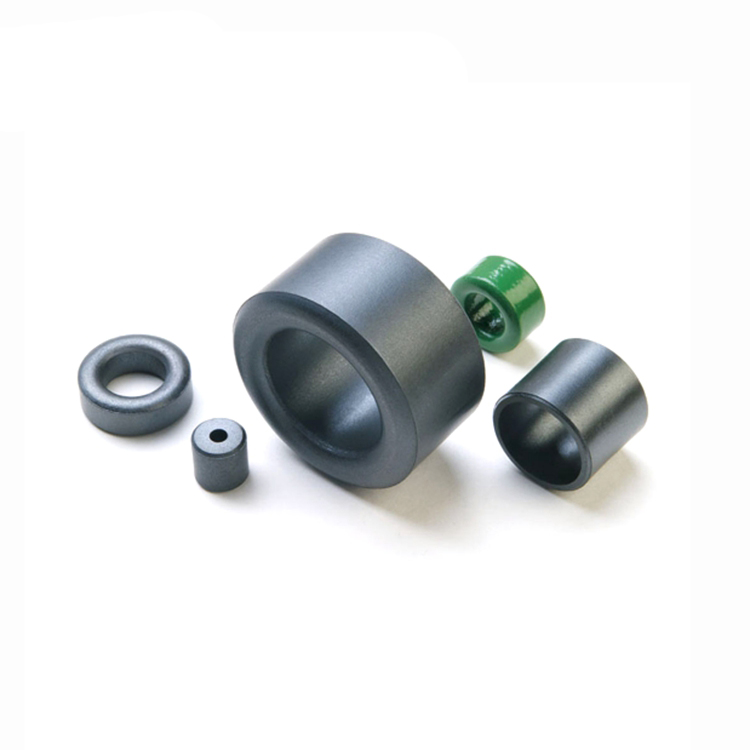

Larger neodymium magnet
DC (Direct Current) motors and AC (Alternating Current) motors are two common types of electric motors used in various applications.
DC Motor:
Working Principle: DC motors operate on the principle of Lorentz force, where a current-carrying conductor placed in a magnetic field experiences a force.
Types:
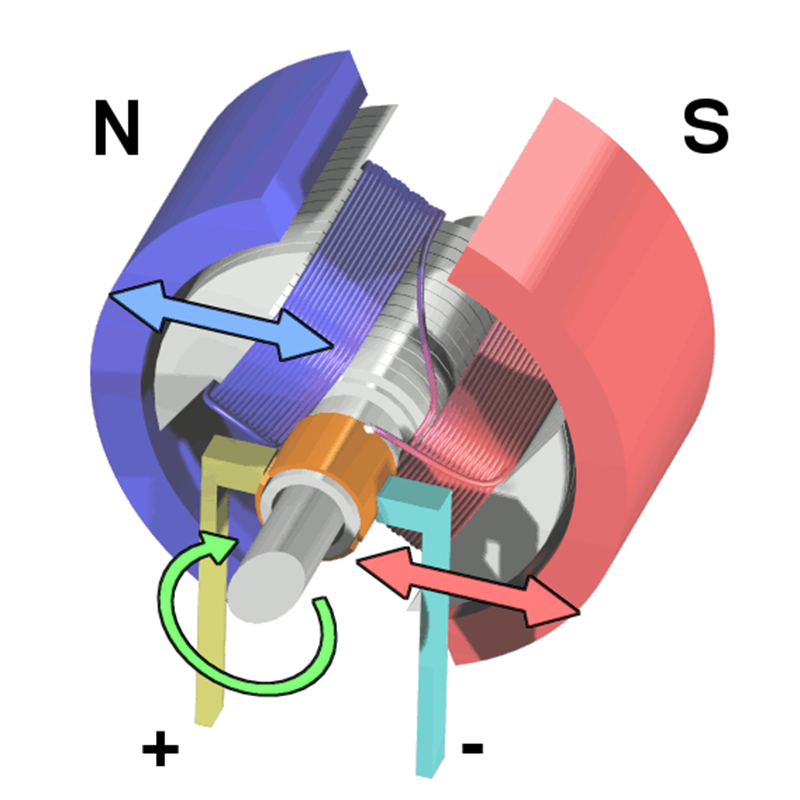
Brushed DC Motor: These motors have a wound rotor (armature) and a permanent magnet stator. The rotor has a commutator and brushes which help in reversing the current direction in the rotor windings, thereby maintaining rotation.
Brushless DC Motor (BLDC): BLDC motors have permanent magnets on the rotor and use electronic commutation (hall sensors or encoder feedback) to switch the currents in the stator windings.
Advantages:
Simple speed control.
High starting torque.
Good speed regulation.
Applications: DC motors are commonly used in applications where adjustable speed and torque control are required, such as in electric vehicles, industrial machinery, and robotics.
AC Motor:
Working Principle: AC motors operate on the principle of magnetic induction, where a rotating magnetic field produced by the alternating current in the stator windings induces current in the rotor, causing it to rotate.
Types:
Induction Motor (IM): The most common type of AC motor, it has a simple design with a rotor and a stator. It doesn’t have brushes or commutators.
Synchronous Motor larger neodymium magnet: These motors have a rotor that rotates at the same speed as the magnetic field of the stator. They are used in applications where precise speed control is required.
Advantages:
More robust and require less maintenance due to the absence of brushes.
Suitable for high-power applications.
Applications: AC motors are widely used in industrial and commercial applications, including pumps, compressors, fans, and HVAC systems.
In summary, while both DC and AC motors serve the purpose of converting electrical energy into mechanical energy larger neodymium magnet, they have different operating principles, advantages, and applications. The choice between them depends on factors such as required torque, speed control, efficiency, and cost considerations.
At the 2018 Rare Earth Scientific and Technological Achievements Promotion Conference and Academic Exchange Meeting, Li Wei, an academician of the Chinese Academy of Engineering larger neodymium magnet, pointed out that industrial motors have replaced magnetic separation and speakers as the largest application field of rare earth permanent magnet materials. Looking for Magnetic Materials will conduct a series of introductions on motors and the application of magnetic materials in motors to help you become familiar with and understand motor knowledge and the motor industry.
Motors can be divided into two categories: DC motors and AC motors according to the type of external power supply. DC motors use direct current as their power source; AC motors use alternating current as their power source.
Direct current is a current whose size and direction do not change with time. For example, the electricity emitted by dry batteries and photovoltaic panels is direct current.
Alternating current is an alternating current whose intensity and direction change periodically with time. It is referred to as alternating current. Our household power supply is alternating current.
Structure and Principle
In a DC motor, the magnetic field does not move, and the conductor moves in the magnetic field; in an AC motor, the magnetic field rotates, but the conductor does not move.
DC
DC motors are divided into stator windings and rotor windings. When DC current is applied, the stator winding generates a magnetic field of fixed polarity, and the rotor is forced to rotate in the magnetic field when DC electricity is applied larger neodymium magnet. A DC motor passes direct current and does not directly generate a rotating magnetic field. It relies on a commutator that rotates with the rotor to change the direction of the current entering the rotor, so that the polarity of the magnetic field between the rotor and the stator is always opposite, so that the rotor can rotate. The principle of DC motor is simple but its structure is complex.

DC motors can be divided into electromagnetic DC motors and permanent magnet DC motors according to the materials used in the stator.
Electromagnetic DC motor – the stator magnetic pole is composed of an iron core and an excitation winding larger neodymium magnet. According to its different excitation methods, it can be divided into separately excited DC motor, shunt DC motor, series DC motor and compound excited DC motor.
The iron core material is generally made of silicon steel sheets.
The excitation method refers to the way in which the electromagnet is energized in the coil to generate a magnetic field. The power supply for series excitation and shunt excitation are the same as the armature power supply larger neodymium magnet, except that two different wiring methods are used in series or parallel; while the power supply for separate excitation is Independent of the armature power supply.
Permanent magnet DC motor – the stator poles use permanent magnets, such as ferrite, alnico, and neodymium iron boron permanent magnets. The stator has its own magnetic field and does not require excitation.
DC motors can also be divided into brushed DC motors and brushless DC motors according to whether they are equipped with brushes. (There will be a detailed introduction in subsequent articles)
AC motor
When the AC motor is working, it does not use commutation, but changes the direction of the stator’s magnetic field to ensure that the rotor continues to rotate. For AC motors, the stator magnetic field is not fixed, but rotates according to certain rules larger neodymium magnet, so it can ensure that the direction of the electromagnetic force received by the rotor winding remains unchanged. A three-phase symmetrical alternating current is passed through the stator of the AC motor.
The stator does not move, and a rotating synthetic magnetic field is generated through changes in the current. This magnetic field is like a magnet rotating around the stator. When the rotor closed coil is energized larger neodymium magnet, a magnetic field is generated. The rotation of the stator’s magnetic field will rotate with the rotor magnetic field inside, so the rotor of the AC motor rotates.
According to the arrangement of the stator windings, AC motors can be divided into single-phase AC motors and three-phase AC motors.
According to the relationship between the stator magnetic field and the speed of rotor rotation larger neodymium magnet, AC motors can be divided into synchronous AC motors and asynchronous AC motors. Among them, asynchronous motors can be divided into two types: squirrel cage type and wound type according to the shape of the rotor.
Summary: The working principles of DC and AC motors are both based on the law of electromagnetic induction, but there are differences between the two, which can be understood through the differences in the starting methods of the two. The rotor of the DC motor rotates (the armature winding moves or receives force) because the energized armature winding receives electromagnetic force in the magnetic field larger neodymium magnet, so the premise is that there is current in the armature, so to start the DC motor, there needs to be armature current, that is, given The rotor is energized;
when the AC motor is started, as long as the stator is supplied with alternating current, a rotating magnetic field will be generated. Since this magnetic field is moving, the rotor winding will induce an electromotive force. As long as the rotor winding can form a closed loop larger neodymium magnet, a current will be generated. The electromagnetic force will be induced to drag the rotor to rotate, so the premise for the movement of the AC motor rotor is that the magnetic field is rotating.
Performance pros and cons
DC
Advantages: Speed control is relatively simple. You only need to control the voltage to control the speed. Large equipment with high speed regulation performance requirements, such as steel rolling mills, are driven by DC motors. DC motors have stable speed and precise speed control, so DC motors are preferred under conditions with strict speed requirements.
Disadvantages: There are DC commutation problems, complex structure, and inconvenient maintenance and repair. Brushed motors use carbon brushes as current commutators. The dirt generated by the friction of the carbon brushes needs to be cleaned regularly, and the maintenance cost is high. Brushless motors reduce the friction between carbon brushes and shafts larger neodymium magnet, so they save energy and are quieter, but they are more difficult to make and more expensive. In addition, DC motors should not be operated in high temperature, flammable and other environments.
In terms of price, DC motors with the same power are more expensive than AC motors.
AC motor
Advantages: It can operate in high temperature, flammable and other environments, has no carbon brushes and commutators, is maintenance-free, sturdy, and has wide applications. However, in terms of characteristics, complex control technology must be used to achieve performance equivalent to that of a DC motor.
Disadvantages: Speed control is difficult larger neodymium magnet, because controlling the speed of an AC motor requires controlling the frequency of the AC (or using an induction motor to reduce the motor speed at the same AC frequency by increasing internal resistance).
Larger neodymium magnets offer several advantages and applications compared to their smaller counterparts:
Increased Holding Force: Larger neodymium magnets typically have stronger magnetic fields, allowing them to exert greater holding force. This makes them ideal for applications where strong magnetic attraction is required, such as magnetic separators larger neodymium magnet, magnetic chucks, and magnetic lifters.
Improved Performance in Motors and Generators: In electric motors and generators, larger neodymium magnets can enhance performance by providing higher torque and power output. They are commonly used in applications such as wind turbines, electric vehicle propulsion systems, and high-efficiency industrial motors.
Enhanced Magnetic Resonance Imaging (MRI): In the medical field, larger neodymium magnets are used in MRI machines to produce strong and uniform magnetic fields for imaging purposes. These magnets enable clearer and more detailed images of internal body structures larger neodymium magnet, aiding in diagnosis and treatment planning.
Industrial Applications: Larger neodymium magnets find numerous applications in industrial settings, including magnetic separation, material handling, and magnetic resonance spectroscopy larger neodymium magnet. Their strong magnetic fields enable efficient and precise separation of ferrous and non-ferrous materials in industries such as mining, recycling, and food processing.
Research and Development: In scientific research and experimental setups, larger neodymium magnets are valuable for studying magnetic phenomena, conducting experiments in materials science, and developing new technologies larger neodymium magnet. They are used in laboratories for applications such as magnetic levitation, magnetic confinement fusion, and particle accelerators.
Specialized Equipment: Large neodymium magnets are also used in specialized equipment and machinery, such as magnetic bearings, magnetic resonance therapy devices, and magnetic levitation trains larger neodymium magnet. These magnets enable innovative technologies and solutions in various fields.
Overall, larger neodymium magnets offer increased magnetic strength and versatility, making them indispensable in a wide range of industrial, medical, scientific, and technological applications. However, it’s important to handle them with care due to their strong magnetic fields, which can cause injury or damage if proper precautions are not taken.