



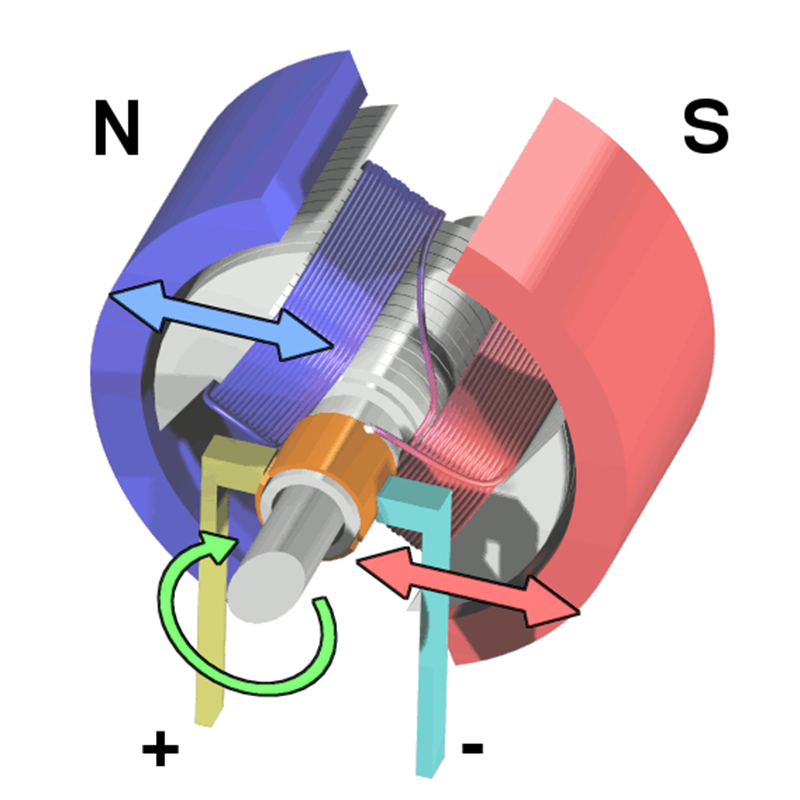
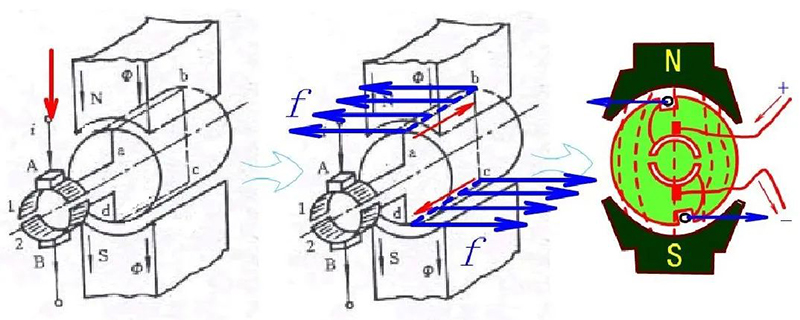
The figure below is a simple model of the working principle of a permanent electric motor magnet.
Two permanent magnets generate a magnetic field at the coil in the center, and the coil is passed a current.
The electromagnetic force (left-hand rule) will be generated under the action of the magnetic field, and then rotate.
The motor The rotating part is called the rotor, and the stationary part is called the stator. Obviously, the permanent magnet in the figure below belongs to the stator, and the coil belongs to the rotor.
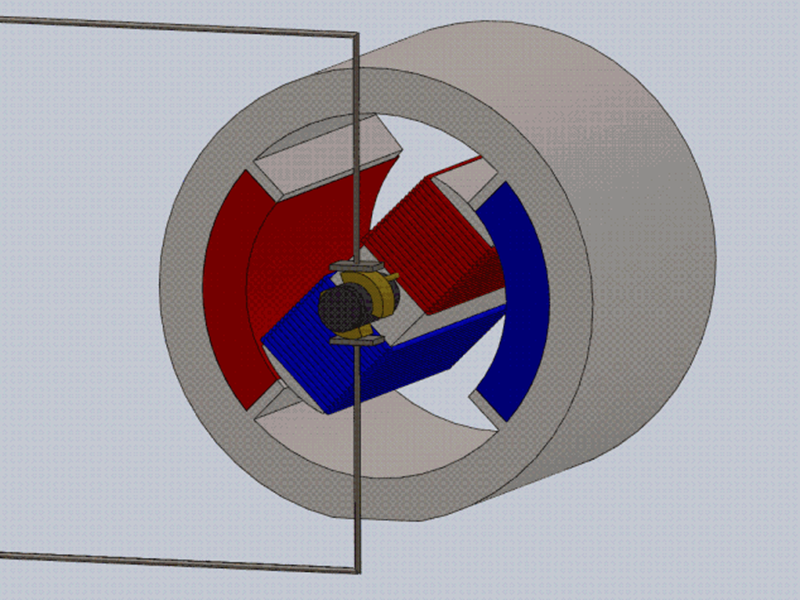
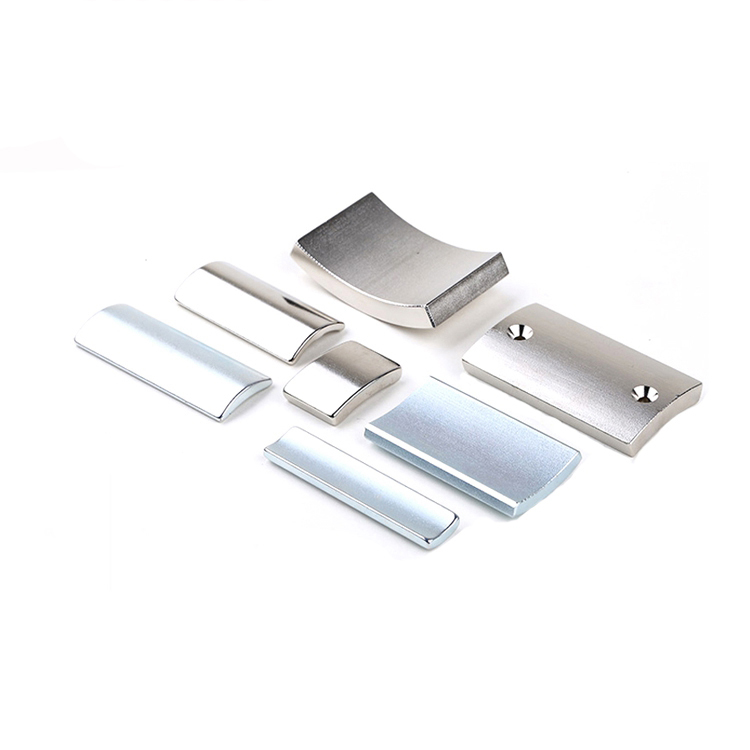
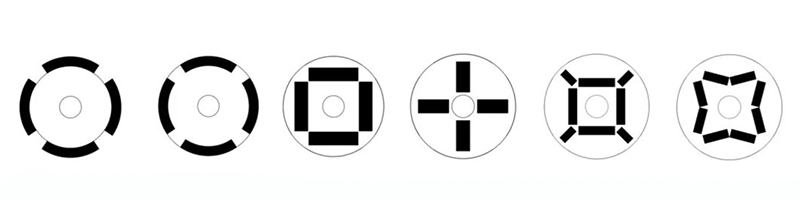
For rotating electrical machines, when the permanent magnet is the stator, the outer arc surface-mounted tile-shaped magnet is attached to the casing; when the permanent magnet is the rotor, the inner arc surface-mounted tile-shaped magnet is attached to the rotor core. , or embedded in the rotor core in a square shape, as shown in the figure below.
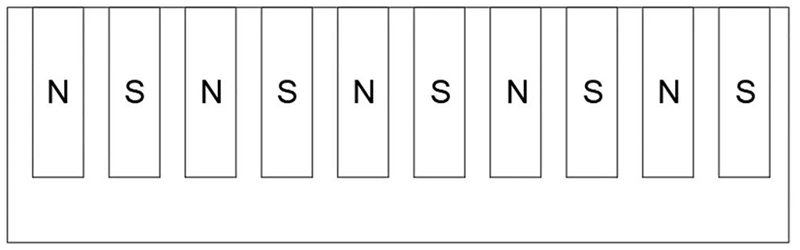
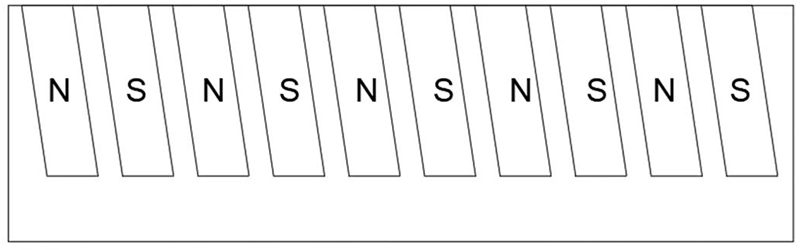
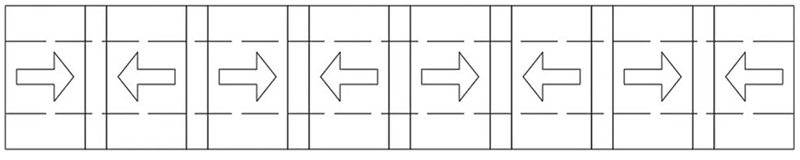
For linear motors, the permanent magnets are mainly square and parallelogram, and cylindrical linear motors also use axially magnetized ring magnets.
Permanent magnet motor magnets have the following characteristics:
1. The shape will not be too complicated (except for some micro motors, such as VCM motors), most of which are rectangular, tile-shaped, fan-shaped, and bread-shaped. Especially under the premise of reducing the cost of motor design, many of them will use embedded square magnets steel;
2. Magnetization is relatively simple, basically unipolar magnetization, and a multi-pole magnetic circuit is formed after assembly. If the whole ring is made, such as bonding NdFeB magnetic ring or hot-pressed magnetic ring, multi-pole radiation magnetization is generally used;
3. The core of technical requirements mainly lies in high temperature stability, magnetic flux consistency and adaptability. Surface-mounted rotor magnets will require good affinity for glue. Linear motor magnets will have relatively strict requirements for salt spray. Wind power magnets The requirements for salt spray will be stricter, and the drive motor magnet will require very good high temperature stability;
4. The magnetic energy product is applied in high, medium and low grades, but the coercive force is mostly at the middle and high-end level. At present, the magnetic steel grades of the drive motors of electric vehicles are mostly high magnetic energy product and high coercive force, such as 45UH, 48UH, 50UH, 42EH , 45EH, etc. Mature diffusion process is essential;
5. Segmented bonding magnets have been widely used in the field of high-temperature motors. The purpose is to improve the segmental insulation of the magnets to reduce the eddy current loss of the magnets when the motor is running, and some magnets will be on the surface. Epoxy coating is added to increase its insulation.
Key testing items for motor magnets:
1. High temperature stability. Some customers will request to measure the magnetic decay of open circuit, and some customers will request to measure the magnetic decay of semi-open circuit. When the motor is running, the magnetic steel must bear the alternating reverse magnetic field in addition to high temperature, so the magnetic decay of the finished product and the high temperature demagnetization curve of the base material must be tested and monitored;
2. Flux consistency. Magnetic steel is used as the magnetic field source of the motor rotor or stator. If there is a difference in consistency, it will cause vibration of the motor, reduce power and affect the function of the overall motor. Therefore, the magnetic steel of the motor generally has requirements for the consistency of the magnetic flux, and some require 5% Within, some require within 3% or even 2%. Factors that affect the consistency of magnetic flux must be taken into account, such as the consistency of residual magnetism, the consistency of tolerances, and the consistency of chamfering coatings.
3. Adaptability. Most of the surface-mounted magnets are tile-shaped. For the included angle and radian, the conventional two-dimensional test method has large errors or is difficult to test. At this time, its adaptability needs to be considered. Some closely arranged magnets require To control the accumulative gap, some dovetail surface-mounted magnetic steel needs to consider the tightness of assembly. It is best to make a profiling fixture according to the user’s assembly method to test the suitability of the magnetic steel.
Purchasing personnel need to focus on the following points:
1. Rare earth market. As the single item cost of the motor accounts for the largest part, the magnet steel has always been the main source of motor cost reduction. Because the shape of the motor magnet itself is relatively simple, the material cost accounts for the largest proportion. Purchasers need to pay attention to rare earth metals at any time. Market conditions, in order to understand the price trend of motor magnets;
2. Performance indicators. The shape of the magnetic steel is relatively simple, and the material cost accounts for a large proportion, so the performance index will directly affect the amount of heavy rare earth in the magnetic steel, thereby directly affecting the cost of the magnetic steel;
3. Quantity. Most of the motor magnets are relatively large, with a length as small as 10mm and as large as more than 100mm. The number of pieces produced from a blank will not be many, so when the demand is not large, there will be a large waste of blanks in stock, and the production of fixed molds will require The problem of apportioning mold costs results in higher costs.
The magic of magnets
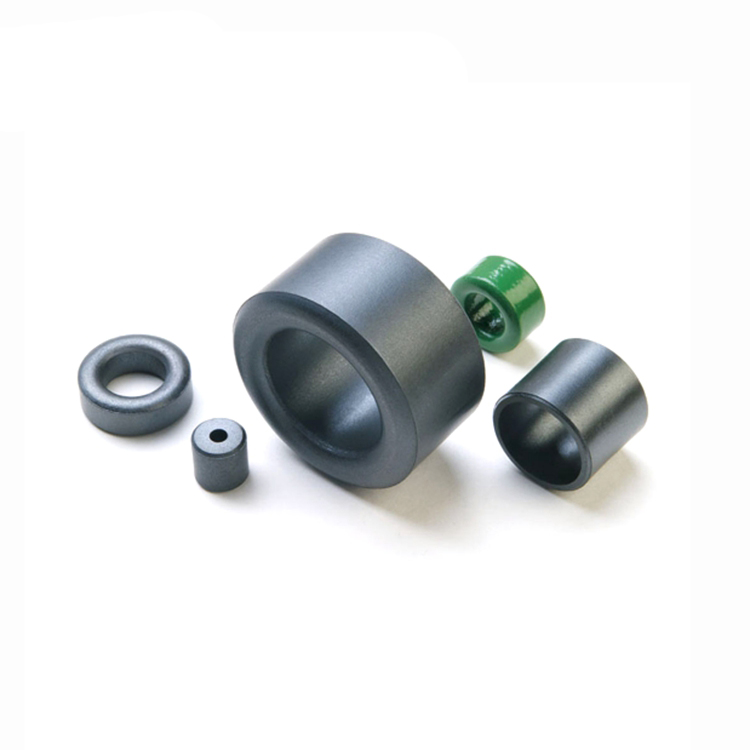
We know that the main component of the magnet is ferric oxide. An ordinary small magnet is made of black ferric oxide. However, due to the nature of ferroferric oxide itself, its attraction to iron objects will not be too strong, and its magnetism will gradually weaken over time. In this case, how can we make a magnet with stronger suction and not easy to decay? Under such a premise, NdFeB magnets came into being.
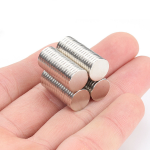
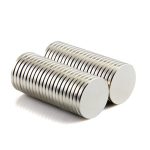
This kind of magnet with anti-corrosion treatment and shiny surface is NdFeB magnet, and its chemical formula is Nd2Fe14B. The most commonly used NdFeB magnet is made of three elements of neodymium, iron and boron sintered at high temperature. It is the most magnetic artificial magnet so far. If the core element of traditional ferroferric oxide is iron, then the reason why NdFeB magnets have such strong magnetism is the effect of neodymium. These pieces of metal in the picture below are neodymium:
Neodymium (sound nǚ) is the fourth element in the lanthanide family of rare earth elements, and like iron, cobalt, nickel, and the aforementioned gadolinium, it can also be attracted by magnets. In addition, neodymium is more active among lanthanide elements, so it is as easy to be oxidized as iron, which is why the surface of NdFeB magnets is coated. If neodymium is used to enhance magnetism, then the role of boron should not be underestimated. This black thing is boron:
Boron is located to the left of carbon in the periodic table, so boron chemistry similar to carbon-centered organic chemistry has recently emerged. In NdFeB magnets, boron acts as a mediator between neodymium and iron. While ensuring the stability of its molecular structure, boron greatly expands the maximum magnetism that the substance can produce, making the magnetic performance of the entire magnet extremely high, and even allowing him to pick up objects equivalent to 640 times its own weight.
Related Products