



Small neodymium magnet for wireless magnets
Since the iPhone 8 in 2017, Apple has added wireless charging functions to all iPhone models. It is similar to the wireless charging method of other mobile phones. Charging starts when it is placed on the wireless charger.
This wireless charging relies on the transmitting coil and The alignment of the receiving coil cannot achieve the best effect of placing it casually. If it is placed crookedly, it will cause problems such as reduced wireless charging efficiency, inability to increase power, slow charging, severe heating, etc., hindering the development of wireless charging and also causing disadvantages. experience.
Starting from its roots small neodymium magnet, Apple has launched a new MagSafe magnetic charging technology to solve the poor experience of traditional wireless charging small neodymium magnet. iPhone 12 mobile phones, peripheral accessories, and chargers are all equipped with MagSafe magnetic components to achieve automatic positioning and alignment.
How MagSafe magnetic charging works

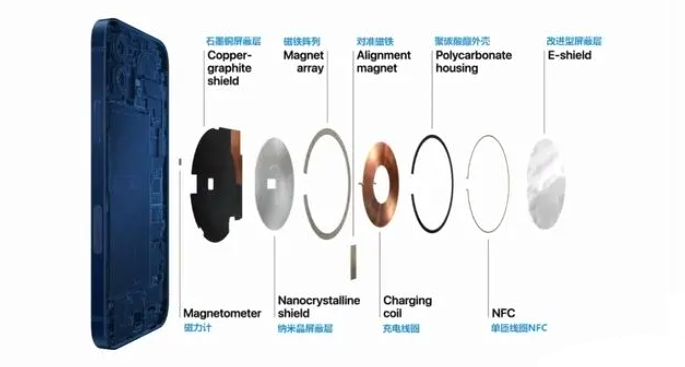
A perspective view of the iPhone 12 shows the MagSafe magnetic charging system component structure, a unique wire-wound coil to withstand greater reception power, a nanocrystalline panel to capture magnetic flux small neodymium magnet, and an improved shielding layer for safer wireless reception. fast charging.A dense array of magnets is integrated around the wireless receiving coil to achieve automatic alignment and adsorption with other magnetic accessories, thereby improving wireless receiving efficiency.
Equipped with a high-sensitivity magnetometer, it responds immediately to changes in magnetic field intensity, allowing iPhone 12 to quickly identify magnetic accessories and prepare for wireless charging.
The MagSafe magnetic charger is significantly different from traditional chargers in use. The metal shell is flat and round, and comes with a power supply cable. It is small and lightweight. When the iPhone 12 is placed small neodymium magnet, the MagSafe magnetic charger bounces up directly due to the strong magnetic force, making a “click” sound, automatically aligning with the magnetic ring on the phone and firmly adsorbing it.
The transmitting coil and receiving coil reach millimeters that cannot be reached by human hands. level of alignment accuracy, thereby achieving high-efficiency and high-power charging.
Compared with wired charging, the wireless charging system is easier to use and charge at any time. However, the process of transmitting energy through the air relies heavily on the precise alignment of the transmitting coil and the receiving coil. Apple has applied magnetic technology to wireless charging to solve the problem of wireless charging. Difficult to align small neodymium magnet.
There is no possibility of placing it crookedly, which optimizes the wireless charging efficiency and makes it feasible to increase the wireless charging power. The wireless charging power of this generation of iPhone 12 is doubled from 7.5W to 15W, which greatly improves the speed of wireless charging and reduces the cost of wireless charging. User waiting time.

The convenient adsorption of MagSafe magnetic charging can develop more playability. For accessories, magnetic charging also supports the Qi wireless charging standard, which means that third-party manufacturers can develop their own 7.5W Qi standard magnetic wireless chargers and other Accessories.
Permanent magnets in Qi wireless chargers
Qi transmits electricity based on the principle of electromagnetic induction. The basic principle of the inductive coupling power transmission system is shown in the figure on the right. This system consists of a transmitter coil and a receiver coil, which together form an electromagnetic coupling inductor.

The alternating current carried by the transmitter coil generates a magnetic field and induces a voltage in the receiver coil. This voltage can be used to power mobile devices or charge batteries. This type of fixed-position wireless charger will use NdFeB permanent small neodymium magnet for positioning, so that the terminal device can be placed in a fixed position to maximize charging efficiency.
The permanent small neodymium magnet used in Apple’s magnetic wireless charger, known as MagSafe, is likely a neodymium magnet. Neodymium magnets are commonly used in small electronic devices due to their strong magnetic properties and compact size.
These small neodymium magnet provide the necessary magnetic force to ensure a secure attachment between the charger and compatible devices, such as iPhone models equipped with MagSafe technology small neodymium magnet. The magnet helps align the charger with the device for efficient wireless charging and also allows for easy detachment when needed.
The term “wireless small neodymium magnet” is a bit ambiguous and could refer to different things depending on context. Here are a few possibilities:
Inductive Charging: In the context of wireless charging, a wireless magnet might refer to a small neodymium magnet used in conjunction with inductive charging technology. In devices like smartphones or electric toothbrushes, magnets can help align the device properly with the charging pad or base station, ensuring efficient charging. These small neodymium magnet are often paired with coils to create an electromagnetic field that transfers power wirelessly.
Magnetic Attachment: Another interpretation could be a small neodymium magnet used for wireless attachment, such as in Apple’s MagSafe technology. In this case, the magnet allows for the wireless attachment of accessories or chargers to compatible devices. These magnets provide a secure yet detachable connection without the need for physical plugs or connectors.
Wireless Power Transfer: In a broader sense, a wireless magnet might relate to any magnet involved in wireless power transfer systems. This could include technologies like resonant inductive coupling or magnetic resonance, small neodymium magnet where magnets are used to create magnetic fields that transfer power wirelessly between two devices over short distances.
Without further context, it’s challenging to pinpoint the exact meaning of “wireless magnet,” but these are some potential interpretations based on common uses of small neodymium magnet in wireless technologies.
Compared with the traditional powder metallurgy process, the molding of NdFeB has the two major characteristics of magnetic field orientation and oxidation protection. The molding process basically determines the geometry, size and orientation of the magnet, and is a key link in the preparation of sintered NdFeB. Molding is generally divided into two categories: dry pressing and wet pressing.
1. Wet molding
Wet molding process is widely used in functional ceramics and other fields. In 2001, Hitachi used mineral oil as a solvent and added the surfactant methyl oleate to prepare a high-performance magnet with Br = 1.46 T (14.6 kG) and 1.20 MA/m (15.1 kOe). The lubrication effect of organic reagents can improve the fluidity and orientation of the powder, thereby preparing a compact with high uniformity. However, the wet molding process is complex and extremely inefficient. The large amount of solvent released during the sintering process will damage the vacuum system, and Residual carbon will also affect the performance of the magnet, so the wet molding method is gradually abandoned.
2. Dry molding
After years of practice and improvement by magnetic material practitioners, dry molding has become the preferred method for large-scale mass production. The magnetic powder is oriented by a magnetic field in a mold cavity of a certain shape, and the indenter is closed to complete the pressure small neodymium magnet. However, as the density of the green body increases, the orientation will inevitably be destroyed. Dry molding can be divided into parallel pressing and vertical pressing based on the corresponding relationship between the magnetic field direction and the pressing direction. The vertical pressing method is more widely used because it causes less damage to the powder orientation.
In China, a two-step pressing method is often used, that is, the green compact density is pressed to 3.8-4.1g/cm3, and then equal pressure reduction (about 180MPa) is used to increase the green compact density (about 4.5g/cm3) without destroying the existing orientation level. In this way, various types of molds such as automatic molds and combined molds can be tried small neodymium magnet, with high production efficiency and stable performance. However, the methods of vertical press pressing, isostatic pressing, post-grinding, and slicing processing have the following shortcomings:
(1) Due to the limitation of the deformation amount of the blank and the oxide layer, the processing allowance of the blank is large and the yield rate is low;
(2) The secondary pressing method requires vacuum sealing after the green body, which has a long process cycle and a low degree of automation;
(3) The orientation degree will still be damaged during the mold closing and pressing process.
The main directions for improvement at present are: first, to cancel isostatic pressing and realize automated production from molding to sintering; second, to use pressureless molding and other methods to further improve the orientation; in addition, for tile-shaped, ring-shaped, thin sheets and various complex shapes, The product has developed a near-net molding process and a processing-free molding process to directly produce products that are equal to or close to the shape of the final product.
1. One-time molding process
By increasing the pressure of the molding press, the density of the green body is increased to above 4.2g/cm3, thereby eliminating isostatic pressing. After being pressed by the fully automatic molding press, it is automatically stacked into the sintering box by a robot and transported through a sealed channel protected by inert gas. To the continuous sintering furnace, the furnace is entered through the gate valve small neodymium magnet, which realizes automated production and reduces labor costs. The entire process is carried out in a low-oxygen environment, which is conducive to the stability of the process and performance.
2. Pressureless molding
In order to eliminate the damage to the orientation degree during the molding process, the orientation is carried out in a loose state or a micro-pressure state, and the mold is used for vacuum or high-pressure sintering. This method has high requirements on mold material, magnetic permeability and inner cavity wall roughness. However, because the powder gap is too large, it is difficult to densify solely by capillary action during the sintering process, and it is easy to shrink and deform.
3. Isostatic pressure pulse magnetic field molding of rubber film
The rubber mold filled with magnetic powder is placed in the metal moldsmall neodymium magnet. Through the pulse magnetic field orientation, the metal indenter compresses the rubber film and magnetic powder. Due to the restriction of the metal mold cavity, the rubber mold expands toward the inner cavity and applies its isostatic pressure to the powder.
On the sample, since there is no relative movement between the inner wall of the mold cavity and the powder, the orientation is well maintained. However, due to the difference in hardness and Young’s modulus between the rubber film and the steel mold, the compact is prone to non-uniform deformation.
4. Near-net molding process (single piece pressing)
The magnetic field orientation of the parallel press is the same as the pressing direction, so the degree of damage to the orientation is much higher than that of the vertical press. Moreover, due to the limitation of the size of the orientation pole, the product pressing area is smaller. However, due to the advantages of feeding and orientation, the parallel pressing method can form and press cylindrical, circular, special-shaped and single-piece products in one go. It has high pressing accuracy and good magnetic properties consistency, which reduces the processing allowance and improves material utilization. .
However, the single-piece pressing process has higher requirements on powder fluidity, press (servo control accuracy, magnetic field size and uniformity, automatic powder distribution, etc.), mold and sintering process.