Reluctance torque is extensively used in industry as a high performance and highly efficient electric motor because it can make use of the internal permanent magnet synchronous motor (IPMSM). However, because of its construction, the general IPMSM exhibits cogging torque and torque fluctuation. The center is used to produce cogging force. And the presence of a significant number of space harmonics in the gap’s magnetic flux density distribution results in torque ripple. Due to the resonance occurrence between the mechanical system and the control system, these cogging torques and torque ripples not only create noise and vibration, but also have a negative impact on the complete system. In an endeavor to make efforts from both the hardware and software components, study findings have been shared.
such as rotor form modification and the addition of a ripple canceller.
In our lab, we concentrate on dual Halbach arrays as a hardware strategy because they produce a magnetic field with a lower space harmonic in the gap and can achieve exceptionally high magnetic flux densities without the need for a center made of ferromagnetic material. It is feasible to achieve both a high magnetic flux density and a sinusoidal magnetic flux density pattern by using the dual Halbach array. Therefore, coreless electric motors with very minimal cogging torque and torque ripple are feasible.
Prior research has made clear the impact that the magnet division number and gap spacing have on the flux linkage number when the parallel dual Halbach field magnet is bent into a cylinder shape to create a dual Halbach field magnet synchronous motor. Additionally, using software for electromagnetic field analysis, real machine design was done based on this study.
In this article, we describe the process used to create a coreless synchronous motor with a 45° rotary dual Halbach field using the architecture described above.
Outline of the Dual Halbach array
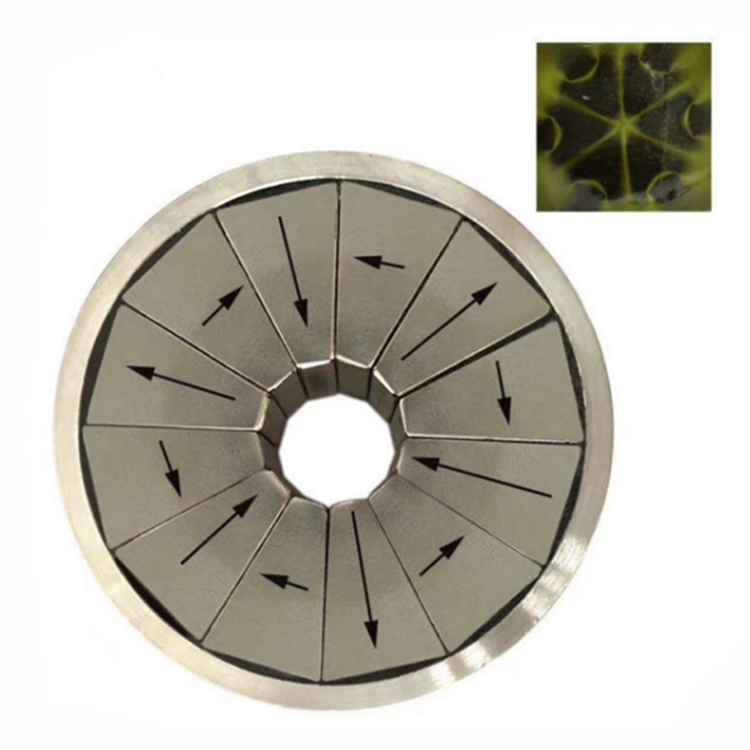
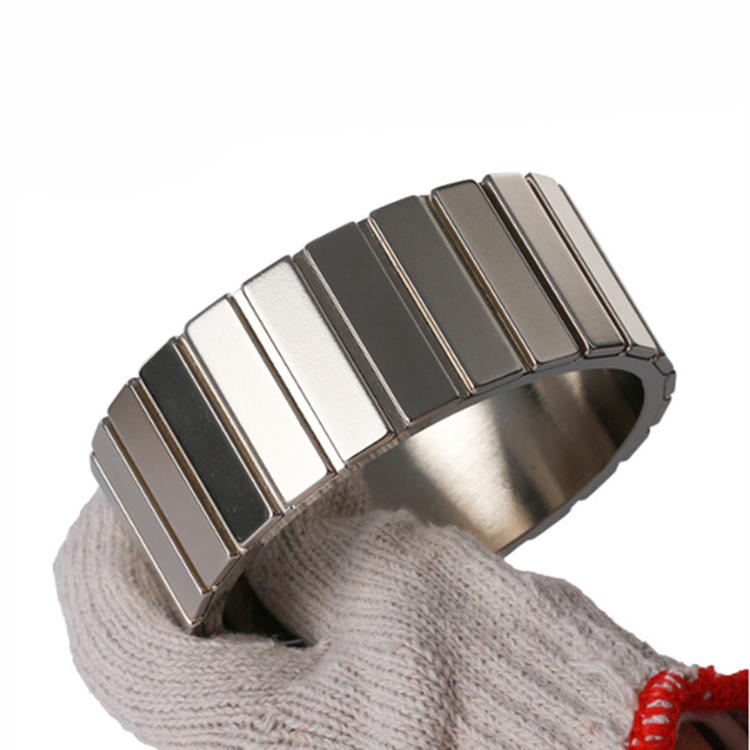
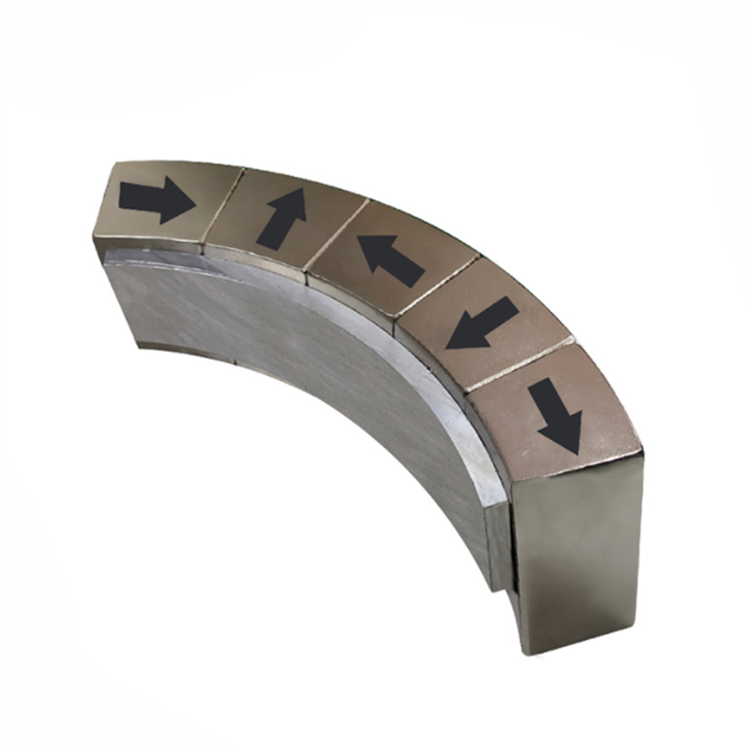
The Halbach array is a configuration of spinning permanent magnets at preset angles, with a cross section formed by a predetermined angle along the magnetic pole direction. A distinctive feature of this arrangement is that a powerful magnetic field only manifests on one side of the permanent magnet. A dual Halbach array is made up of two rows of Halbach arrays that are organized so that the sections with the highest magnetic flux densities are parallel to one another. The dual Halbach array’s magnetic flux line pattern is depicted in Fig. 1. The polarization orientations of the permanent magnets are indicated by arrows in the illustration.
First, the gap is found to have a distribution of exceptionally high magnetic flux intensity. Second, the gap’s middle has a sinusoidal spread of magnetic flux intensity. Additionally, there is little magnetic flux loss outside of the parallel magnets, so protective steps can be scaled back. The dual Halbach array’s magnetization orientation is turned by 90 degrees in Fig. 1, and by doubling by an integer, it is possible to produce a potent sinusoidal magnetic field at the gap’s center at 45 degrees or 22.5 degrees, which is 360 degrees.
Typical fixed magnet form
Unless the aspect ratio of the permanent magnet used in the dual Halbach array is exceptionally big, the magnetic flux in the array focuses on one side. By using a magnetic circuit to analyze the dual Halbach field magnet, we made the decision to use a square permanent magnet in this research. A magnetic circuit using a dual Halbach array and a square magnet is shown in Fig. 2(a). The sum of the magnetomotive forces in the closed path symbolizing the leakage magnetic flux in this figure is zero, assuming that half of the permanent weak magnetomotive force magnetized in the y axis direction contributes to the main magnetic force and the other half contributes to the leakage magnetic flux.
This indicates that there isn’t any magnetic flux escape. On the other hand, Fig. 2 (b) illustrates the dual Halbach array’s magnetic circuit using a rectangle magnet. The total of the magnetomotive forces in the closed route depicting the leakage magnetic flux does not equal zero if the magnetomotive force is specified as in the case of a square magnet. In other terms, there is leaking magnetic flow when a rectangular magnet is used.
The permanent magnet has a fan form when a dual Halbach array is used in a spinning machine. However, by conducting equipartial deformation in the prior example, the same characteristics as those of a square magnet are also achieved in this instance.
Applications for demanding spaceships, like the CMG (Control Moment Gyroscope) [1], which demands positional precision of less than 1%, are particularly vulnerable to torque ripple’s negative impacts.
arc seconds. They cause efficiency degradation by causing speed fluctuations. Furthermore, the torque fluctuation may trigger auditory noise-producing resonances in the mechanical part of the drive system. In addition to achieving high torque density and efficiency, the most crucial design factor when selecting low speed high performance torquer motors for spaceship uses is to reduce torque ripple and its associated harmonics.
In order to address this issue, the enclosed rotor radial flux Halbach array PMBLDC machines are proposed and examined in this article. Although a few core type radial-flux dual-rotor [2],[3] and dual-stator PM machines [4] have been documented, there isn’t much information in the literature about the potential of a radial flux enclosed rotor coreless design using halbach array.
Because of their extended lifespan, high torque, and high efficiency, brushless direct current motors (BLDC) have been shown to be the finest form of motor overall for aerospace uses.
It is a Selection Grade Professor in the Faculty of Engineering’s Electrical Department at the University of Kerala in India.
economy and little thermal loss [5]. Due to their high ripple torque, stepper motors—a unique type of BLDC motor—cannot be used for essential aerospace uses.
Additionally, the authors’ previous research [6] unmistakably demonstrates the size of the detent torque, which accounts for nearly 13% of the generated torque in the stepper motor.
The cogging torque generated by the machine and the commutation torque linked to the drive circuitry are both components of the ripple torque found in permanent magnet BLDC motors. Cogging, which results in a ripple in the motor’s produced power, is one of the drawbacks of the slotted motor construction.
Cogging The change of the magnetic energy held in the air gap due to the PM flow and the angular location of the rotor is what generates torque. It results from the interplay of the magnetic flux produced by the rotor and the slotting-induced change in stator reluctance. However, a slotless BLDC motor design removes the cogging’s tooth ripple component and has minimal slot harmonic effects, making it easier to achieve the application’s need for a smooth power output.
However, a slotless machine has a reduced power output compared to a comparable slotted design because there is typically less magnetic flux traversing the motor air gap [7],[8]. Halbach magnetization’s potent and consistent magnetic field allows it to partially make up for this production reduction.
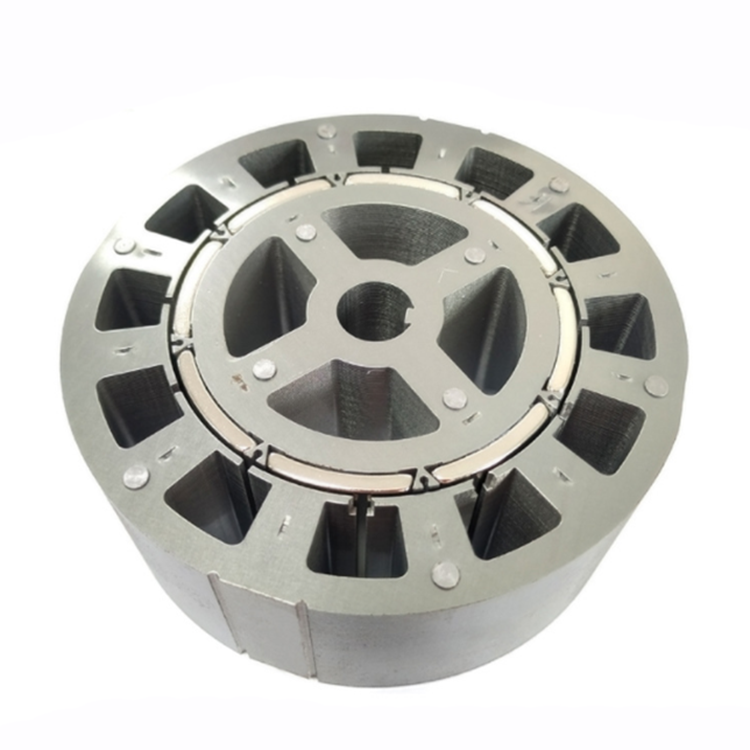
depicts a permanent magnet BLDC motor with a Halbach array and an enclosed rotor zero cogging. The design makes use of the Halbach Array’s intrinsic self-shielding capability because it enables the use of coreless configurations with high power to inertia ratios. The enclosed rotor BLDC motor uses slotless stator winding in contrast to traditional notched type PMBLDC motors.
Because it provides less end winding and prevents phase winding duplication, concentrated form of winding is used. This device has no stiction and no cogging tension because it is aircored. By adding a flux-focusing magnet, core loss and flux through the rotor’s iron core are both eliminated. Additionally, the force rises as the mean air gap flux density does as well.
The presence of circulating currents in the stator wires is one of the major difficulties encountered in the construction of low speed single rotor coreless machines. This can be ascribed to the flux variance that connects them across the machine’s wide air gap. Enclosed Rotor Halbach BLDC Motor prevents circulating currents in stator wires by distributing consistent air gap flux along the machine’s radius. This machine is a great choice for low speed, high torque spacecraft uses that call for positional precision of less than an arc second due to its benefits. The machine’s outer circumference and axial length are chosen to be 123 mm and 40 mm, respectively, in accordance with the needs of the spaceship application.
As a result, a plan must be created that meets the requirements for CMG as well as other spacecraft uses.