


N50 NdFeB magnets
Studying the magnetic anisotropy of NdFeB (Neodymium Iron Boron) magnets is crucial for understanding their magnetic properties and optimizing their performance for various applications N50 NdFeB magnets. Magnetic anisotropy refers to the directional dependence of a material’s magnetic properties, including its magnetic susceptibility, coercivity, and remanence. Here’s how the magnetic anisotropy of NdFeB magnets can be studied:
1.Magnetic
Experiments show that any substance can be magnetized to a greater or lesser extent in an external magnetic field, but the degree of magnetization is different. According to the characteristics of substances in external magnetic fields, substances can be divided into five categories: paramagnetic substances, diamagnetic substances, ferromagnetic substances, ferrimagnetic substances, and antiferromagnetic substances.
We call paramagnetic substances and diamagnetic substances weak magnetic substances, and ferromagnetic substances and ferrimagnetic substances are called strong magnetic substances.
2. Magnetic materials
Soft magnetic material: It is a magnetic material with low coercive force and high magnetic permeability that can achieve the maximum magnetization intensity with the smallest external magnetic field. Soft magnetic materials are easy to magnetize and demagnetize. For example: soft ferrite, amorphous nanocrystalline alloy.
Hard magnetic materials: also called permanent N50 NdFeB magnets materials, are materials that are difficult to magnetize and are difficult to demagnetize once magnetized. Their main feature is high coercive force, including rare earth permanent N50 NdFeB magnets materials, metal permanent magnet materials and permanent ferrite magnets. .
Functional magnetic materials: mainly include magnetostrictive materials, magnetic recording materials, magnetoresistance materials, magnetic bubble materials, magneto-optical materials and magnetic film materials, etc.
3. NdFeB permanent magnet material
The sintered NdFeB permanent N50 NdFeB magnets material uses a powder metallurgy process. The smelted alloy is made into powder and pressed into a compact in a magnetic field. The compact is sintered in an inert gas or vacuum to achieve densification. In order to improve the coercive force of the magnet , usually requires aging heat treatment, and then post-processing and surface treatment to obtain the finished product.
Bonded NdFeB is made of permanent N50 NdFeB magnets powder mixed with bonding materials such as rubber with good windability or hard and light plastics and rubber, and is directly formed into permanent magnet components of various shapes according to user requirements.
Hot-pressed NdFeB can achieve magnetic properties similar to those of sintered NdFeB without adding heavy rare earth elements. It has high density, high orientation, good corrosion resistance, high coercivity and near-net shape. Advantages, but poor mechanical properties and higher processing costs due to patent monopoly.
4.Remanence Br
It refers to the magnetic induction intensity displayed by the sintered NdFeB magnet when a magnet is magnetized by an external magnetic field in a closed circuit environment to technical saturation and then the external magnetic field is removed. In layman’s terms, it can be temporarily understood as the magnetic force of the magnet after magnetization. The units are Tesla (T) and Gauss (Gs), 1Gs=0.0001T.
5. Coercive force Hcb
When the magnet is reversely magnetized, the value of the reverse magnetic field intensity required to reduce the magnetic induction intensity to zero is called the magnetic induction coercivity N50 NdFeB magnets. However, the magnetization intensity of the magnet is not zero at this time, but the applied reverse magnetic field and the magnetization intensity of the magnet cancel each other out. If the external magnetic field is removed at this time, the magnet still has certain magnetic properties. The unit is Oersted (Oe) or A/m (A/m), 1A/m=79.6Oe.
6.Intrinsic coercive force Hcj
The strength of the reverse magnetic field required to reduce the magnetization of a magnet to zero is called the intrinsic coercive force. The classification of magnetic material grades is based on the size of their intrinsic coercive force. Low coercivity N, medium coercivity M, high coercivity H, ultra high coercivity UH, extremely high coercivity EH, and highest coercivity TH.
7. Maximum magnetic energy product (BH)max
It represents the magnetic energy density established in the two magnetic pole spaces of the magnet, that is, the static magnetic energy per unit volume of the air gap. It is the maximum value of the product of Br and Hcj. Its size directly indicates the performance of the magnet. Under the same conditions, that is, the same size, the same number of poles and the same magnetizing voltage, magnetic parts with high magnetic energy products also have high surface magnetism, but at the same (BH)max value, the level of Br and Hcj It has the following effects on magnetization:
High Br, low Hcj: under the same magnetizing voltage, higher surface magnetism can be obtained;
Low Br, high Hcj: To obtain the same surface magnetism, a higher magnetizing voltage is required.

8.SI system and CGS system
That is, the International System of Units and the Gaussian System of Units are like the difference between “meter” and “mile” in the unit of length. There is a certain complex conversion relationship between the International System of Units and the Gaussian System of Units.
9. Curie temperature
It is the temperature at which magnetic materials change between ferromagnets and paramagnets N50 NdFeB magnets. When the material is lower than the Curie temperature, it becomes a ferromagnet. At this time, the magnetic field related to the material is difficult to change.
When the temperature is higher than the Curie temperature, the material becomes a paramagnet, and the magnetic field of the magnet changes easily with changes in the surrounding magnetic field.
The Curie temperature represents the theoretical operating temperature limit of magnetic materials. The Curie temperature of NdFeB is about 320-380 degrees Celsius. The level of the Curie point is related to the crystal structure formed by the sintering of the magnet.
If the temperature reaches the Curie temperature, the molecules inside the N50 NdFeB magnets will move violently and demagnetize, which is irreversible. The magnet can be magnetized again after demagnetization, but the magnetic force will drop significantly and can only reach about 50% of the original value.
10.Operating temperature
The maximum operating temperature of sintered NdFeB is much lower than its Curie temperature. As the temperature increases within the operating temperature, the magnetic force will decrease, but most of the magnetic force will recover after cooling.
The relationship between working temperature and Curie temperature: the higher the Curie temperature, the higher the working temperature of magnetic materials, and the better the temperature stability N50 NdFeB magnets. Adding cobalt, terbium, dysprosium and other elements to sintered NdFeB raw materials can increase its Curie temperature. Therefore, high coercivity products (H, SH,…) generally contain added dysprosium.
The maximum operating temperature of sintered NdFeB depends on its own magnetic properties and the selection of the working point. For the same sintered NdFeB N50 NdFeB magnets, the closer the working magnetic circuit is, the higher the maximum operating temperature of the magnet is, and the more stable the performance of the magnet is. Therefore, the maximum operating temperature of the N50 NdFeB magnets are not a definite value, but changes with the degree of closure of the magnetic circuit.

11. Magnetic field orientation
Magnetic materials are divided into two categories: isotropic magnets and anisotropic magnets. The magnetic properties of isotropic magnets are the same in any direction and can be attracted together at will N50 NdFeB magnets; the magnetic properties of anisotropic magnets will be different in different directions. The direction in which it can obtain the best magnetic properties is called the orientation direction of the magnet.
For a square sintered NdFeB N50 NdFeB magnets, only the orientation direction has the largest magnetic field intensity, and the other two directions have much smaller magnetic field intensity.
If the magnetic material has an orientation process during the production process, it is an anisotropic magnet. Sintered NdFeB is generally molded and pressed with magnetic field orientation, so it is anisotropic N50 NdFeB magnets. Therefore, it is necessary to determine the orientation direction before production, that is, the future magnetization direction. . Powder magnetic field orientation is one of the key technologies for manufacturing high-performance NdFeB. (Bonded NdFeB can be either isotropic or anisotropic)
12. Surface magnetism
It refers to the magnetic induction intensity at a certain point on the surface of the magnet (the surface magnetism at the center and edge of the magnet is different). It is a value measured by the contact between a gaussmeter and a certain surface of the magnet, not the overall magnetic performance of the magnet.
13.Magnetic flux
Assume that in a uniform magnetic field with a magnetic induction intensity B, there is a plane with an area S and perpendicular to the direction of the magnetic field. The product of the magnetic induction intensity B and the area S is called the magnetic flux passing through this plane, referred to as magnetic flux, symbol “Φ” , the unit is Weber (Wb).
Magnetic flux is a physical quantity that represents the distribution of a magnetic field. It is a scalar quantity, but it has positive and negative values. The positive and negative values only represent its direction. Φ=B·S, when there is an angle θ between the vertical plane of S and B, Φ=B·S·cosθ.
14.Electroplating
Sintered NdFeB permanent N50 NdFeB magnets material is produced by powder metallurgy process. It is a very chemically active powder material. There are tiny pores and cavities inside, which are easily corroded and oxidized in the air. Therefore, strict surface treatment must be carried out before use. As a mature metal surface treatment method, electroplating is widely used.
The most commonly used coatings for NdFeB N50 NdFeB magnets powerful magnets are zinc plating and nickel plating. They have obvious differences in appearance, corrosion resistance, service life, price, etc.:
Difference in polishability: Nickel plating is superior to zinc plating in terms of polishing, and the appearance is brighter. Those with high requirements on product appearance generally choose nickel plating N50 NdFeB magnets, while some magnets are not exposed, and those with relatively low requirements on product appearance are generally galvanized.
Difference in corrosion resistance: Zinc is an active metal and can react with acid, so its corrosion resistance is poor; after nickel plating surface treatment, its corrosion resistance is higher.
Difference in service life: Due to different corrosion resistance, the service life of zinc plating is lower than that of nickel plating N50 NdFeB magnets. The main reason is that the surface coating easily falls off after a long time of use, causing the magnet to oxidize, thereby affecting the magnetic performance.
Difference in hardness: Nickel plating is higher than zinc plating N50 NdFeB magnets. During use, it can greatly avoid collisions and other situations, which may cause the NdFeB powerful magnets to fall off, break, etc.
Price difference: Galvanizing is extremely advantageous in this regard. The prices from low to high are galvanizing, nickel plating, epoxy resin, etc.
15.Single sided magnet
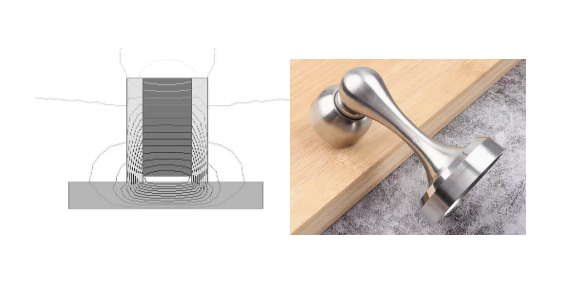
Magnets have two poles, but in some working positions, single-sided magnets are required, so one side of the magnet needs to be wrapped with an iron sheet so that the magnetism of the side covered by the iron sheet is shielded. Such magnets are collectively called single-sided magnets. Or a single sided magnet. There is no such thing as a true single-sided magnet.