



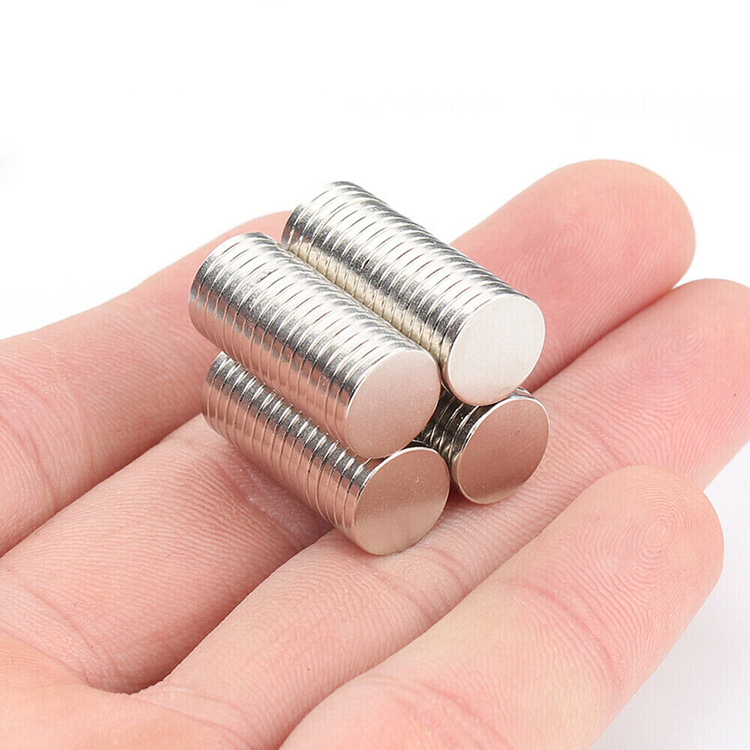
There are many different materials used in the permanent magnet market—ceramic (ferrite), aluminum nickel cobalt (AlNiCo), samarium cobalt (SmCo), bonded neodymium, and sintered neodymium. We specialize in the production and supply of sintered neodymium magnets.
We believe the two most common types are ceramic neodymium magnets and sintered neodymium magnets. In this article, we will compare the two materials, explore their respective advantages and disadvantages, and ultimately demonstrate the advantages of neodymium magnets (our perspective may be slightly biased).
Thinking about replacing ceramic neodymium magnets with neodymium magnets? Please email our engineers and we will be happy to discuss potential options and advantages with you.
Material Specifications
Let’s compare the key specifications of ceramic and sintered neodymium magnets. We won’t list all available “grades,” but rather provide a range of grades and their specifications.

What do these mean (please explain in plain language)?
Maximum Magnetic Strength (BHmax) – A single number describing the strength of a magnet. In neodymium magnet grades (N35, N42, N52, etc.), it also happens to be the “N” number.
Coercivity – Resistance to demagnetization. The higher the number, the greater the resistance to demagnetization.
Maximum Operating Temperature – Also known as the maximum use temperature, this is the temperature to which a magnet can be continuously exposed without significant long-term instability or structural changes. Above the maximum operating temperature, the magnet will begin to lose strength.
Curie Temperature – The temperature at which a magnet loses all its magnetic properties.
Coating – Magnets may be plated/coated to prevent corrosion.
Comparing Specifications
BHmax—This is a single number that describes a material’s strength, but the actual pulling force also depends on the size and shape of the magnet. However, the BHmax value allows us to infer the strength difference between two materials. For example, taking the strongest grades of each material, C8 and N52, based on the BHmax specification, we can assume that N52 is 6.5 times stronger than C8.
Coercivity – Neodymium magnets have a higher coercivity, meaning they are more resistant to demagnetization. Neodymium magnets require a strong external magnetic field to demagnetize. Ceramic magnets, on the other hand, do not. In fact, a strong neodymium magnet can demagnetize a ceramic magnet (see our video above). Under the right conditions, ceramic magnets can also demagnetize themselves.
In our “Repairing Ceramic Magnets” article, we even used two neodymium magnets to remagnetize a ceramic magnet.
Assuming a neodymium magnet is not heated above its maximum operating temperature or damaged, it only loses about 1% of its strength every 10 years.
Maximum Operating Temperature/Curie Temperature – The maximum operating temperature of a magnet depends on its grade and shape. We’ll discuss this in the “Temperature” article. Taller cylinders can have higher maximum operating temperatures than thinner disks.
This is one area where ceramic magnets have a slight advantage over neodymium magnets. Generally speaking, ceramic magnets can withstand higher temperatures without completely demagnetizing. Some high-temperature neodymium magnet grades can withstand temperatures as high as 220°C. K&J does offer some of these high-temperature grades!
Plated – Most ceramic magnets you see are unplated, primarily because plating isn’t necessary for corrosion protection. Unplated ceramic magnets can withstand humid environments without corrosion. Plating is often added for aesthetic reasons or to absorb ceramic dust that may be associated with ceramic magnets.
Neodymium magnets require plating to prevent corrosion. Because neodymium magnets are nearly two-thirds iron, unplated magnets will corrode rapidly in humid environments. In most applications, our standard nickel plating is sufficient. For wet areas, an epoxy coating can add an additional layer of protection. For underwater applications, plastic coating is the only suitable long-term protection option.
1. Price
Perhaps the primary consideration for any project is cost, and at first glance, ceramic magnets clearly outperform neodymium magnets in this regard. Ceramic magnets are the most cost-effective permanent magnet solution. However, if you’re looking for the best balance between pulling force and cost, neodymium magnets generally offer the best results.
For example, our D82 magnet, with a diameter of 0.5 inches and a thickness of 0.125 inches, has a pulling force of 6.44 pounds and a price of $0.99 per unit. We examined several ceramic magnet suppliers, and their prices varied, so we chose one as an example. One magnet, with a diameter of 0.710 inches and a thickness of 0.250 inches, has a nominal pulling force of 1 pound and a price of $0.34 per unit.
In this example, the neodymium magnet produces approximately 6.5 pounds of pulling force per dollar, while the ceramic magnet produces approximately 3.4 pounds of pulling force per dollar. We performed the same test on ceramic magnets from several other sizes and suppliers and obtained similar results. The neodymium magnet has the upper hand.
Neodymium magnets are more powerful. 2. Magnetic Force
The most obvious difference is the strength of the magnet. Even the weakest neodymium magnet has a magnetic force 5-6 times stronger than the strongest ceramic magnet. Neodymium magnets are unmatched in this regard.
Neodymium magnets also have a longer lifespan.
3. Lifespan
What about lifespan? Neodymium magnets have an advantage in terms of magnetic strength. We often receive emails from customers informing them that their ceramic magnets have lost strength and need to be remagnetized or replaced with neodymium magnets. In practical applications using neodymium magnets, replacement due to a loss of magnetic strength is generally not necessary unless the magnets exceed their maximum operating temperature, are damaged, or corrode. Neodymium magnets offer an advantage.
Ceramic magnets are more corrosion-resistant.
4. Corrosion Resistance
Speaking of corrosion, ordinary uncoated ceramic magnets do have better corrosion resistance than nickel-plated neodymium magnets. Ceramic magnets have the advantage.
Brittleness (Tie)
5. Brittleness
So what if they’re damaged? Both ceramic and neodymium magnets can break, but neodymium magnets are harder and more brittle. Because neodymium magnets are stronger, they can break if left to attract each other. We discussed this in the article “Breaking Magnets.” Ceramic magnets can also break due to impact, but generally not due to mutual attraction (because their attraction is weaker). Side-by-side.
High Temperature Resistance (Side-by-Side)
6. High Temperature Resistance
Ceramic magnets offer better high-temperature resistance, although high-temperature grades of neodymium magnets are available. To our knowledge, there are no dedicated high-temperature-resistant grades of ceramic magnets. The 250°C ceramic magnet specifications listed in the table above are general specifications. We’ve found other information indicating that ceramic magnets only lose about 25% of their strength above 150°C—not a good thing for already weak magnets. Given that different grades of neodymium magnets have similar high-temperature resistance, we refer to them as side-by-side magnets.
Why Neodymium?
While ceramic magnets do have their place (yes… in the trash can!), the advent of neodymium magnets transformed entire industries. Neodymium magnets are key to increasing the efficiency and size of products like motors, hard drives, electronics, and commercial equipment. Their stronger magnetic force means higher output power for the same input power in a motor or generator.
Neodymium magnets deliver greater magnetic force in a smaller space, allowing products to be smaller—meaning less material, saving costs and making the most of our limited resources. Neodymium magnets also last forever, reducing waste.
For these reasons (and more), K&J Magnetics chooses to supply only sintered neodymium magnets. We’re proud of the products we supply and how they make the products we use better. Magnets are ubiquitous and key to the development of key technologies of the future.