


The experimental results show that the 1cm³ sintered NdFeB permanent magnet will be completely oxidized and corroded if it is placed in the air at 150°C for 51 days. After the magnetic material is corroded or the components are damaged, the magnetic properties will be attenuated or even lost over time, which will affect the performance and life of the whole machine, so strict anti-corrosion treatment must be carried out before use.
At present, electroplating, electroless plating, electrophoretic coating, phosphating treatment and other methods are generally used for NdFeB anti-corrosion treatment, among which electroplating is widely used as a mature metal surface treatment method. The NdFeB electroplating process includes two important steps: pretreatment and electroplating.
Pre-processing
The quality of NdFeB electroplating is closely related to its pre-treatment effect. Pre-treatment generally includes abrasive grinding and chamfering-soaking chemical degreasing-pickling oxide film-weak acid activation and other processes, during which ultrasonic cleaning is interspersed. After the above-mentioned treatment, the NdFeB magnets expose a clean base surface suitable for electroplating, which is then ready for electroplating. If there is a link in the pre-treatment process that is not handled cleanly, it will bring latent defects to the final electroplating product, resulting in problems such as blistering and peeling of the electroplating layer.
Compared with ordinary steel parts, the pre-plating treatment of NdFeB products is more difficult. The reason is that the surface is rough, loose and porous, and the dirt is difficult to completely remove, which will adversely affect the bonding force between the NdFeB coating and the substrate. At present, multi-channel ultrasonic cleaning is generally used for NdFeB pre-plating treatment. The cavitation of ultrasonic waves can completely remove oil, acid and alkali in the micropores of NdFeB; in addition, ultrasonic cleaning is also beneficial to remove NdFeB in acid The boron ash produced on the surface during washing further eliminates the hidden danger of binding force.
Plating
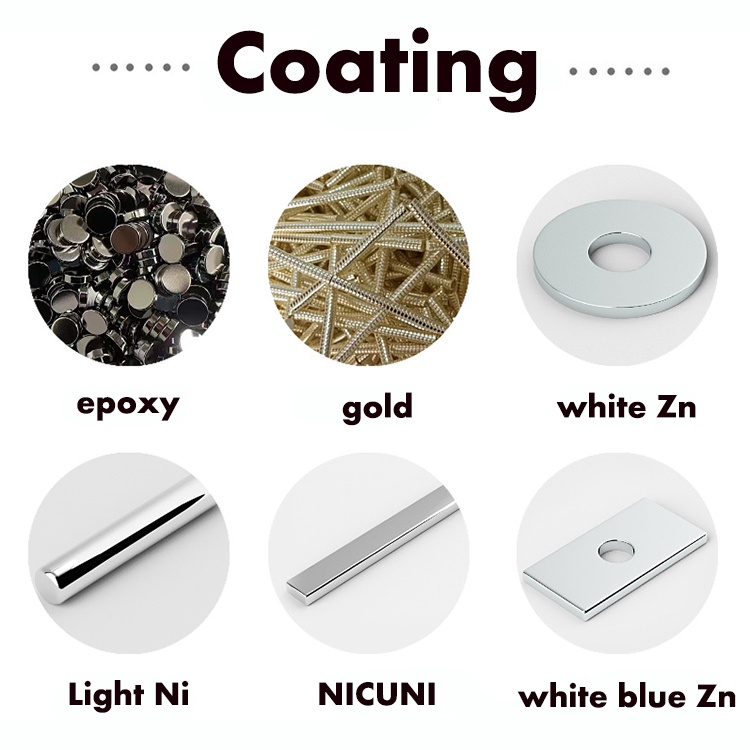
NdFeB strong magnetic electroplating can adopt different electroplating processes according to the different use environments of the products, and the surface coatings are also different, such as galvanized, nickel-plated, copper-plated, tin-plated, precious metal-plated, epoxy resin, etc., generally galvanized , Nickel + copper + nickel, nickel + copper + electroless nickel three processes are the mainstream.
Only zinc and nickel are suitable for direct plating on the surface of NdFeB magnets, so multi-layer electroplating technology is generally implemented after nickel plating. At present, the technical difficulty of direct copper plating of NdFeB has been broken through. Direct copper plating followed by nickel plating is a development trend. Such a coating design is more conducive to the thermal demagnetization index of NdFeB components to meet customer needs.
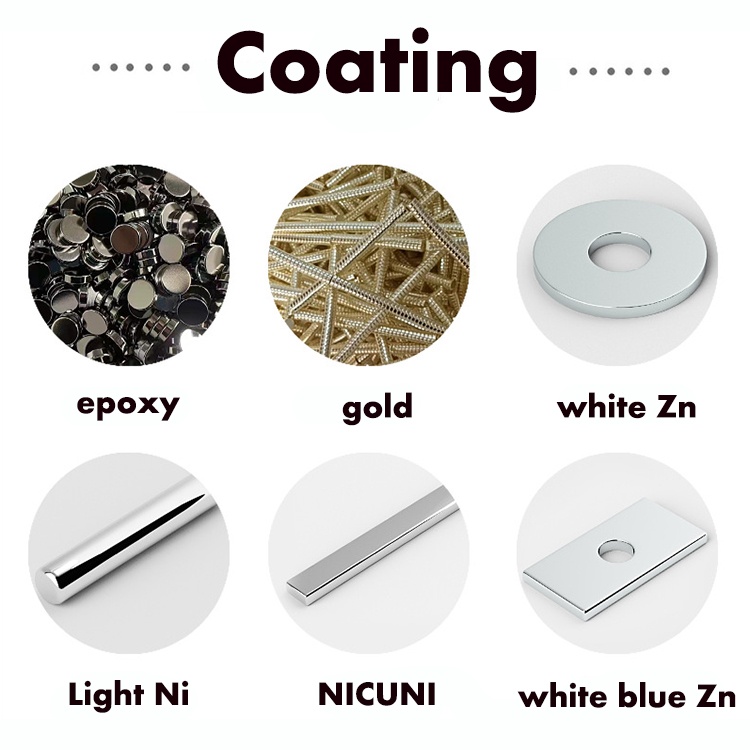
The most commonly used coatings of NdFeB magnets are galvanized and nickel-plated. They have obvious differences in appearance, corrosion resistance, service life, price, etc.:
The difference in polishing: nickel plating is superior to galvanized in polishing, and the appearance is brighter. Those who have high requirements on the appearance of the product generally choose nickel plating, while some magnets are not exposed, and those who have relatively low requirements on the appearance of the product generally choose galvanization.
The difference in corrosion resistance: Zinc is an active metal that can react with acid, so its corrosion resistance is poor; after nickel-plating surface treatment, its corrosion resistance is higher.
Difference in service life: Due to the difference in corrosion resistance, the service life of galvanizing is lower than that of nickel plating, mainly because the surface coating is easy to fall off after a long time of use, which leads to oxidation of the magnet and affects the magnetic performance.
Difference in hardness: Nickel plating is higher than zinc plating, which can largely avoid the phenomenon of falling corners and fragmentation of NdFeB powerful magnets caused by collisions during use.
Price difference: In terms of price, galvanizing is extremely advantageous. The price of NdFeB coatings is ranked from low to high: galvanized, nickel-plated, epoxy resin.
When choosing NdFeB strong magnets, it is necessary to consider which coating to choose based on factors such as operating temperature, environmental influence, corrosion resistance, product appearance, coating bonding force, and adhesive effect.
When it comes to the relationship between temperature and magnetism, we must first understand a concept – “Curie temperature”. Do you feel familiar when you hear the word Curie? Did you think of the famous Mrs. Curie? This concept barely has a little relationship with Mrs. Curie~
More than 200 years ago, a famous physicist discovered a physical characteristic of the magnet in his laboratory, that is, when the magnet is heated to a certain temperature, its original magnetism will disappear. This great physicist is Ju Mrs. Rie’s husband—Pierre Curie, later people called this temperature the Curie point (Curie point), also known as the Curie temperature (Curie temperature, Tc) or magnetic transition point.
When it comes to the relationship between temperature and magnetism, we must first understand a concept – “Curie temperature”. Do you feel familiar when you hear the word Curie? Did you think of the famous Mrs. Curie? This concept barely has a little relationship with Mrs. Curie~
More than 200 years ago, a famous physicist discovered a physical characteristic of the magnet in his laboratory, that is, when the magnet is heated to a certain temperature, its original magnetism will disappear. This great physicist is Ju Mrs. Rie’s husband—Pierre Curie, later people called this temperature the Curie point (Curie point), also known as the Curie temperature (Curie temperature, Tc) or magnetic transition point.
After talking about the Curie temperature, let’s talk about the working temperature (Working temperature, Tw). In fact, the Curie temperature is only the temperature under laboratory conditions, or it can be said to be the ideal temperature, and the working temperature of the magnet is the temperature of the material. The maximum temperature at which the magnetism can be maintained in practice. The maximum working temperature of sintered NdFeB is much lower than its Curie temperature. Within the working temperature, the magnetic force will decrease as the temperature rises, but most of the magnetic force will recover after cooling.
The relationship between working temperature and Curie temperature: The higher the Curie temperature, the higher the working temperature of the magnetic material, and the better the temperature stability. Adding cobalt, terbium, dysprosium and other elements to sintered NdFeB raw materials can increase its Curie temperature.
The maximum service temperature of sintered NdFeB depends on its own magnetic properties and the selection of working point. For the same sintered NdFeB magnet, the closer the working magnetic circuit is, the higher the maximum operating temperature of the magnet and the more stable the performance of the magnet. Therefore, the maximum operating temperature of the magnet is not a definite value, but changes with the degree of closure of the magnetic circuit.
The magnetism of sintered NdFeB materials is mainly derived from its easily magnetized crystal structure, which can obtain extremely high magnetism under the action of a strong external magnetic field, and its magnetism will not disappear after the external magnetic field disappears, so “magnetization” It is a key step for sintered NdFeB materials to obtain magnetism. In the production and preparation process of sintered NdFeB materials, magnetization is the last step before the finished product is delivered, but the magnetic field orientation of the NdFeB blank, that is, the future magnetization direction, has been determined when the magnetic powder is pressed into the blank.
Magnetic field orientation
Magnetic materials are divided into two categories: isotropic magnets and anisotropic magnets. Isotropic magnets have the same magnetic properties in any direction and can be attracted together arbitrarily; anisotropic magnets have different magnetic properties in different directions, and the direction that can obtain the best magnetic properties is called the orientation direction of the magnet. A square sintered NdFeB magnet has the largest magnetic field strength only in the orientation direction, and the magnetic field strength in the other two directions is much smaller.
If the magnetic material has an orientation process in the production process, it is an anisotropic magnet. Sintered NdFeB is generally pressed by magnetic field orientation molding, so it is anisotropic. Therefore, it is necessary to determine the orientation direction before production, that is, the direction of magnetization in the future. . Powder magnetic field orientation is one of the key technologies for manufacturing high-performance NdFeB. (Bond NdFeB can be isotropic or anisotropic)
Magnetization direction and method
Magnetization is the process of applying a magnetic field to the n35sh high temp ndfeb rare earth magnets along the direction of the magnetic field orientation, and gradually increasing the magnetic field strength to make it reach the technical saturation state.
المنتجات ذات الصلة