


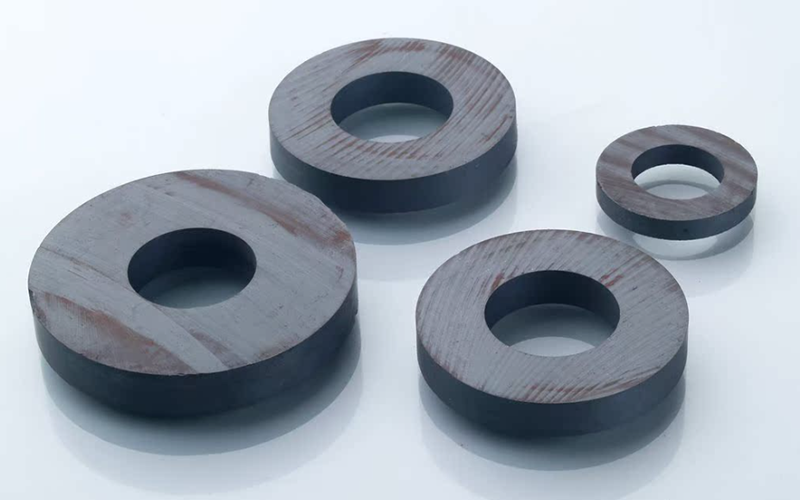
What is a ferrite magnet
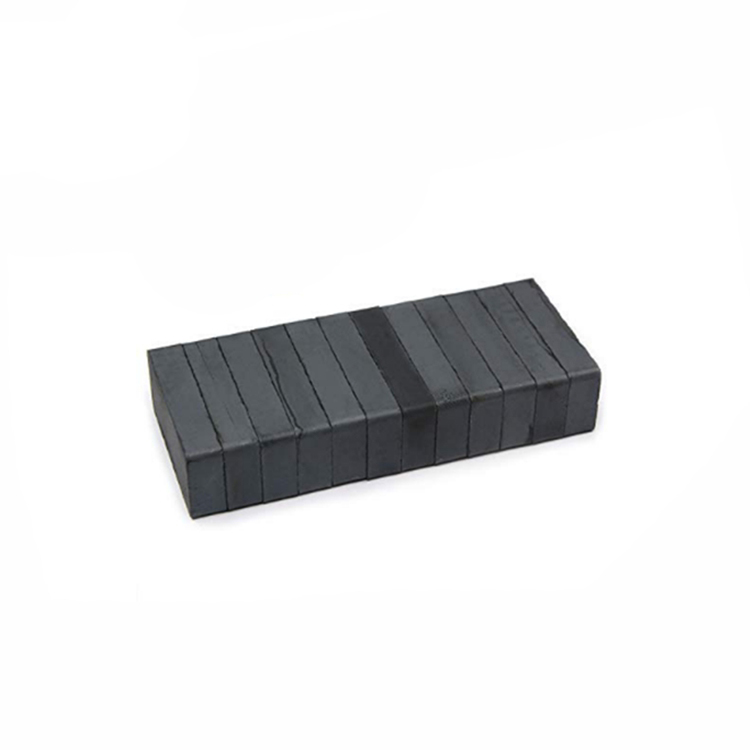
Barium and strontium ferrite are combined to form the permanent magnet material known as ferrite. In addition to having excellent anti-demagnetization properties, this type of magnetic material also offers the benefit of being reasonably priced. Ferrite magnets need particular machining methods since they are stiff and brittle.
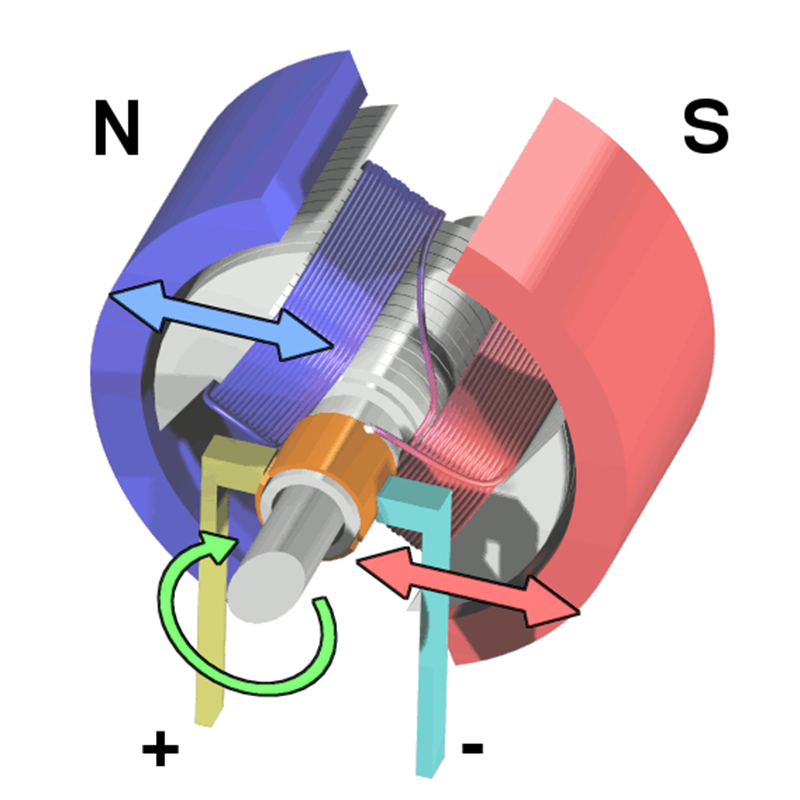
The same-sex magnet can be magnetized in any direction because it is not oriented, but a slightly stronger magnetic induction will be found on the side where the pressure is frequently the smallest. The opposite-sex magnet must be magnetized in the direction taken because it is oriented along the manufacturing direction. From 1.1MGOe to 4.0MGOe is the range of the magnetic energy product. Ferrite magnets are now the most extensively used permanent magnet materials because of their inexpensive cost and wide range of uses, including motors, speakers, toys, and handicrafts.
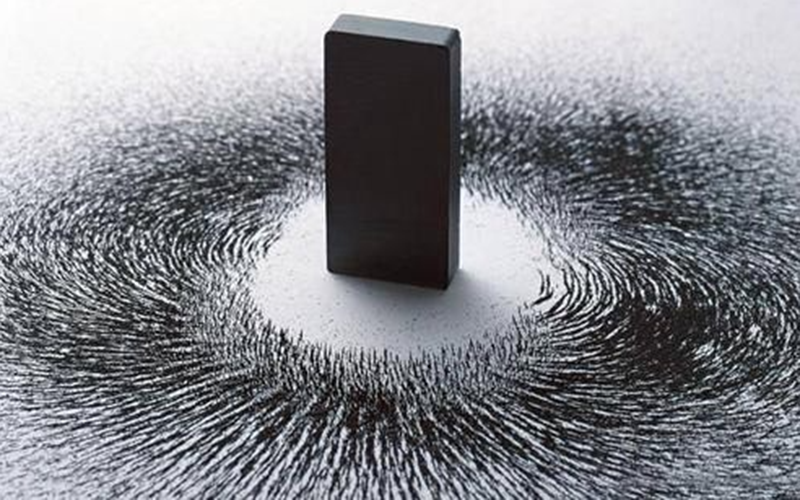
特徴
The residual magnetism and recovery magnetic permeability of materials produced using the powder metallurgy process are both minimal. Strong anti-demagnetization properties and a large coercive force make them particularly appropriate for magnetic circuit structures under situations of dynamic operation. The material is brittle and hard and can be cut using diamond-tipped tools. Since oxide is the primary raw element, corrosion is difficult to achieve. Working temperatures range from -40°C to +200°C.
Additional classifications for ferrite magnets include anisotropy (anisotropy) and isotropy (isotropy). While anisotropic sintered ferrite permanent magnet material has strong magnetic properties, it can only be magnetized in the magnet’s direction, isotropic sintered ferrite permanent magnet material has weak magnetic properties. Magnetization in a predetermined direction.
Bodily characteristics
Even when using raw materials with appropriate chemical composition, it’s not always possible to produce ferrite magnets with high performance and microstructure. The impact of physical characteristics is the cause. The bulk density BD, specific surface area SSA, and average particle size APS of iron oxide are among its stated physical characteristics. Iron oxide’s APS value significantly affects the APS value of ferrite magnet powder since it makes up around 70% of the formula for manganese-zinc ferrite magnets.
In general, the APS values of iron oxide and ferrite magnet powder are low, which is advantageous for accelerating the chemical process. The APS value shouldn’t be too low, either, because too-fine powder particles make further pressing difficult and make crystallization during sintering simple. Naturally, when the APS value of iron oxide is too high, only the spinel phase’s diffusion reaction can be carried out during pre-calcination due to the large particle size, and the subsequent grain development process cannot be carried out. As a result, sintering’s activation energy will surely rise, which will be detrimental to solid-state processes.
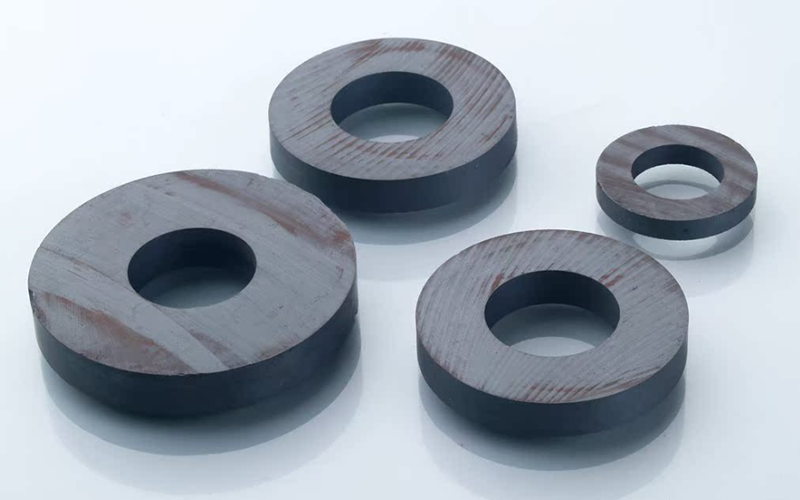
Differences from NdFeB magnets
A ferrite magnet is a metal oxide with ferromagnetic properties. In terms of electrical properties, the resistivity of ferrite is much larger than that of metal and alloy magnetic materials, and it also has higher dielectric properties. The magnetic properties of ferrite are also shown to have higher magnetic permeability at high frequencies. Therefore, ferrite has become a widely used non-metallic magnetic material in the field of high frequency and weak current. Belonging to non-metallic magnetic materials, it is a composite oxide (or ferrite) of magnetic ferric oxide and one or more other metal oxides. The magnetic force is usually 800-1000 gauss, and it is often used in speakers, speakers and other equipment.
The advantages of NdFeB magnets are high cost performance and good mechanical properties; the disadvantages are that the Curie temperature point is low, the temperature characteristics are poor, and it is easy to be pulverized and corroded. It must be adjusted by adjusting its chemical composition and adopting surface treatment methods. Improvement can meet the requirements of practical application. NdFeB belongs to the third generation of rare earth permanent magnet materials. It has the characteristics of small size, light weight and strong magnetism. It is the magnet with the best performance and price ratio at present. The advantages of high energy density make NdFeB permanent magnet materials widely used in modern industry and electronic technology. In the state of bare magnets, the magnetic force can reach about 3500 Gauss.
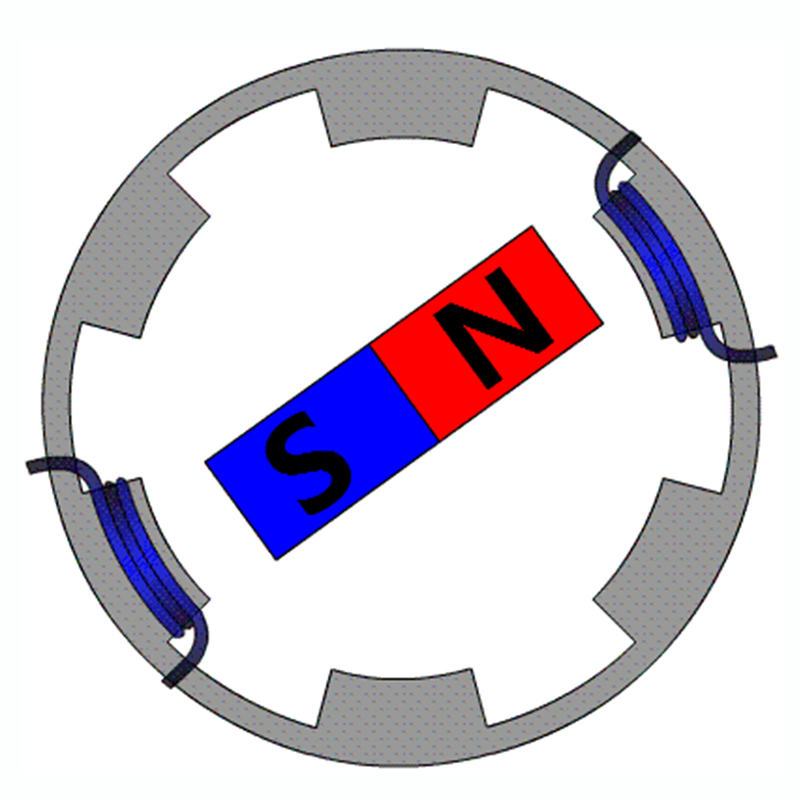
The existing application conundrum of permanent magnet motors (high temperature demagnetization + high cost) may be seen from the perspective of our motors, and we can see that ferrite materials can effectively resolve it. Currently, some of the ferrite motors used in household white goods are mass-produced, and the technique of employing a lot of ferrite materials to make up for the performance shortfall is implemented (will be described in more detail later). Ferrite motors are still in the exploratory and small-batch application stages in sectors with high performance requirements, and this is because several essential technologies have not yet made a breakthrough, which prevents them from becoming widely adopted.
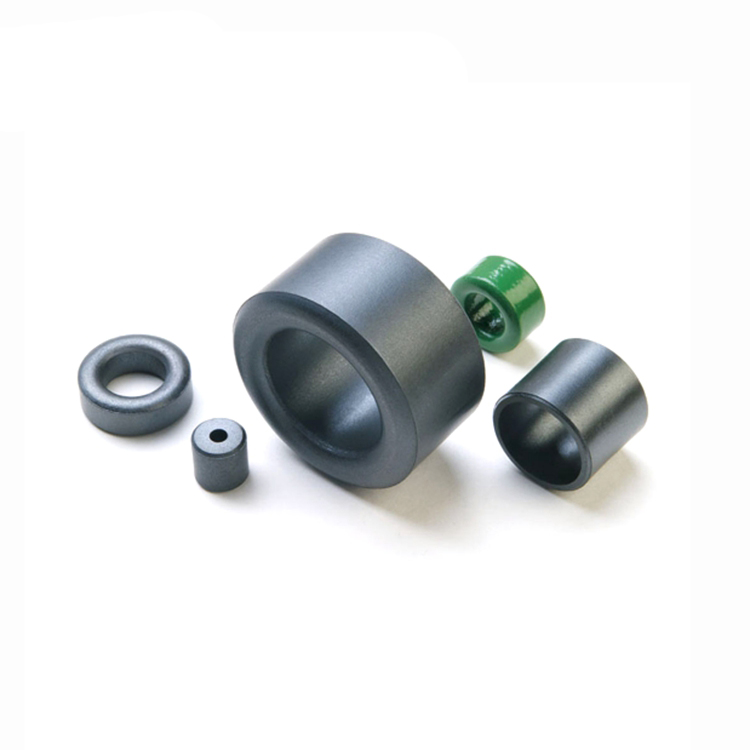
Hard and soft ferrite are two broad categories for ferrite. Take the most straightforward example while discussing its applicability. The speaker magnet inside the conventional radio is constructed of ferrite, as we discover when we disassemble it. Ferrite doesn’t function very well magnetically. The magnetic energy product can now only reach slightly higher levels than 4MGOe (or roughly one hundredth of NdFeB’s). The price of this material is by far its greatest benefit. On the one hand, raw resources are cheap and plentiful, and rare earth-free materials are also inexpensive. On the other hand, processing is also inexpensive and performs similarly to how ceramics do. Molded and sintered ferrite magnets are produced.
When processing is necessary, just straightforward cutting and grinding are needed; painting or other surface treatments, such as electroplating, are not required for the completed product. The cost is further decreased by the availability of several manufacturers’ ready-made standard items, such as rings and squares in typical forms and sizes.
The following are the primary distinctions between permanent ferrite magnets and NdFeB magnets: 1. NdFeB magnets perform better than ferrite magnets in terms of performance. 2. Ferrite magnets are significantly less expensive than NdFeB magnets in terms of cost. 3. Permanent magnet ferrite can survive temperatures beyond 80 degrees without demagnetizing, but NdFeB can only withstand temperatures up to roughly 80 degrees. 4. Ferrite has extremely good stability. It is an extremely stable oxide in and of itself. Because NdFeB is an alloy and is prone to oxidation and pulverization, it has to be coated.
関連商品