


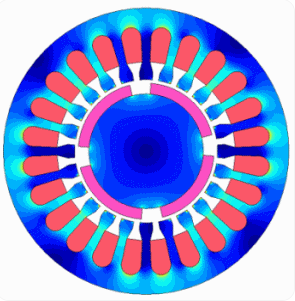
Neodymium Arc Magnets
Both samarium cobalt and neodymium iron boron are metal materials. Due to the good conductivity of metal materials, the resistivity is very low. This is not a good thing for rotating machinery such as motors because it will bring eddy currents to the rotating machinery. Loss, causing rotating machinery, including neodymium arc magnets, to heat up. Therefore, magnet eddy current losses that occur in rotating machinery must be considered by magnet and motor designers. Today, Understanding Magnet Emperor will take you through what is the eddy current loss of magnets and how to avoid eddy current losses in the production of magnetic materials.

To understand and reduce eddy current losses, we should first know how eddy current losses are generated. Here we need to introduce a concept – skin effect (skin effect)
When alternating current passes through a wire, the current density is distributed unevenly across the cross-section of the wire. As the frequency of current changes increases, the current becomes more and more concentrated on the conductive surface, and the current inside the wire becomes smaller and smaller. This The phenomenon is called the skin effect.

The cause of the skin effect is eddy currents. It can be known from the law of electromagnetic induction that an alternating magnetic field will be generated around an alternating electric field. When alternating current passes through a conductor neodymium arc magnets, an alternating magnetic field will be generated inside and around the conductor, causing a vortex-shaped induced current inside the conductor. Eddy current is referred to as eddy current. .
The closer it is to the center of the conductor, the higher the induced electromotive force generated by the alternating magnetic field in the conductor. The stronger the eddy current neodymium arc magnets, the stronger the obstruction to the original current, resulting in a small current density approaching the center of the conductor and a small current density approaching the surface. The current density is larger.
Since the induced electromotive force increases with the frequency, the skin effect also becomes more significant with the frequency. When a current with a very high frequency passes through a wire, it can be considered that the current only flows in a very thin layer on the surface of the wire neodymium arc magnets, which is equivalent to a reduction in the cross-section of the wire and greatly reduces the effective utilization of the conductor material.
Eddy current loss
Since the resistance of samarium cobalt and neodymium iron boron permanent magnets is relatively small, the eddy currents in the alternating electric field are generally relatively large. Due to the thermal effect of the current, eddy currents will heat the magnet, and thermal demagnetization will occur when the temperature is too high.
The size of eddy current loss is related to factors such as the way the magnetic field changes, the movement of the magnet neodymium arc magnets, the shape of the neodymium arc magnets, magnetic permeability and resistivity.
The higher the rotational speed (equivalent to frequency) and magnetic permeability of the rotating machinery, and the lower the resistivity, the smaller the skin depth and the greater the loss caused. In fields such as electric vehicles and elevators, permanent neodymium arc magnets motors are usually controlled by inverter power sources for speed control. Due to the presence of higher harmonics of the carrier frequency, eddy current losses in the magnets will increase and cause thermal demagnetization.
Reduce eddy current loss of sintered NdFeB by increasing resistivity
From the perspective of motor design, in order to reduce the eddy current loss of permanent magnets in rotating machinery, several technical methods have been proposed, such as shielding columns surrounding the magnets, methods of dividing magnets and side isolation neodymium arc magnets, etc.
From the perspective of magnets, one of the most effective ways to reduce eddy current losses in motors is to use bonded magnets. Because of the presence of the binder and its high enough volume fraction, the resistivity of the bonded magnet points is 102 times that of the sintered magnets. ~104 times, but the power and maximum operating temperature of the motor are greatly limited, so the most direct method is to increase the resistivity of the sintered magnet itself.
There are many ways to improve the resistivity of sintered magnets, such as adding high-resistivity powder (Al2O3, etc.), coating with SiO2 coating, etc. However, these methods will affect the magnetic properties of sintered magnets to a certain extent. Therefore, in magnet research and development A balance needs to be made between resistivity and magnetic properties during the process.
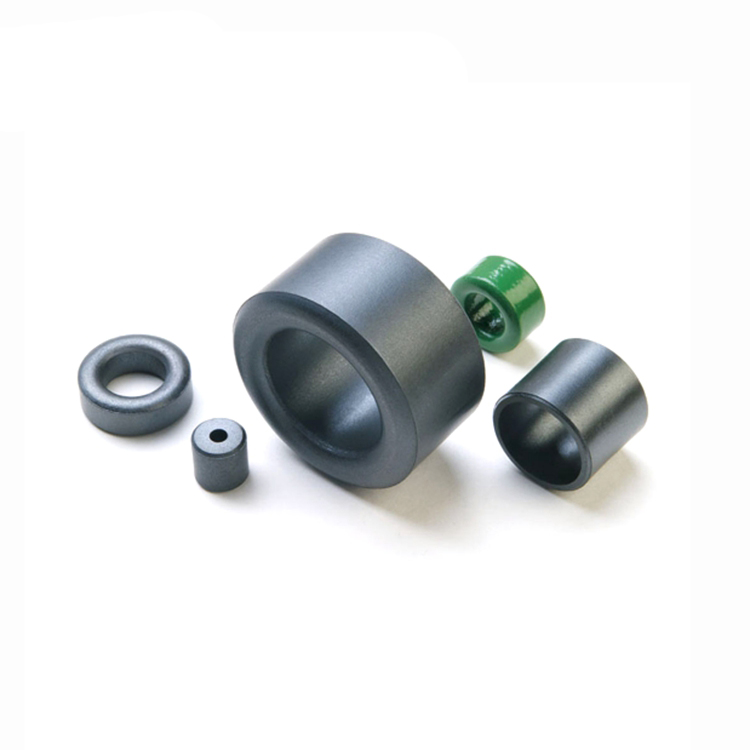
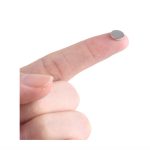
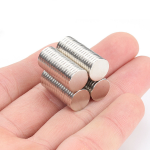
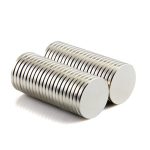
Neodymium arc neodymium arc magnets are a specific type of neodymium magnet that is shaped like a segment of a ring or arc. These magnets are commonly used in various applications where a curved or cylindrical shape is required, such as in motors, generators, speakers, magnetic couplings, magnetic separators, and many other industrial and consumer products.
Neodymium arc magnets are the strongest type of permanent neodymium arc magnets available commercially, known for their excellent magnetic properties. They are composed mainly of neodymium, iron, and boron, which together form the NdFeB alloy. This alloy allows neodymium magnets to have incredibly high magnetic strength relative to their size.
Arc magnets are particularly useful in applications where a circular or curved magnetic field is needed, such as in electric motors or generators where they can be used to produce torque. They come in various sizes and configurations to suit different needs and can be custom-made to fit specific applications.
Eddy current losses can occur in rare earth permanent neodymium arc magnets materials, including neodymium (NdFeB) magnets, due to their high electrical conductivity. Eddy currents are induced currents that circulate within the material when it is exposed to changing magnetic fields, such as those present in alternating current (AC) applications or when the magnet moves relative to a conductive surface.
These eddy currents generate heat within the magnet material, leading to energy losses. In high-frequency applications or in situations where the magnets experience rapid changes in magnetic fields, such as in motors or generators, eddy current losses can become significant.
To mitigate eddy current losses in rare earth permanent neodymium arc magnets, various techniques can be employed, including:
- Laminating: The magnet can be segmented into thin layers separated by insulating material. This reduces the size of the eddy currents and therefore decreases the overall losses.
- Magnet Shape Optimization: Designing the magnet shape to minimize the formation of large loops for eddy currents can help reduce losses.
- Magnet Coating: Coating the magnet with an insulating layer can help to reduce eddy current losses by preventing direct contact with conductive surfaces.
- Magnet Arrangement: In some applications, arranging magnets in a specific configuration can minimize eddy current losses.
While rare earth permanent neodymium arc magnets are known for their high magnetic strength and energy efficiency, eddy current losses are a consideration in certain applications, especially those involving high-frequency operation or rapid changes in magnetic fields. Balancing the need for high magnetic performance with minimizing losses is crucial in the design of devices utilizing these materials.
Nuclear Magnetic Resonance (NMR) is a nuclear physics phenomenon. As early as 1946, Block and Purcell reported this phenomenon and applied it to wave spectroscopy. Lauterbur published MR imaging technology in 1973, making nuclear magnetic resonance not only used in physics and chemistry. Also used in clinical medicine.
In recent years, magnetic resonance imaging technology has developed very rapidly and has become increasingly mature and perfect. The scope of examination basically covers all systems of the body, and is promoted and applied around the world. In order to accurately reflect its imaging basis and avoid confusion with nuclide imaging, it is now called magnetic resonance imaging.
Magnetic resonance imaging requires a strong and uniform magnetic field, which is generated by a magnet. Magnets are the most important and expensive part of MR equipment. Currently, there are two types of magnets commonly used: permanent magnets and electromagnets. Electromagnets are divided into two categories: normally conducting and superconducting.
Normally conductive electromagnets use strong direct current to pass through a coil to generate a magnetic field. The power consumption to maintain the magnetic field of a main magnet is about 100kW. Generally, it takes several hours after power is applied for the magnetic field to reach a stable state neodymium arc magnets. A large current flowing through the coil will generate a large amount of heat, which must be dissipated by cooling water through a heat exchanger.
Superconducting magnets are currently used more frequently. In the superconducting state, there is no resistance loss when current flows through the conductor, which does not cause the conductor to heat up neodymium arc magnets. A wire of the same diameter can pass a larger current without being damaged in the superconducting state. A coil made of superconducting material can generate a strong magnetic field by passing a strong current, and after the external current is cut off, the current in the superconducting coil remains unchanged, so the superconducting magnetic field is extremely stable.
Permanent magnet materials can maintain magnetism for a long time after being magnetized, and the magnetic field intensity is stable. Therefore, the maintenance of the magnet is simple and the maintenance cost is minimal.
Permanent magnets used in magnetic resonance equipment include alnico, permanent ferrite, and neodymium iron boron. Among them, neodymium iron boron permanent neodymium arc magnets have the highest magnetic energy product and can achieve the maximum field strength (up to 0.2T field) with a smaller amount. It requires 23 tons of AlNiCo, but only 4 tons if NdFeB is used). The disadvantage of permanent magnets as main magnets is that it is difficult to achieve a field strength of 1T.
Currently, the field strength is generally below 0.5T and can only be used in low-frequency magnetic resonance equipment. When a permanent magnet is used as the main magnet, the magnetic resonance equipment can be designed in a ring or yoke shape, and the instrument is semi-open. This structure is a great boon for children or people with claustrophobia.