


Small Disc Neodymium Magnet
Sintered NdFeB small disc neodymium magnet magnet products should provide the technical magnetic parameters of the product, including remanence Br, magnetic coercivity Hcb, intrinsic coercivity Hcj, magnetic energy product (BH)m, demagnetization curve squareness and B-H demagnetization curve recovery magnetic material rate μrec, etc. In 1992, the State Administration of Quality Supervision, Inspection and Quarterly Inspection formulated the national standard for the magnetic energy detection of permanent magnet (hard magnetic) materials in my country.
The standard was redrafted in 2013. The new standard refers to and quotes the IEC60404-5:2013 of the International Electrotechnical Commission and its 2006 amendment. This is the latest national standard for the magnetic performance detection of magnetic materials in my country.
The specific measurement and calculation methods are detailed in the national standard documents. I will not elaborate on them here. Friends who want to understand or obtain the original text of the national standard can leave a message “national standard” on the official account, and our staff will send the file to you.
Today we will focus on the principle and technology of relative detection (or comparative detection) of the magnetic properties of NdFeB products. Sintered NdFeB products come in various shapes and sizes. In addition to strict requirements on the performance and grade of the products, some users also require relative detection of the magnetic properties of the samples.
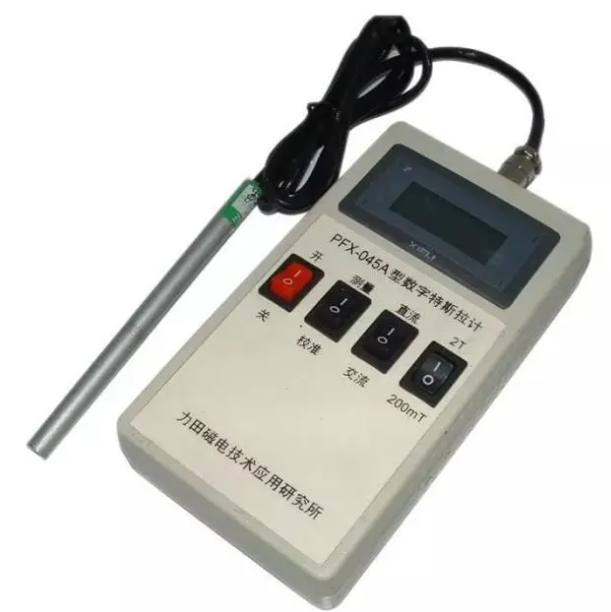
For example, some users require random inspection of the surface magnetic field value of the product, some users require random inspection of the magnetic flux value of the product, and some users require random inspection of the magnetic moment of the product. In order to meet these requirements, the following have been developed accordingly: 1. Tesla meter detects the surface field of the magnet; 2. Fluxmeter measures the magnetic flux of the small disc neodymium magnet; 3. Helmholtz coil + fluxmeter measures the magnetic moment of the small disc neodymium magnet. Today, I will briefly introduce these instruments to you.
Teslameter measures the surface magnetic field of a small disc neodymium magnet
Teslameters include Hall effect Teslameter, coil Teslameter and rotating coil Teslameter. Hall effect Teslameter is the most commonly used in the detection of permanent magnetic material products. The Hall effect is a phenomenon in which a sheet semiconductor carrying current is placed in a magnetic field perpendicular to the direction of the current, and the semiconductor will generate a transverse magnetic field, that is, an electromotive force is generated in the direction perpendicular to the magnetic field and the current. (Related reading: Working principle of Hall element) When the Hall device and the current passing through are constant, the Hall voltage is proportional to the measured magnetic field, so the Hall effect can measure the magnetic field.

When using a Hall effect Tesla meter to measure the surface magnetic field of a small disc neodymium magnet’s pole, the following issues need to be noted: 1. The plane of the Hall probe must be perpendicular to the magnetic field direction, so the plane of the Hall probe must be close to the surface of the pole; 2. The surface field at different positions of the pole in the open circuit magnetic field is uneven, so the surface magnetic field at a specified fixed position should be measured.
Fluxmeter measures the magnetic flux of a small disc neodymium magnet
The magnetic flux cannot be measured directly, but it can be calculated and determined by the induced electromotive force of the measuring coil through Maxwell’s equations. Fluxmeters for measuring the magnetic flux of samples have been widely used as a comparative measurement method in the detection of permanent magnetic small disc neodymium magnet products. The disadvantage of this method is that when measuring small-sized samples, the degree of the fluxmeter is related to the different positions of the sample in the measuring coil.

Permanent small disc neodymium magnet with ultra-high coercivity are either small in size or complex in shape. For some thin or tile-shaped magnets, it is very difficult to measure their surface field with a tesla meter or to measure the flux value with a fluxmeter, because the measured values are very scattered and have poor repeatability. For such thin magnets or special-shaped small disc neodymium magnet (such as tile-shaped or fan-shaped), only the method of measuring the magnetic moment can be used.
The method of measuring the magnetic moment of permanent small disc neodymium magnet uses the Helmholtz coil and fluxmeter method (as shown below). This method has the characteristics of fast speed, high accuracy and small error, and is suitable for measuring products with complex shapes.

Measurement of density of permanent small disc neodymium magnets
The mass of a substance per unit volume is called the density of the substance. The density of sintered NdFeB permanent magnets is one of the important indicators to measure their mass. The theoretical density of Nd2Fe14B compound is 7.62g/m3, and the density of pure ternary sintered NdFeB permanent magnets should reach 7.5-7.55 g/m3. When a small amount of dysprosium, terbium and other elements are added, the density of sintered NdFeB permanent small disc neodymium magnets may be higher.
Il existe de nombreuses façons de mesurer la densité, et la méthode de la pesée hydrostatique est souvent utilisée. Selon le principe d'Archimède, un objet perd de la masse dans un fluide en raison de la flottabilité. Par conséquent, la masse de l'échantillon dans l'air et la masse dans le fluide sont pesées, et le volume de l'échantillon peut être calculé lorsque la densité du fluide est connue, ce qui permet de calculer la densité de l'échantillon.
In order to accurately measure the density of sintered NdFeB permanent small disc neodymium magnet, it is recommended to use a fluid with an accurately known density, such as anhydrous ethanol (0.989g/cm3) or distilled water (1.003 g/cm3).
NdFeB (Neodymium-Iron-Boron) magnets are a type of rare-earth small disc neodymium magnet known for their strong magnetic properties. Detection of NdFeB magnets involves identifying their magnetic field or properties rather than the material itself. Here’s an overview of the principle and technologies used for detecting NdFeB small disc neodymium magnet:
### Detection Principles
1. **Magnetic Field Measurement:**
– **Magnetometers**: Instruments like Hall effect sensors, fluxgate magnetometers, and magneto-resistive sensors can measure the magnetic field generated by NdFeB small disc neodymium magnet. These sensors can detect the presence, strength, and direction of the magnetic field.
– **Hall Effect Sensors**: These sensors measure the voltage difference (Hall voltage) across a conductor when it is placed in a magnetic field. This voltage can be used to determine the strength of the magnetic field, and thereby detect the presence of NdFeB small disc neodymium magnet.
2. **Magnetic Flux Measurement:**
– **Fluxgate Magnetometers**: These measure the magnetic flux density by detecting changes in the magnetic field. They are often used for precise measurements of the magnetic field strength and can be used to detect NdFeB small disc neodymium magnet.
3. **Metal Detectors:**
– **Inductive Metal Detectors**: These can detect ferromagnetic materials including NdFeB magnets. They work by generating an alternating electromagnetic field and detecting changes in this field caused by the presence of metal objects.
4. **Magnetic Susceptibility Measurement:**
– **Magnetic Susceptibility Meters**: These devices measure how a material responds to an applied magnetic field. NdFeB magnets have a high magnetic susceptibility, and this property can be used to detect their presence.
### Detection Technologies
1. **Handheld Magnetic Detectors:**
– These are portable devices equipped with magnetic sensors that can be used to find NdFeB magnets in various environments. They are commonly used in industrial applications and field surveys.
2. **Integrated Detection Systems:**
– In manufacturing and quality control, integrated systems may use arrays of magnetometers to detect the presence and orientation of NdFeB magnets in automated processes.
3. **Non-Destructive Testing (NDT):**
– Techniques like magnetic particle inspection can be adapted to detect NdFeB small disc neodymium magnet by assessing the influence of the magnet on magnetic particles or fields.
4. **Magnetic Imaging:**
– **Magnetic Resonance Imaging (MRI)** and similar techniques can detect magnetic fields and can be used to visualize the distribution of NdFeB magnets within a material or environment.
5. **Robotic and Automated Detection:**
– Robots equipped with magnetic sensors can automatically locate and handle NdFeB small disc neodymium magnets in automated production lines or sorting systems.
In practical applications, the choice of detection technology depends on the specific requirements, such as sensitivity, accuracy, and environmental conditions. Each method has its advantages and limitations, and often a combination of techniques is used to achieve the desired results.
Small disc neodymium magnets are incredibly strong for their size due to the high magnetic energy density of neodymium-iron-boron (NdFeB) material. These small disc neodymium magnets are commonly used in various applications, such as:
1. **DIY Projects**: They’re great for craft projects, science experiments, and small mechanical devices.
2. **Magnetic Holders**: Used in magnetic holders for tools, kitchen gadgets, or office supplies.
3. **Sensors**: Employed in various sensor technologies due to their strong magnetic fields.
4. **Magnetic Jewelry**: Used in magnetic bracelets or necklaces for their aesthetic and therapeutic properties.
5. **Electronics**: Found in motors, generators, and other electronic components.
When handling them, keep in mind:
– **Strength**: Even small magnets can be very powerful. They can snap together with significant force, which can be dangerous.
– **Fragility**: They can be brittle and break or chip easily if dropped or subjected to impact.
– **Magnetic Fields**: Strong fields can interfere with electronic devices, so keep them away from things like credit cards, hard drives, and medical devices.
If you have any specific questions or need guidance on a particular application, feel free to ask!