


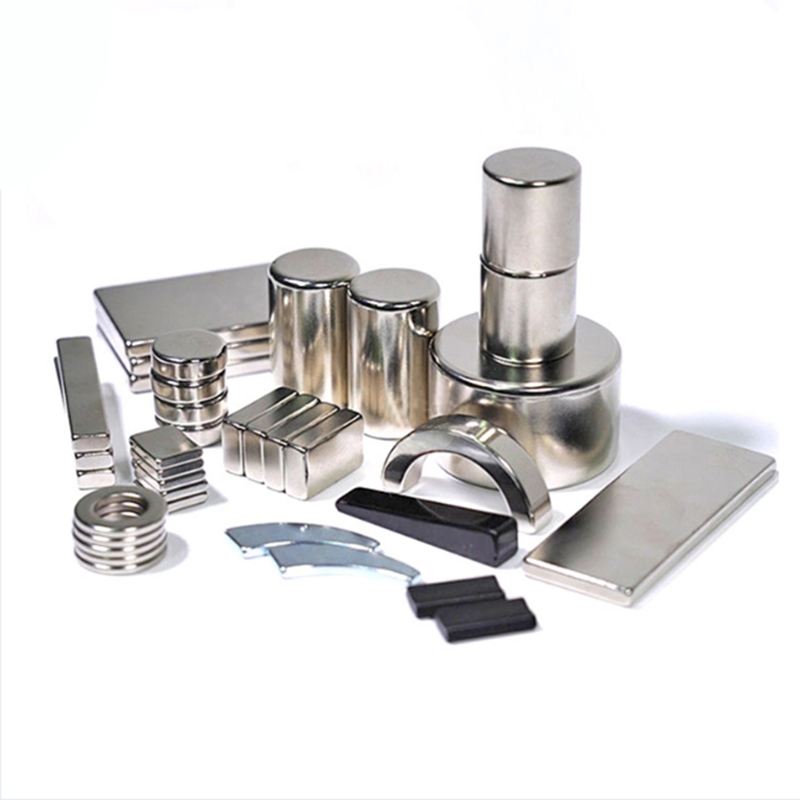
Sintered NdFeB Magnet
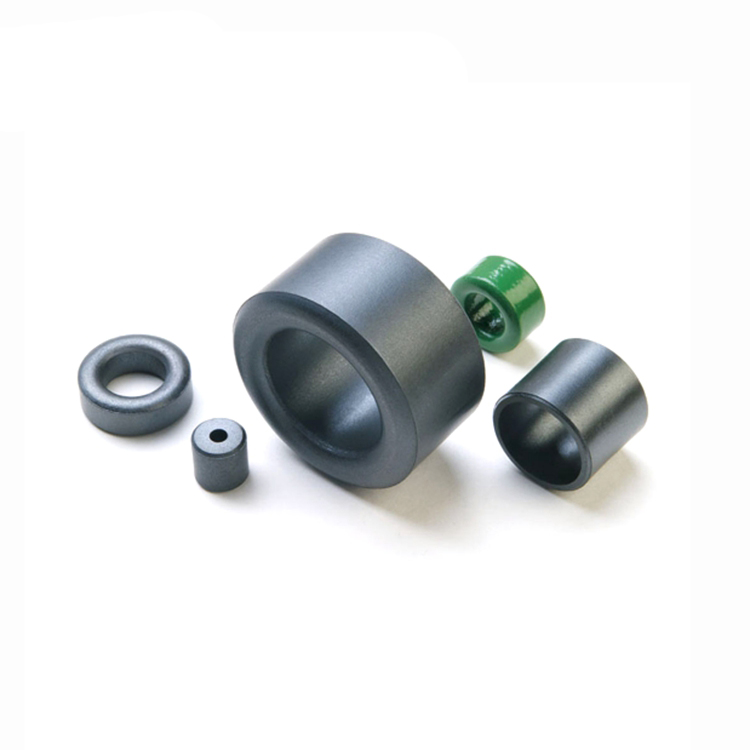
Sintered NdFeB (Neodymium Iron Boron) magnets are among the strongest permanent magnets available today. They are made through a powder metallurgy process, where neodymium, iron, and boron powders are mixed together, compacted in a mold under high pressure, and then sintered at high temperatures.
These magnets have exceptional magnetic properties, including high magnetic strength, excellent coercivity and remanence, and high energy density. They are widely used in various applications such as speakers, magnetic separators, MRI machines, electric motors, sensors, and more.
In speaker systems,sintered NdFeB magnets are often employed to produce powerful magnetic fields, allowing for compact speaker designs with high efficiency and excellent sound quality. Their strong magnetic properties contribute to better performance and overall speaker functionality.

The application of sintered NdFeB permanent sintered NdFeB magnet mainly uses their magnetic properties. However, due to different usage environments and conditions, in addition to magnetic performance requirements, there are also mechanical and chemical performance requirements for the magnets.
For example, some permanent magnets are used in high-speed rotating machinery and must withstand large centrifugal forces, or are used in vibration environments, or withstand extremely high acceleration (3g~5g), or are subject to stress when installing the magnets. It may peel, fall off, corners or crack, etc., so it is natural to have requirements for the mechanical properties of the magnet.
What are the mechanical properties of materials?
The mechanical properties of materials generally include strength, hardness, plasticity and toughness. These mechanical property parameters have different physical meanings.
Strength refers to the maximum ability of a material to resist the damaging effects of external forces. Intensity is divided into different types according to the different forms of external force:
Tensile strength (tensile strength) refers to the strength limit when the external force is pulling force.
Compressive strength refers to the strength limit when external force is pressure sintered NdFeB magnet.
Bending strength refers to the strength limit when an external force is perpendicular to the axis of the material and causes the material to bend.
Hardness refers to the ability of a material to locally resist hard objects from being pressed into its surface. It is an indicator for comparing the softness and hardness of various materials sintered NdFeB magnet. The higher the hardness, the stronger the metal’s ability to resist plastic deformation.
Plasticity refers to the ability of a solid material to resist deformation under a certain external force. It is the ability of a material to permanently deform without being destroyed under the action of external force.
Toughness represents the ability of a material to absorb energy during plastic deformation and rupture. The better the toughness, the less likely brittle fracture will occur. In materials science and metallurgy sintered NdFeB magnet, toughness refers to the resistance of a material to breaking when it is subjected to a force that causes it to deform. It is the ratio of the energy that the material can absorb before breaking to its volume.
Mechanical properties of sintered NdFeB
Sintered NdFeB is a brittle material. Its mechanical properties are hard and brittle, that is, high strength and low toughness. There is almost no plastic deformation before fracture, that is, it fractures during the elastic deformation stage.
The figure below is a comparison of the magnetic energy product (BH)m and fracture toughness of various permanent magnet materials. We can find that sintered NdFeB has the highest magnetic energy product (BH)m, and the fracture toughness is still comparable to Sm2Tm17, SmCo5, and ferrite permanent magnets, because they are all permanent magnet materials based on intermetallic compounds and belong to Brittle materials. Bonded rare earth permanent magnet materials, Fe-Cr-Co, and magnetic steel have the best fracture toughness, but their magnetic energy product (BH)m is much lower than that of sintered NdFeB.
Brittle materials commonly use three indicators to describe the mechanical properties of the material:
Fracture toughness usually reflects the strength of a material when cracks expand. The unit is MPa·m1/2. To test the fracture toughness of materials, tensile testing machines, stress sensors, extensometers, signal amplification dynamic strain gauges, etc. must be used. In addition, the samples must be made into thin sheets.
Impact strength (impact fracture toughness) reflects the energy absorbed by the material during the fracture process under the action of impact stress. The unit is J/m2. The measured value of impact strength is too sensitive to the size, shape sintered NdFeB magnet, processing accuracy and test environment of the sample, and the dispersion of the measured value will be relatively large.
Flexural strength is a material’s bending fracture strength measured using the three-point bending method. Because the sample is easy to process and the measurement is simple, it is most commonly used to describe the mechanical properties of sintered NdFeB magnets.
Magnetic Emperor found the approximate fluctuation range of the mechanical properties of sintered NdFeB given by some scholars based on different tests. Since it is a brittle material, the test data is widely dispersed.
The high strength and low toughness characteristics of sintered NdFeB magnet materials are determined by its own crystal structure. In addition, the following two factors will affect the bending strength of sintered NdFeB permanent magnets and are also ways to improve its strength. .
The Nd content has a certain impact on the strength of sintered NdFeB magnet. Experimental results show that under certain conditions, the higher the Nd content, the higher the material strength.
Adding other metal elements has a certain impact on the strength of sintered NdFeB. When a certain amount of Ti, Nb or Cu is added, the impact fracture toughness of the permanent magnet is improved; when a small amount of Co is added, the flexural strength of the permanent magnet is improved.
The comprehensive mechanical properties of sintered NdFeB magnet are not high enough, which is one of the important reasons limiting its application in wider areas. If the toughness of the product can be improved while ensuring that the magnetic properties are improved or unchanged, it will make the sintered NdFeB in Military, aerospace and other fields will play a greater role and enter a new period of development.
Samarium cobalt and neodymium iron boron are both metal materials. Due to the good conductivity of metal materials, the resistivity is very low. This is not a good thing for rotating machinery such as motors because it will bring eddy currents to the rotating machinery.
Loss, causing rotating machinery, including magnets, to heat up. Therefore, sintered NdFeB magnet eddy current losses that occur in rotating machinery must be considered by magnet and motor designers. Today, Understanding Magnet Emperor will take you through what is the eddy current loss of magnets and how to avoid eddy current losses in the production of magnetic materials.
Pour comprendre et réduire les pertes par courants de Foucault, il faut d'abord savoir comment les pertes par courants de Foucault sont générées. Pour cela, nous devons introduire un concept : l'effet de peau (effet de peau).
When alternating current passes through a wire, the current density is distributed unevenly across the cross-section of the wire. As the frequency of current changes increases, the current becomes more and more concentrated on the conductive surface, and the current inside the wire becomes smaller and smaller. This The phenomenon is called the skin effect sintered NdFeB magnet.
The cause of the skin effect is eddy currents. It can be known from the law of electromagnetic induction that an alternating magnetic field will be generated around an alternating electric field. When alternating current passes through a conductor, an alternating magnetic field will be generated inside and around the conductor, causing a vortex-shaped induced current inside the conductor. Eddy current is referred to as eddy current.
The closer it is to the center of the conductor, the higher the induced electromotive force generated by the alternating magnetic field in the conductor. The stronger the eddy current, the stronger the obstruction to the original current, resulting in a small current density approaching the center of the conductor and a small current density approaching the surface sintered NdFeB magnet. The current density is larger.
Since the induced electromotive force increases with the frequency, the skin effect also becomes more significant with the frequency. When a current with a very high frequency passes through a wire sintered NdFeB magnet, it can be considered that the current only flows in a very thin layer on the surface of the wire, which is equivalent to a reduction in the cross-section of the wire and greatly reduces the effective utilization of the conductor material.
Perte par courants de Foucault
Since the resistance of samarium cobalt and neodymium iron boron permanent magnets is relatively small, the eddy currents in the alternating electric field are generally relatively large sintered NdFeB magnet. Due to the thermal effect of the current, eddy currents will heat the magnet, and thermal demagnetization will occur when the temperature is too high.
The size of eddy current loss is related to factors such as the way the magnetic field changes, the movement of the magnet, the shape of the magnet, magnetic permeability and resistivity. The higher the rotational speed (equivalent to frequency) and magnetic permeability of the rotating machinery, and the lower the resistivity, the smaller the skin depth and the greater the loss caused.
In fields such as electric vehicles and elevators, permanent magnet motors are usually controlled by inverter power sources for speed control sintered NdFeB magnet. Due to the presence of higher harmonics of the carrier frequency, eddy current losses in the magnets will increase and cause thermal demagnetization.
Réduire la perte par courants de Foucault du NdFeB fritté en augmentant la résistivité
From the perspective of motor design, in order to reduce the eddy current loss of permanent magnets in rotating machinery, several technical methods have been proposed, such as shielding columns surrounding the magnets sintered NdFeB magnet, methods of dividing magnets and side isolation magnets, etc.
From the perspective of magnets, one of the most effective ways to reduce eddy current losses in motors is to use bonded magnets. Because of the presence of the binder and its high enough volume fraction, the resistivity of the bonded magnet points is 102 times that of the sintered magnets. ~104 times sintered NdFeB magnet, but the power and maximum operating temperature of the motor are greatly limited, so the most direct method is to increase the resistivity of the sintered magnet itself.
There are many ways to improve the resistivity of sintered magnets, such as adding high-resistivity powder (Al2O3, etc.), coating with SiO2 coating, etc. However, these methods will affect the magnetic properties of sintered magnets to a certain extent sintered NdFeB magnet. Therefore, in magnet research and development The process requires a balance between resistivity and magnetic properties.