


Small disc neodymium magnets
The stability of permanent magnetic material performance is an important indicator of permanent magnetic materials. Stability mainly refers to the process of magnetic properties changing under the influence of internal and external factors after magnetization, and is usually expressed by the rate of change of performance indicators small disc neodymium magnets. Common causes of magnetic property changes include temperature, time, electromagnetic field, radiation, mechanical vibration and impact, etc.
In the last issue of Understand Magnetics, we have introduced the temperature stability of permanent magnetic materials (remanent magnetism temperature coefficient, coercive force temperature coefficient, reversible temperature coefficient, click to learn more). In this issue, let’s learn about the time stability of permanent magnetic materials.

When the magnet works for a long time or is placed for a long time, the surrounding environment (such as temperature, humidity, corrosive liquid, etc.) may cause the physical and chemical properties of the magnet to change. After the permanent small disc neodymium magnets are magnetized, most of the area is magnetized to a specific direction, but there are still some small magnetic domains whose magnetization direction is chaotic (called reverse magnetization core).
Under the influence of various environmental factors, the original reverse magnetization core will grow and new reverse magnetization core will be generated, which will cause the magnetic properties of the permanent small disc neodymium magnets to decay. This change is generally a slow and irreversible change from the outside to the inside, which directly affects the main performance parameters of the magnet, such as remanence, intrinsic coercivity, coercive force or maximum magnetic energy product, and even causes the magnet to fail completely.
This loss of magnetic properties is irreversible. Even if the small disc neodymium magnets are magnetized again, it cannot be restored to the level before long-term placement. In recent years, with the widespread application of NdFeB permanent small disc neodymium magnets materials in aerospace, electric vehicles, high-power wind power generation and other fields with long service life requirements, application designers have paid more and more attention to the time stability of NdFeB permanent magnets.

Long-term stability at room temperature
A study published by Finnish scholars in 2013 showed that sintered NdFeB magnets (HcJ=15.6kOe) placed at room temperature for 1 year (10,000 hours) showed no perceptible magnetization loss for samples with different Pc values (Pc=-0.33, -1.1, -3.3). Sanhuan Research Institute also conducted a similar measurement study, which lasted for more than 12 years (4441 days). The intrinsic coercive force of the sintered NdFeB magnets used in the experiment was HcJ=18kOe. The sample was an uncoated cube with a side length of 10.2mm and a magnetic permeability coefficient of Pc=-2 (click on Magnetic Moment, Magnetic Flux and Remanence to learn what Pc value is).
The number of samples was 8, which were directly exposed to the atmospheric environment of the laboratory at a temperature between 22℃ and 28℃. Observations and measurements were conducted once a year for 12 years.
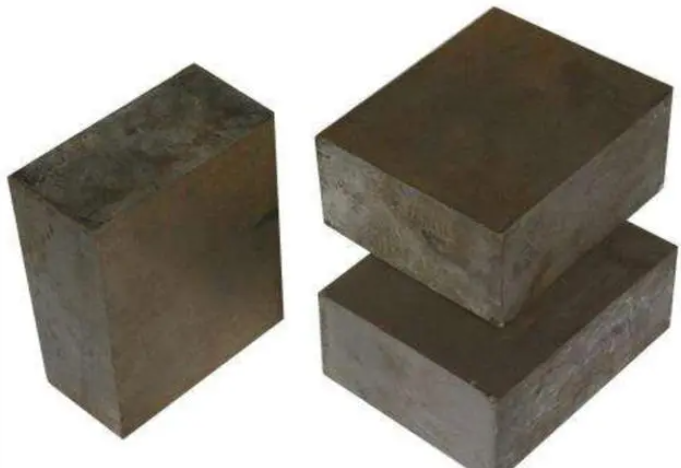
From the above data, it can be found that the relative flux loss measured in the first 6 years is basically not large, and there is an inflection point near 2208 days (about 6 years). From the appearance, rust spots can be seen on the surface of the black sheet magnet after being placed for 6 years, which means that the surface and interior of the small disc neodymium magnetst have begun to oxidize and corrode. As time goes by, the scope of oxidation or corrosion will continue to expand, and the rate of performance degradation will also accelerate significantly.
In addition, the experiment also extrapolates the flux loss from the currently measured 4441 days (12 years and 2 months) to 30-50 years. The flux loss is expected to be less than 1% in 30 years, about 1.3% in 50 years, and 2% corresponds to about 150 years. (Hollow dots in the figure above)
This result shows that if the service life of the magnet is defined as the time corresponding to the flux loss rate equal to 5%, even if the magnet is on the surface without corrosion-resistant coating, the sintered NdFeB small disc neodymium magnets currently measured still have a very long service life, conservatively estimated to be 30-50 years.
Usually, the larger flux loss comes from the oxidation or corrosion of the magnet surface, which is an irreversible loss. Among all kinds of rare earth permanent magnet materials, this loss of sintered NdFeB is the most serious. However, after component optimization and surface protection treatment, the oxidation resistance and corrosion resistance of sintered NdFeB small disc neodymium magnets have been greatly improved. Therefore, if the surface of the magnet is well protected, for sintered NdFeB with sufficiently high HcJ, the service life can exceed 30-50 years. (This is under the condition of not exceeding the operating temperature~)
Long-term stability at high temperatures
The following figure shows the change of relative flux loss over time for magnets with different Pc values and HcJ=20.1 kOe at 80℃, 120℃ and 150℃.

It is not difficult to find from the above figure that under the same Pc value, the higher the storage temperature of the small disc neodymium magnets, the faster the relative magnetic flux loss decreases. The initial magnetization loss and long-term magnetization loss of the small disc neodymium magnets with a lower absolute value of Pc are significantly greater than those of the magnet with a higher Pc, and both types of losses increase significantly with increasing temperature. When HcJ cannot be further increased due to technical and cost reasons, increasing the absolute value of Pc can effectively suppress the magnetization loss.

It is not difficult to find from the above figure that under the same Pc value, the higher the storage temperature of the small disc neodymium magnets, the faster the relative magnetic flux loss decreases. The initial magnetization loss and long-term magnetization loss of the magnet with a lower absolute value of Pc are significantly greater than those of the magnet with a higher Pc, and both types of losses increase significantly with increasing temperature. When HcJ cannot be further increased due to technical and cost reasons, increasing the absolute value of Pc can effectively suppress the magnetization loss.
The service life of small disc neodymium magnets (NdFeB magnets) can vary depending on several factors, including the environment they are used in, how they are handled, and their specific application. Here are some key factors that influence the service life of NdFeB small disc neodymium magnets:
1. **Corrosion Resistance**: NdFeB small disc neodymium magnets are prone to corrosion, especially when exposed to moisture or acidic environments. To improve their longevity, they are often coated with a protective layer (such as nickel, zinc, or epoxy) to prevent corrosion. The type and quality of this coating can significantly affect how long the magnet retains its magnetic properties.
2. **Operating Temperature**: The performance of NdFeB small disc neodymium magnets can deteriorate at high temperatures. Above a certain temperature (typically around 80-150°C depending on the grade), the magnetic properties can start to degrade. Special high-temperature grades are available for applications requiring magnets to operate in elevated temperatures.
3. **Mechanical Stress**: Excessive mechanical stress, such as impact or vibration, can cause physical damage to the small disc neodymium magnets or its coating, reducing its effectiveness over time.
4. **Demagnetization**: NdFeB small disc neodymium magnets can lose their magnetism over time due to factors such as exposure to strong opposing magnetic fields or improper handling during installation or use.
5. **Application Environment**: The environment in which the magnet is used plays a crucial role. For example, magnets used outdoors may experience greater exposure to humidity and temperature variations compared to those used indoors.
6. **Quality of Manufacturing**: The quality of the manufacturing process and the materials used can affect the consistency and durability of the small disc neodymium magnets.
Generally, if NdFeB magnets are properly handled, protected against corrosion, and used within their specified temperature and environmental limits, they can have a long service life. For critical applications, it’s advisable to consult with magnet suppliers who can recommend the most suitable grade and provide guidance on maximizing the small disc neodymium magnets’s longevity.
Small disc neodymium magnets are commonly used for various applications due to their strong magnetic properties and compact size. Here are some key points about them:
1. **Material**: Neodymium magnets are made from an alloy of neodymium, iron, and boron (NdFeB). They are known for their strong magnetic field.
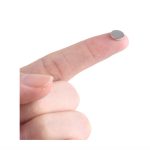
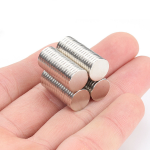
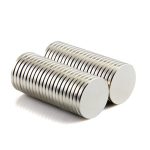
2. **Shape**: The disc shape refers to a round, flat magnet with a circular face.
3. **Size**: They come in various sizes, typically ranging from a few millimeters to a few centimeters in diameter, and are often quite thin relative to their diameter.
4. **Strength**: Despite their small size, neodymium magnets can have very strong magnetic fields, capable of lifting objects many times their own weight.
5. **Applications**: These magnets are used in a wide range of applications including:
– Holding objects in place (e.g., closures on doors or cabinets).
– Magnetic clasps for jewelry.
– Magnetic sensors.
– Hobby and craft projects.
– Magnetic therapy devices.
– Motors and generators.
– Magnetic stirrers in laboratories.
– Magnetic separation in industrial processes.
6. **Handling**: Due to their strong magnetic force, small disc neodymium magnets should be handled with care to avoid injury or damage to nearby electronics (such as credit cards, pacemakers) and to prevent pinching injuries.
7. **Availability**: They are widely available for purchase online and in specialty hardware stores, often sold in bulk quantities or specific grades depending on the required magnetic strength.
When purchasing these magnets, consider the specific size, strength (often denoted by the grade such as N35, N52, etc.), and intended application to ensure they meet your needs effectively.