


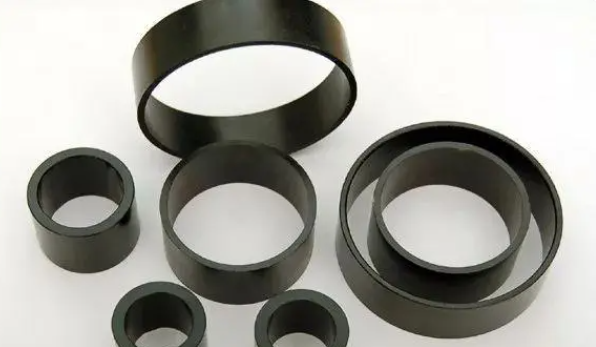
N52 Permanent Magnet
NdFeB permanent magnet products can be divided into sintered NdFeB, bonded NdFeB and hot pressed NdFeB N52 Permanent Magnets according to different production processes. Due to different production processes, they have great differences in product magnetic properties, post-processing and applications. In the early stage, we have made a systematic introduction to sintered NdFeB N52 Permanent Magnets. Next, we will introduce bonded and hot pressed NdFeB, as well as the comparison of the performance and application of the three different types of NdFeB products.

Bonded NdFeB N52 Permanent Magnets
Bonded magnets appeared around the 1970s, when SmCo had already been commercialized and the market for sintered NdFeB permanent N52 Permanent Magnets was very good. However, it was difficult to precisely process them into special shapes, and they were prone to cracking, breakage, edge loss, and corner loss during processing. In addition, they were not easy to assemble, which limited their application.
To solve this problem, the permanent N52 Permanent Magnets were crushed and mixed with plastics, and then pressed into shape in a magnetic field. This is probably the most primitive manufacturing method for bonded magnets. Bonded Nd-Fe-B magnets are widely used due to their low cost, high dimensional accuracy, large shape freedom, good mechanical strength, and light weight.
1. Production process:
Bonded NdFeB is a mixture of permanent magnet powder and rubber or hard and light plastic and other bonding materials, and is directly formed into permanent magnet parts of various shapes according to user requirements.
The preparation of magnetic powder is a key process in processing NdFeB N52 Permanent Magnets, and the quality of magnetic powder directly affects the magnetic properties of permanent magnets. The methods for preparing Nd-Fe-B magnetic powder include mechanical crushing, melt rapid quenching, HDDR, gas spraying and mechanical alloying.
The current mainstream process uses the HDDR method, which is a process of hydrogenation-decomposition-dehydrogenation-recombination to prepare high-performance rare earth permanent magnet powder: first, the alloy is crushed into coarse powder, loaded into a vacuum furnace, and crystallized at a certain temperature.
The alloy absorbs hydrogen and undergoes a disproportionation reaction, and then the hydrogen is extracted to re-combine it into rare earth permanent magnet powder with extremely small grains. This method can obtain fine grains with an average particle size of 0.3μm N52 Permanent Magnets, thereby obtaining magnetic powder with high coercivity.
There are currently four processes for the compression molding of bonded NdFeB: calendering, injection molding, extrusion molding and compression molding, among which calendering and injection molding are more mainstream.
Calendering is to mix magnetic powder and binder evenly in a certain volume ratio, roll them into the required thickness and then cure them to make finished products. Generally, ethylene resin and nitrile rubber are used as adhesives, and the surface of the product needs to be protected by coating.
Injection molding is to mix magnetic powder with binder (thermoplastic resin), heat and mix, granulate, dry, and then send them to the heating chamber for heating through a spiral guide rod, inject them into the mold cavity at a certain speed, and get the finished product after cooling. Due to the high resin content, a protective film can be formed on the surface of the magnet. Generally, no surface anti-corrosion treatment is required unless there are high requirements for surface anti-corrosion ability N52 Permanent Magnets.
Extrusion molding is basically the same as injection molding. The only difference is that the heated pellets are squeezed into the mold through a hole for continuous molding.
Compression molding is to mix magnetic powder and binder in proportion, granulate and add a certain amount of coupling agent, press molding in the mold, and cure at 120°~150° to finally get the finished product N52 Permanent Magnets.

2. Product performance
Adding adhesive, the magnetic properties are lower than sintered NdFeB: Bonded NdFeB magnets are made by bonding magnetic powder into large magnets with adhesives, and their density is generally only 80% of the theoretical density. Sintered N52 Permanent Magnets are made by heating at high temperatures through complex processes, so in terms of magnetic properties, bonded NdFeB is weaker than sintered NdFeB.
In addition, the national standard for bonded NdFeB permanent magnet materials is GB/T 18880-2012, which you can also refer to. If you need an electronic version, you can leave a message to the Emperor of Magnetism in the background of the official account.
High product precision and large degree of freedom in shape: Sintered N52 Permanent Magnets are produced by powder sintering. Generally, only blanks can be produced after sintering, and then they can be made into magnets of various shapes after mechanical processing (such as wire cutting, slicing, grinding, etc.).
Compared with sintered NdFeB, the production process of bonded NdFeB permanent magnets is simpler, and no secondary processing is required. Its product size accuracy is high and does not deform; at the same time, the degree of freedom in shape is large, and various shapes of products can be manufactured according to actual use needs, such as long strips, sheets, tubes, rings or other complex shapes, which is convenient for mass automated production and has high mechanical strength.
Isotropic magnets are easy to magnetize in any direction: Bonded NdFeB N52 Permanent Magnets are an isotropic magnet with the same magnetic properties in all directions, so it is convenient to make multi-pole or even countless-pole integral magnets, which is usually difficult to achieve for sintered magnets.
3. Product Application
The magnetic properties of bonded NdFeB magnets are inferior to those of sintered NdFeB, but because of its convenience in manufacturing multi-level magnetized ring N52 Permanent Magnets, excellent performance consistency and uniformity, and easy integration with other metal or plastic parts, it has much higher magnetic properties than bonded ferrites and is widely used in various micro motors and sensor systems. The specific uses of bonded NdFeB can be divided into:
Digital products: hard disk drive magnets (HDD)-this is currently the largest application area of bonded NdFeB
Office OA products: transmission motors for printers, motors for scanners, synchronous advance motors (STP) for copiers, magnetic rollers for laser printers, etc.
Automotive motors and magnetic sensor products: including EPS power steering sensor magnets, wiper motors, window motors, seat adjuster motors, etc.
Other types of industrial and household motors: mainly including various types of servo motors, motors for power tools, air conditioning refrigeration motors, etc.
Due to the huge differences in magnetic properties and molding, the intersection of bonded NdFeB and sintered NdFeB is not large.
Bonded NdFeB is mainly used in hard disk optical drive spindle motors and small power micro motors, while sintered NdFeB is more used in high power drive motors and other fields.
The magnetism of sintered NdFeB materials mainly comes from its easily magnetized crystal structure. It can obtain extremely high magnetism under the action of a strong external magnetic field, and its magnetism will not disappear after the external magnetic field disappears. Therefore, “magnetization” is a key step for sintered NdFeB materials to obtain magnetism. In the production and preparation process of sintered NdFeB materials, magnetization is the last step before the delivery of the finished product, but the magnetic field orientation of the NdFeB blank has been determined when the magnetic powder is pressed into a blank, that is, the future magnetization direction.

Magnetic field orientation
Magnetic materials are divided into two categories: isotropic magnets and anisotropic magnets. Isotropic magnets have the same magnetic properties in any direction and can be attracted together at will; anisotropic magnets have different magnetic properties in different directions, and the direction that can obtain the best magnetic properties is called the orientation direction of the N52 Permanent Magnets. For a square sintered NdFeB magnet, only the orientation direction has the largest magnetic field intensity, and the magnetic field intensity in the other two directions is much smaller.
If the magnetic material has an orientation process during the production process, it is an anisotropic magnet. Sintered NdFeB is generally formed and pressed by magnetic field orientation, so it is anisotropic. Therefore, it is necessary to determine the orientation direction before production, that is, the future magnetization direction. Powder magnetic field orientation is one of the key technologies for manufacturing high-performance NdFeB. (Bonded NdFeB can be isotropic or anisotropic)
Magnetization direction and method
Magnetization is the process of applying a magnetic field to the sintered NdFeB permanent magnet along the magnetic field orientation direction, gradually increasing the magnetic field strength to reach the technical saturation state.
Sintered NdFeB generally has several forms such as square, cylindrical, annular, and tile-shaped. Next, let’s talk about their respective magnetization directions.
In addition to the above-mentioned ordinary single-pole magnetization, sintered NdFeB can also be multi-pole magnetized according to actual needs, that is, multiple N and S poles can be presented on one plane after magnetization N52 Permanent Magnets. Due to the use of specially designed specifications and pole head magnetization fixtures, additional magnetization fixture costs will be incurred.
The magnetizer is a tool for magnetizing and magnetizing magnetic materials or magnetic device magnets. It applies a magnetic field to the NdFeB products that need to be magnetized N52 Permanent Magnets. If the magnetized magnetic field does not reach the technical saturation magnetic field, the remanence Br and intrinsic coercive force Hcj of the permanent magnet will not reach the expected values.
Magnetizer, picture from the Internet
So how to determine the energy of the magnetizer? First, according to the size of the magnetized product magnet and the magnetization direction, determine the size of the magnetizing tooling, and then calculate the size of the magnetic field at the center of the tooling. The size of the tooling magnetic field should be 3-5 times the coercive force of the magnet. Then calculate the magnetizing current N52 Permanent Magnets, determine the energy storage capacitor capacity of the magnetizer according to the current and the voltage of the magnetizer, and finally determine the energy of the magnetizer.
The basic principle of magnetization is to place the magnetic object to be magnetized in the magnetic field formed by the coil with direct current passing through. There are two main methods: DC magnetization and pulse magnetization. We will talk about the technical details later.