



When the magnetic field changes in the order of Hm→Hc→O→-Hc→-Hm→-Hc→O→Hc→Hm, the corresponding magnetic induction B changes along a closed curve, which is called a hysteresis loop (blue in the figure above) color curve)
initial magnetization curve
The origin 0 in the figure means that the hard magnetic substance is in a magnetically neutral state before magnetization, that is, B=H=0. When the magnetic field H increases from zero, the magnetic induction B increases slowly, as shown by the line segment Oa, followed by B With the rapid increase of H, as shown in ab, the growth of B tends to slow down, and when H increases to Hm, B reaches the saturation value Bm. This red curve is called the initial magnetization curve.
Hysteresis
When the magnetic field gradually decreases from Hs to zero, the magnetic induction intensity B does not return to the “0” point along the initial magnetization curve, but decreases along another new curve Sr. Comparing the line segments OS and Sr, it can be known that H decreases B correspondingly It also decreases, but the change of B lags behind the change of H. This phenomenon is called hysteresis. The obvious feature of hysteresis is that when H=0, B is not zero, but the remanence Br is retained.
Demagnetization curve
When the magnetic field reverses gradually from O to -Hc, the magnetic induction intensity B disappears, indicating that to eliminate the remanence, a reverse magnetic field must be applied. Hc is called the coercive force, and its size reflects the ability of the magnetic material to maintain the remanence state. The purple line is called the demagnetization curve.
basic magnetization curve
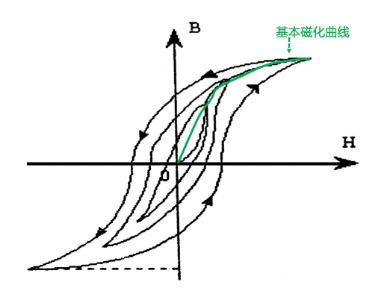
Repeated magnetization of the same ferromagnetic material with different magnetic field strengths H can obtain multiple hysteresis loops of different sizes, as shown in the figure below. Connecting the vertices of the hysteresis loops, the obtained curve is called the basic magnetization curve or the average magnetization curve. The basic magnetization curve and the initial magnetization curve are not a line, but there is little difference between the two. The magnetization curve used in the calculation of the DC magnetic circuit is the basic magnetization curve.
Intrinsic curve
The intrinsic magnetic induction intensity generated by the permanent magnetic material after being magnetized under the action of an external magnetic field is called the intrinsic magnetic induction intensity Bi, also known as the magnetic polarization J. The curve describing the relationship between the intrinsic magnetic induction intensity Bi (J) and the magnetic field intensity H is the curve that F reflects the intrinsic magnetic properties of the permanent magnet material, which is called the intrinsic demagnetization curve, or the intrinsic curve for short.
When the magnetic induction intensity B on the intrinsic demagnetization curve is 0, the corresponding magnetic field intensity is called the intrinsic coercive force Hcj. The value of the intrinsic coercive force reflects the anti-demagnetization ability of the permanent magnet material.
The squareness or squareness of the intrinsic demagnetization curve we often hear refers to the ratio of Hk to Hcj in the intrinsic curve. The larger the ratio, the shorter the orange line on the graph, the more stable the magnetic properties. Hk is the value of the demagnetization magnetic field intensity corresponding to Bi=0.9Br on the intrinsic demagnetization curve, and it is one of the parameters that must be measured for permanent magnet materials.
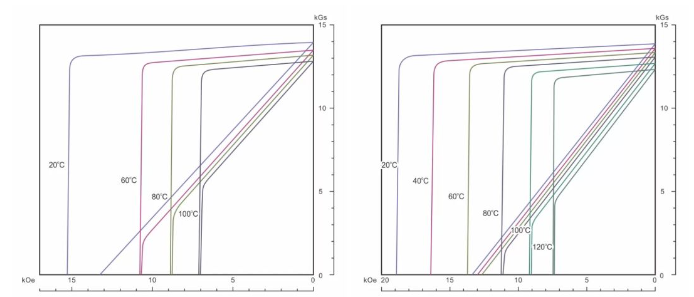
Generally speaking, manufacturers of permanent magnet materials will provide the demagnetization curves of various brands of products at different operating temperatures, as shown in the figure below. It seems complicated, but the essence is to put multiple demagnetization curves and intrinsic curves on one graph.
Main parameters of permanent magnet materials
The shape and characteristics of the hysteresis curve of permanent magnet materials can be expressed by several parameters. In practical applications, magnetic materials can be classified according to the differences in the number of these parameters and their uses can be determined. These parameters are also the main parameters in magnetic circuit design. in accordance with.
1. Saturation magnetic field strength Hm
During the magnetization process of magnetic materials, the magnetic field strength whose induction intensity B reaches the saturation value Bm is called the saturation magnetic field intensity Hm. The magnetic material should be fully magnetized during magnetization, that is, the magnetization magnetic field strength H should reach the value of Hm, in order to obtain the maximum possible magnetization demagnetization curve. Such a demagnetization curve is the most stable and can show the optimal magnetic properties of the material. If the magnetizing magnetic field strength H is lower than the value of Hm, there will be hysteresis curves of different shapes, the demagnetization curve will be unstable, and the magnetic performance of the magnet will be low.
It can be seen that the Hm value of the magnetic material used should be known in the production process of the magnetic material, and the magnetic field must reach or even exceed this value during the magnetization process.
2. Residual magnetic induction Br
The intersection point of the hysteresis curve and the ordinate axis, that is, the B value of the starting point of the demagnetization curve, is called the residual magnetic induction intensity, referred to as the residual magnetism, and is represented by Br. It is the magnetic induction value in the magnet after the magnetic material is removed from the external magnetic field.
3. Magnetic induction coercive force Hc
Under the action of a negative magnetic field, the magnetic induction B in the magnet decreases with the increase of the demagnetizing magnetic field. The demagnetization magnetic field intensity required to make the magnetic induction intensity B in the magnet reach zero is called the magnetic induction coercive force, or coercive force for short, expressed by Hc or Hcb.
4. Magnetic permeability
The slope of any point on the initial magnetization curve and the hysteresis curve, that is, the ratio of the increments of B and H at any point, is called the magnetic permeability, and it varies with the operating point. The magnetic permeability of soft magnetic materials is large, while the magnetic permeability of permanent magnetic materials/hard magnetic materials is small.
Generally speaking, the smaller the ratio of residual magnetic induction Br to coercive force Hc, the smaller the magnetic permeability. For permanent magnets, people usually care about the three quantities of initial permeability, maximum permeability and reversible permeability, which will be explained in detail in the near future.
It can be said that the magnetization curve and hysteresis loop are the main basis for the classification and selection of magnetic materials. The following figure shows several typical hysteresis loops.
The magnetic energy product at a certain position in the middle of the demagnetization curve reaches the maximum value, which becomes the maximum magnetic energy product (BH) max. For the permanent magnet material whose demagnetization curve is a straight line, the magnetic energy product is the largest at (Br/2, Hc/2).
The application range of magnets is extremely wide, such as signal sensors on automobile distributors, speed sensors in ABS systems, automobile speedometers and odometers, liquid physical quantity detectors, current detection and working state diagnosis of various electrical loads, engine speed And crankshaft angle sensor, various switches, etc.
Since the advent of NdFeB permanent magnet materials, it has attracted much attention due to its superior magnetic properties. promote.
NdFeB strong magnetism, as the name implies, is a magnetic material made of rare earth metal neodymium, pure iron and boron using powder metallurgy technology. In order to further improve the magnetic properties of NdFeB, it can be based on the ternary system Nd-Fe-B Further add other elements, but the influence of the addition of elements on the performance of the magnet may be two-way, and the addition of elements should be determined according to the specific requirements of the magnetic material performance in the application of what is a ndfeb magnet strong magnetism.
Related Products