

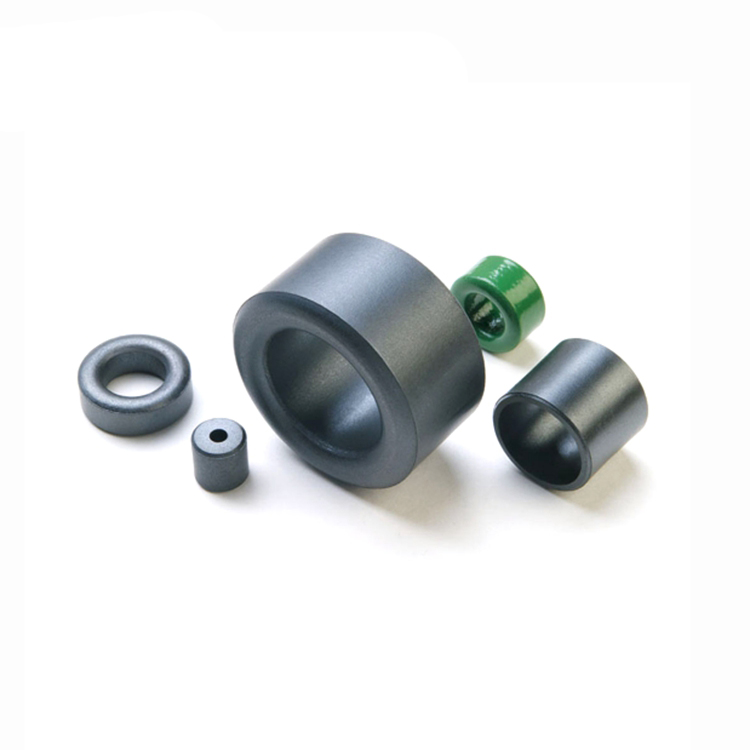




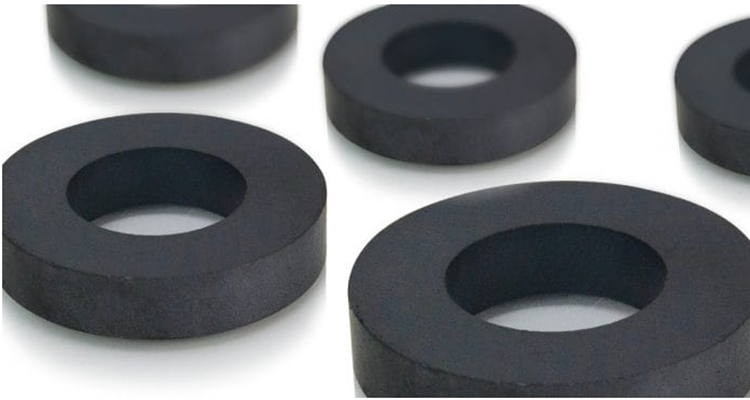
The process of making ferrite magnets, also known as ceramic magnets, is not as expensive or complicated as producing rare earth neodymium magnets.
The compound of ferrite magnets is SrO-6 (Fe2O3), a combination of strontium carbonate and iron oxide. Due to their chemical composition, this means they are extremely resistant to demagnetization from heat and corrosion, although they are very hard and brittle like neodymium magnets.
Ceramic magnets, also known as ferrite magnets, are made from a mixture of iron oxide (Fe₂O₃) and either barium carbonate (BaCO₃) or strontium carbonate (SrCO₃). The process of making ceramic magnets involves several key steps:
-
Raw Material Preparation
The primary ingredients, iron oxide and either barium or strontium carbonate, are carefully measured and mixed.
The mixture is then pre-fired at a high temperature (typically around 1000°C or 1832°F) to form a solid intermediate compound.
-
Milling
The pre-fired material is ground into a fine powder using a ball mill to ensure a uniform particle size.

-
Forming (Pressing or Extruding)
The fine powder is compacted into the desired shape using a pressing method.
Dry pressing: The powder is pressed into a mold under high pressure.
Wet pressing: The powder is mixed with water or a binder to form a slurry and then pressed into a mold.
An external magnetic field may be applied during this process to align the magnetic domains for better performance.
-
Sintering (Firing)
The shaped material is placed into a high-temperature furnace (between 1100°C and 1300°C or 2012°F to 2372°F) and sintered for several hours.
This process fuses the particles together and gives the magnet its hard, brittle structure.
-
Cooling and Machining
After sintering, the material is cooled slowly to prevent internal stress.
Because ceramic magnets are very brittle, they are ground or cut into the final shape using diamond-coated tools.
-
Magnetization
The final step is magnetization, where a strong external magnetic field is applied to the ceramic material, aligning the magnetic domains permanently.
-
Quality Control and Coating (if needed)
The finished magnets are tested for strength and consistency.
Some may receive a protective coating (such as epoxy) to enhance durability.
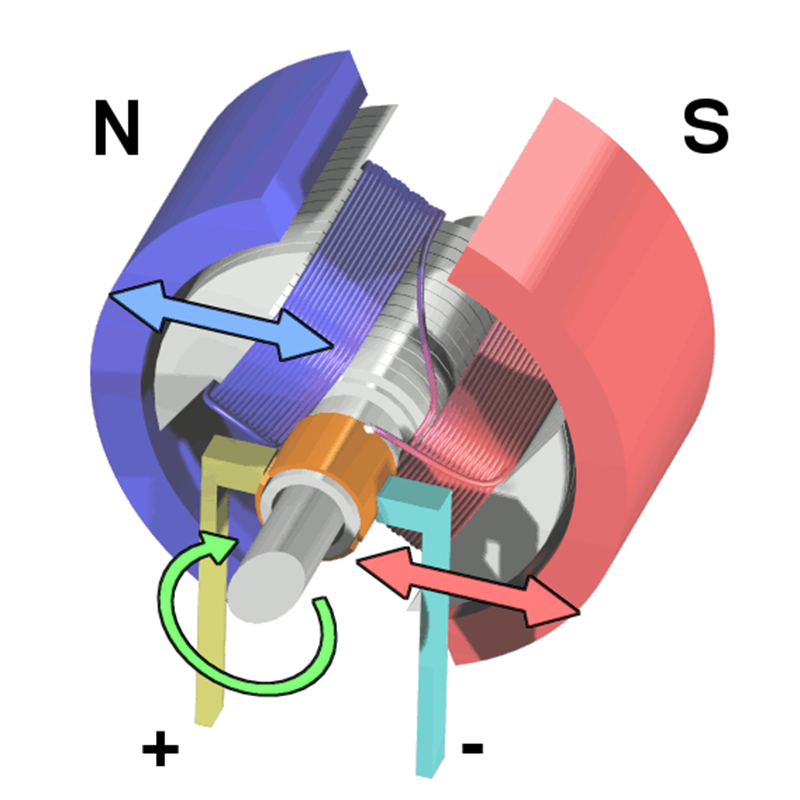
Ceramic magnets are widely used in motors, speakers, refrigerator magnets, and industrial applications due to their affordability, corrosion resistance, and high-temperature stability.