


Production of SmCo Magnets
Production of Samarium Cobalt (SmCo) Magnets
Samarium Cobalt (SmCo) magnets are rare-earth permanent magnets known for their high temperature resistance, strong magnetic properties, and corrosion resistance. They are produced using either the sintering or bonded magnet process, with sintering being the most common.
- Raw Material Preparation
The main elements are Samarium (Sm) and Cobalt (Co), often with small amounts of iron (Fe), copper (Cu), and zirconium (Zr) to enhance performance.
The materials are weighed and mixed according to the desired SmCo magnet grade (SmCo₅ or Sm₂Co₁₇).
- Melting & Alloy Formation
The mixture is melted in a vacuum induction furnace (VIM) at 1300–1600°C (2372–2912°F) to form a homogeneous SmCo alloy.
The molten alloy is then rapidly cooled (strip casting) to create a fine-grain structure.
- Powdering (Milling & Crushing)
The cast SmCo alloy is crushed into fine particles using jet milling or ball milling.
The particle size is carefully controlled to optimize magnetic performance and sintering efficiency.
- Pressing & Compaction
The powdered material is pressed into shape using either:
Die Pressing – Uses a steel mold to form simple shapes.
Isostatic Pressing – Uses hydraulic pressure to ensure uniform density.
An external magnetic field is often applied during pressing to align the particles for better magnetic properties (anisotropic magnets).
- Sintering & Heat Treatment
The pressed SmCo magnets are heated in a vacuum or inert gas furnace at ~1100-1250°C (2012-2282°F).
A slow cooling process follows to improve crystal structure and magnetic alignment.
Further heat treatments at lower temperatures (~800°C / 1472°F) enhance mechanical and magnetic properties.
- Machining & Grinding
SmCo magnets are brittle and hard, requiring diamond grinding tools to achieve precise shapes and tolerances.
Standard shapes include discs, blocks, rings, and arcs.
- Magnetizzazione
The final step involves exposing the magnets to a strong magnetic field (~3 Tesla or more).
Once magnetized, SmCo magnets retain their magnetic properties permanently.
- Coating & Finishing (Optional)
SmCo magnets are naturally corrosion-resistant, but coatings like nickel, epoxy, or parylene may be applied for additional protection in extreme environments.
Key Features of SmCo Magnets:
✔ High magnetic strength (second only to neodymium magnets).
✔ Excellent temperature resistance (up to 350°C / 662°F).
✔ Corrosion-resistant (no coating needed in most cases).
✔ Brittle and fragile, requiring careful handling.

Types of Samarium Cobalt Magnets
- SmCo₅ (Samarium Cobalt 1:5) Magnets
Composition:
Samarium (Sm): ~37%
Cobalt (Co): ~63%
Key Features:
✔ Moderate magnetic strength (lower than Sm₂Co₁₇ but still strong).
✔ Easier to magnetize than Sm₂Co₁₇ (requires a lower external magnetic field).
✔ Good temperature resistance (up to 250°C / 482°F).
✔ Excellent corrosion resistance (no coating needed in most applications).
✔ More machinable than Sm₂Co₁₇, though still brittle.
Common Applications:
Sensors & Motors – Used in precision instruments requiring stable magnetic performance.
Medical Devices – Preferred where corrosion resistance is essential.
Military & Aerospace – Used in extreme environments due to its stability.
- Sm₂Co₁₇ (Samarium Cobalt 2:17) Magnets
Composition:
Samarium (Sm): ~25%
Cobalt (Co): ~50%
Other elements (Fe, Cu, Zr, Hf): ~25% (added for improved properties)
Samarium Cobalt Magnets vs. Neodymium Magnets
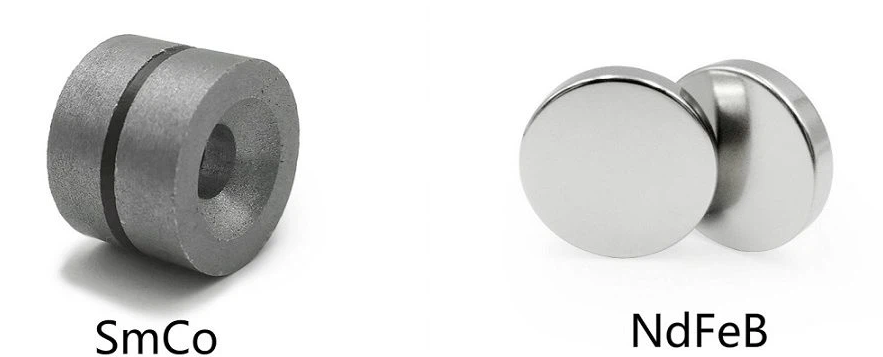
Samarium Cobalt (SmCo) and Neodymium Iron Boron (NdFeB) magnets are both rare-earth permanent magnets renowned for their strong magnetic properties. However, they exhibit distinct characteristics that make them suitable for different applications. Here’s a comparative overview:
Ideal Magnet Solutions
Forza magnetica
Neodymium Magnets: These are the strongest permanent magnets available, offering superior magnetic strength at room temperature.
Ideal Magnet Solutions
Samarium Cobalt Magnets: While powerful, SmCo magnets generally have a lower magnetic strength compared to neodymium magnets.
stanfordmagnets.com
Temperature Resistance
Neodymium Magnets: Their magnetic strength decreases rapidly as temperature rises, making them less suitable for high-temperature applications.
Ideal Magnet Solutions
Samarium Cobalt Magnets: They withstand higher temperatures without significant loss of magnetic properties, making them ideal for applications exposed to extreme heat, such as aircraft engines and industrial ovens.
stanfordmagnets.com
Resistenza alla corrosione
Neodymium Magnets: Due to their high iron content, they are prone to oxidation and corrosion and typically require protective coatings like nickel or epoxy.
stanfordmagnets.com
Samarium Cobalt Magnets: They are highly resistant to corrosion and generally do not require additional coatings, making them suitable for harsh environments, including underwater devices.
stanfordmagnets.com

Costo
Neodymium Magnets: Generally more affordable, offering a good value relative to their performance.
albmagnets.com
Samarium Cobalt Magnets: Typically more expensive due to the high cost of cobalt and their complex manufacturing process.
Mechanical Properties
Neodymium Magnets: They are less brittle than SmCo magnets, making them easier to machine and integrate into assemblies.
albmagnets.com
Samarium Cobalt Magnets: These magnets are more brittle, requiring careful handling and specialized machining techniques.
albmagnets.com
Summary
Property Neodymium Magnets (NdFeB) Samarium Cobalt Magnets (SmCo)
Magnetic Strength Higher Lower
Temperature Resistance Lower Higher
Corrosion Resistance Lower (requires coating) Higher (no coating needed)
Costo
Lower Higher