






Electro Permanent Magnet
According to the characteristics of the material in the external magnetic field, the material can be divided into five categories: paramagnetic material, diamagnetic material, ferromagnetic material, ferrimagnetic material and antiferromagnetic material. Ferromagnetic material electro permanent magnet is a material that can maintain its magnetized state even if the external magnetic field disappears after being magnetized under the action of an external magnetic field. The basic characteristics of ferromagnetic material are the spontaneous magnetization and magnetic domain structure inside the material.
Magnetic domain theory is the basis of modern magnetization theory. Almost all magnetic applications use domains as the basic unit, rather than an electron spin as a unit. The discussion of magnetic moments in magnetism is based on domains; but magnetic domains are something that we cannot see with our naked eyes, so it is a bit difficult to understand and recognize. Today, I will take you to understand what magnetic domains are.
1. Formation of magnetic domains
We all know that ferromagnetic materials do not show magnetism to the outside before they are magnetized. This is because below the Curie temperature, a magnetic domain structure electro permanent magnet will be formed in a large piece of ferromagnetic crystal. The spontaneous magnetization inside each magnetic domain is uniform, but the spontaneous magnetization directions between different magnetic domains are different, the magnetic moments cancel each other out, and the vector sum is zero. Therefore, ferromagnets do not show magnetism on a macro scale.

Magnetic domains are small magnetized areas with different directions that are differentiated in the process of spontaneous magnetization of ferromagnetic materials in order to reduce static magnetic energy. Each area contains a large number of atoms. The magnetic moments of these atoms electro permanent magnet are neatly arranged like small magnets, but the directions of the atomic magnetic moments between adjacent different areas are different. The interface between each magnetic domain is called a magnetic domain wall.
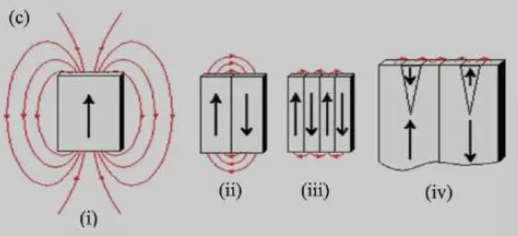
The formation of magnetic domains can be simply understood as reducing the magnetic dipole energy carried by the stray field that fills the external space, that is, the demagnetization energy. The following figure c-i is a single-domain magnet with a wide distribution area of stray fields.
In order to weaken this area, the magnetic moment will spontaneously redistribute inside the magnet to form magnetic domains. The most intuitive redistribution is to form two upper and lower domains as shown in figure c-ii, and the stray field can be greatly weakened. If four upper and lower domains are further formed, as shown in figure c-iii, the stray field will be further weakened.
However, this process will in turn increase the static magnetic exchange energy, which can be roughly understood as domain wall energy. The final shape and size of the magnetic domain are the electro permanent magnet of the competition between magnetic dipole energy and exchange energy. If the size and appearance of the ferromagnetic sample change, the morphology of the magnetic domain will have rich manifestations, such as forming a domain structure like Figure c-ⅴ.

2. Magnetic domain wall
The boundary between magnetic domains is called a magnetic domain wall. The magnetic domain wall with opposite magnetic moments of atoms in adjacent magnetic domains (the angle between magnetic moments is 180°) is called a 180° domain wall; the magnetic domain wall with perpendicular magnetic moments of atoms in adjacent magnetic domains is called a 90° domain wall.
The thickness of the magnetic domain wall is several atoms, and the thickness of the magnetic domain wall of different materials is different.
The magnetic domain wall is a transition zone with a certain thickness. The magnetization direction of the magnetic domain electro permanent magnet cannot suddenly turn a large angle at the domain wall, but gradually turns through a certain thickness of the domain wall, that is, in this transition zone, the atomic magnetic moment gradually changes direction. The energy inside the domain wall is always higher than the energy inside the domain.
3. Technical magnetization process
To distinguish the spontaneous magnetization in the magnetic domain of ferromagnets or ferrimagnets, we call the magnetization of ferromagnets or ferrimagnets in a magnetic field technical magnetization.
We all know that the technical magnetization curve (M~H curve) of ferromagnetic or ferrimagnetic materials is nonlinear, with the ordinate being the magnetization intensity M and the abscissa being the magnetic field intensity H. Assume that a electro permanent magnet has two magnetic domains:
When the magnetic field is zero, the number of atomic magnetic moments in the upper and lower domains is equal and opposite, the vector sum of the atomic magnetic moments is zero, and the magnetization intensity of the material is zero. As shown in Figure (a)

When the magnetic field H1 is applied along the positive direction of the horizontal axis, the angle θ between the magnetic moment M of the upper magnetic domain and the external magnetic field is less than 90° electro permanent magnet, the static magnetic energy is low and relatively stable; while the angle θ between the magnetic moment M of the lower magnetic domain and the external magnetic field is greater than 90°, the static magnetic energy is high and relatively unstable.
Therefore, under the action of the external magnetic field H1, the upper magnetic domain will expand and the lower magnetic domain will shrink, that is, the 180° domain wall is displaced in the direction of the arrow as shown in Figure (b), resulting in an increase in magnetization along the direction of the magnetic field electro permanent magnet, and the displacement speed of the 180° domain wall may be very fast, and the ab segment of the M~H magnetization curve becomes very steep.

When the external magnetic field increases to a large HR, that is, point c in the figure, the domain wall displacement has ended, the 180° domain wall has been driven out of the magnet, and the entire magnet becomes a single domain body electro permanent magnet. The atomic magnetic moment still remains in the direction of the original magnetic moment of the upper magnetic domain, as shown in Figure (c). The technical magnetization process from point a to point c is the process of domain wall displacement.

When the external magnetic field gradually increases from the HR point to the HS point, that is, from point c to point d, the atomic magnetic moment gradually rotates in the same direction as the external magnetic field, as shown in Figure (d). When the external magnetic field increases to the HS point, the atomic magnetic moment has basically rotated to a direction parallel to the external magnetic field.
At this time, the magnet has reached the technical magnetization saturation state, and the magnetization intensity at this time is called the saturation magnetization intensity. The technical magnetization process is basically achieved by two methods: domain wall displacement and magnetic moment rotation.

If the external magnetic field is reduced to zero, the atomic magnetic moment will gradually move to the long axis direction, as shown in Figure (e). This process is the process of magnetic moment rotation. It can be seen that the magnetization intensity does not decrease to zero after the external magnetic field is removed. In the positive direction of the magnetic field, the magnetization intensity still retains the Mr value, which is called the residual magnetization intensity.

A magnetic domain is a region within a magnetic material where the magnetic moments of atoms are aligned in a common direction. In simpler terms, it’s a small region within a material where all the magnetic fields of the atoms are pointing in the same direction, creating a localized magnetic field.
Here are some key points about magnetic domains:
Natural State: electro permanent magnet In an unmagnetized material, magnetic domains are randomly oriented, canceling out each other’s magnetic fields, resulting in little to no electro permanent magnet net magnetization at the macroscopic scale.
Magnetization: When an external magnetic field is applied to the material, the domains align their magnetic moments in the direction of the applied field. This alignment increases the material’s overall magnetization.
Size and Structure: Magnetic domains can vary in size depending on the material and its properties. Typically, they range from nanometers to micrometers in size. The boundaries between adjacent domains are called domain walls.
Role in Magnetism: The behavior of magnetic domains determines many magnetic properties of materials, such as coercivity (resistance to demagnetization), remanence (remaining magnetization after removing the external field), and magnetic permeability (ability to conduct magnetic flux).
Domain Wall Dynamics: The movement of domain walls is significant in processes like magnetization reversal, where domains reorient to align with a changing magnetic field electro permanent magnet. Understanding domain wall dynamics is crucial for designing magnetic materials and devices.
Applications: Knowledge of magnetic domains is essential in various technologies, including magnetic data storage (like hard drives), magnetic sensors, and magnetic memory devices.
In summary, magnetic domains are fundamental units in understanding the behavior of magnetic materials electro permanent magnet. Their ability to align and realign in response to external fields plays a critical role in the functionality and applications of magnets in technology and industry.
A magnetic domain is a region within a magnetic material where the magnetic moments of atoms or ions are aligned in the same direction electro permanent magnet, creating a localized magnetic field. These domains are characterized by having a uniform magnetization vector within the region, meaning all the atomic magnetic moments point in a specific orientation.
Here are some key aspects of magnetic domains:
Formation and Structure:
In an unmagnetized state, magnetic domains within a material have randomly oriented magnetic moments electro permanent magnet. This random orientation cancels out any macroscopic magnetic effect, resulting in no net magnetic field electro permanent magnet.
When an external magnetic field is applied to the material, the domains begin to align their magnetic moments with the applied field direction. As the external field increases, more domains align, increasing the material’s overall magnetization.
Size and Characteristics:
Magnetic domains typically range in size from nanometers to micrometers, depending on the material and its properties electro permanent magnet. The size of the domains is influenced by factors such as the material’s composition, crystal structure, and external conditions (e.g., temperature).
Domain walls are the boundaries between adjacent magnetic domains where the orientation of magnetic moments changes gradually from one domain to another. These walls play a crucial role in the dynamics of magnetization processes and magnetic behaviors of materials.
Behavior and Dynamics:
The movement and interaction of magnetic domains are fundamental to understanding magnetic phenomena such as magnetization, coercivity, remanence, and magnetic hysteresis.
Domain wall dynamics, including their motion and interaction with defects or boundaries in the material, determine how easily a material can be magnetized or demagnetized and affect its magnetic stability.
Technological Applications:
Understanding and controlling magnetic domains is crucial for various technological applications:
Magnetic Data Storage: Magnetic domains are used to encode information in magnetic storage devices like hard disk drives and magnetic tapes electro permanent magnet.
Magnetic Sensors: Devices such as magnetic field sensors and magnetometers rely on the interaction between external magnetic fields and magnetic domains.
Magnetic Memory Devices: Emerging technologies like spintronics and magnetic random-access memory (MRAM) utilize magnetic domains for storing and retrieving data.
In summary electro permanent magnet, magnetic domains are foundational to the behavior and applications of magnetic materials. Their ability to align and reorient in response to external fields underpins the functionality of magnetic devices and technologies across multiple industries.