Halbach Arrays: Everything You Need to Know
A Halbach array: what is it? What are some uses for Halbach arrays? How do electric engines use the Halbach Array? And how are magnetic bearings used with the Halbach Array? You’ve come to the correct spot if you’re searching for answers to the questions mentioned above. We will cover all the essential information about Halbach Array in this essay.Cluster of Halbach
Un réseau Halbach, c'est quoi ?
A particular configuration of several permanent magnets is known as a Halbach array. A spatially moving magnetic pattern in the array eliminates the field on one side while boosting it on the other. The main benefits of Halbach Arrays are that they can generate powerful
while producing a very tiny errant field on the other side, magnetic fields on one side. The magnetic flux pattern can be observed to better understand this impact.
What are some uses for Halbach arrays?
• Halbach Arrays are naturally weight-efficient • Arrays provide greater fluxes than monolithic magnets of the same size. • One-sided flux is helpful in many uses, including data protection, transit, and motor design.
Halbach Arrays are now used in a variety of systems with different degrees of intricacy and have a wide range of uses. In refrigerator magnets, Halbach Arrays are used in one of the most basic ways. In this instance, the magnet’s holding strength is increased by taking advantage of the one-sided flux characteristics. Simple locking devices can also be made by combining adjustable groups of rod magnets.
The flux confinement can be reversed by rotating each rod magnet by 90 degrees if the magnetizations of the rods are organized so that the field is maximum above the plane and reduced below it.
The use of a Halbach Array in a Maglev railway track or Inductrack, where magnetic levitation is used to sustain the carriage, is a more sophisticated version. The train is raised a short distance above the track by the magnetic bands, which can sustain weights up to 50 times that of the magnet. The process is based on the induction principle; as the array is moved over the coils of a steel track, changes in the magnetic field cause a voltage to be induced in the track. The railway then develops a magnetic field of its own and,
Repulsion makes the train rise when this field aligns with the field generated by the Halbach Array, much like when you try to press the two like poles of neodymium bar magnets together.
Halbach arrays, also referred to as Halbach “wigglers,” are employed in cutting-edge science studies carried out in synchrotrons and free-electron lasers. FELs are used in a variety of fields, from the medical to the military, and have an extremely broad and highly adjustable frequency range.
Halbach range
What role does the Halbach Arrangement play in electric motors?
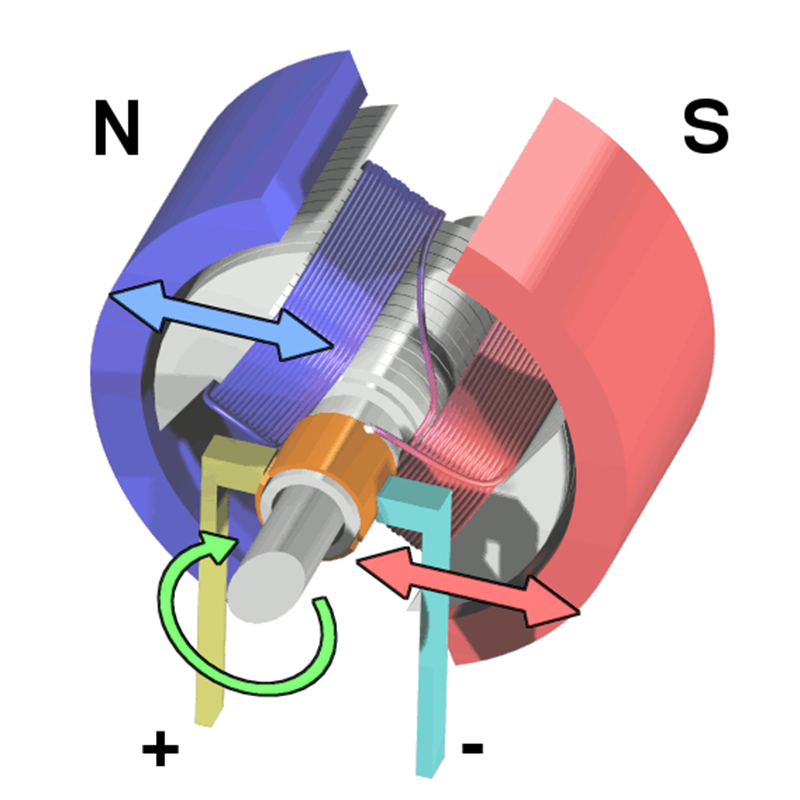
The Halbach Array machine would literally resemble a DC machine in a normal machine arrangement, with the armature mounted on the rotor and the field remaining stationary. A device like that could be used in either
The device might be categorized as an AC generator if slip rings are used to draw the windings out. However, the Halbach Array machine can now be referred to as a DC machine if an electrical commutation circuit is introduced. A mechanical commutator could also be used, if that’s what the user wanted.
The benefit of this building method is that there is no need for laminations, so the magnet rotor’s inertia is entirely determined by the mass of the windings. One can picture building a very fast vehicle with minimal inertia.
How are magnetic bearings used with Halbach Array?
A lot of inactive magnetic bearings use Halbach-arrays. Industrial spinning machines today are more adaptable and frequently run at extremely high speeds.
When using inactive magnetic bearings in some situations, we must consider the possibility of radial components in axial bearings and axial components in radial bearings.
To direct the magnetic field in the desired direction, we can differentiate boards between 180° and 90° among the Halbach Arrays. These words describe how the magnetization vectors are connected.
Conclusion
We appreciate you taking the time to read our article, which we hope will give you a greater grasp of the Halbach Array. Visit Stanford Magnets for more information if you’re interested in learning more about Halbach Arrays and other magnet goods.
Neodymium magnets and other non-rare earth permanent magnets of the highest quality are offered to customers by Stanford Magnets at very reasonable prices. The company has more than 20 years of expertise in the production and selling of permanent magnets.
Receive a quote for the Halbach Ensemble
Fixed magnet assemblies for high-tech applications are available as Halbach Arrays.
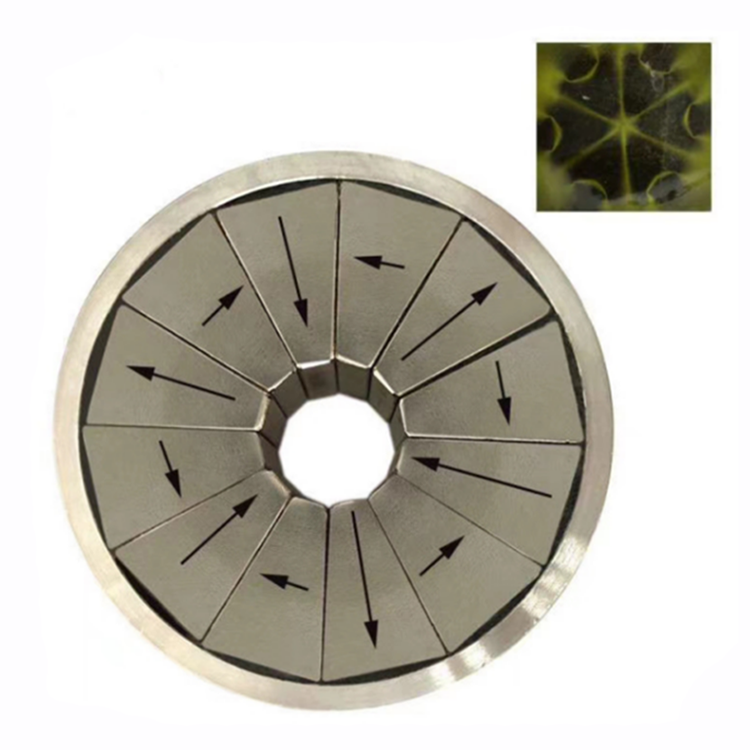
Hexapole magnet Halbach Configuration
A Halbach array is a magnetic array that uses permanent magnets to create a strong magnetic field. The magnetic field is focused and amplified on one side while being cancelled out on the other thanks to the spatial rotation of the magnetic field vector in the arrangement. In contrast to an electromagnet, which would require cooling and power input, Halbach Arrays can reach extremely high and consistent flux densities.
Permanent magnet Halbach Arrays have been made by industry-leading custom manufacturer Integrated Magnetics for industrial and technical applications for more than 25 years. Our technological design, building, and production of multi-segmented, circular, and straight (planar) Halbach is our area of expertise.
Magnetic arrays of the Halbach variety offer numerous pole combinations with high field densities and high uniformity.
Spherical Halbach Arrays with a Halbach Cylinder
Hexapole magnet Halbach Configuration
A Halbach cylinder is a cylindrical Halbach array made up of a number of trapezoidal or arc-shaped magnet pieces with rotating magnetic orientation vectors. They are frequently constructed in quadrupole, hexapole, sextupole, and octupole magnet designs, among others. In general, the field is more consistent across the inside circumference of the Halbach assembly the more discrete magnets there are and the more magnetic vector angles there are for each discrete magnet.
In NMR equipment, high-tech high-torque motors, beam focusing, research, and magnetic particle separation equipment for commercial, life science, R & D, and medicinal uses, Halbach cylinders are employed.
Halbach Linear (Planar) Arrangement
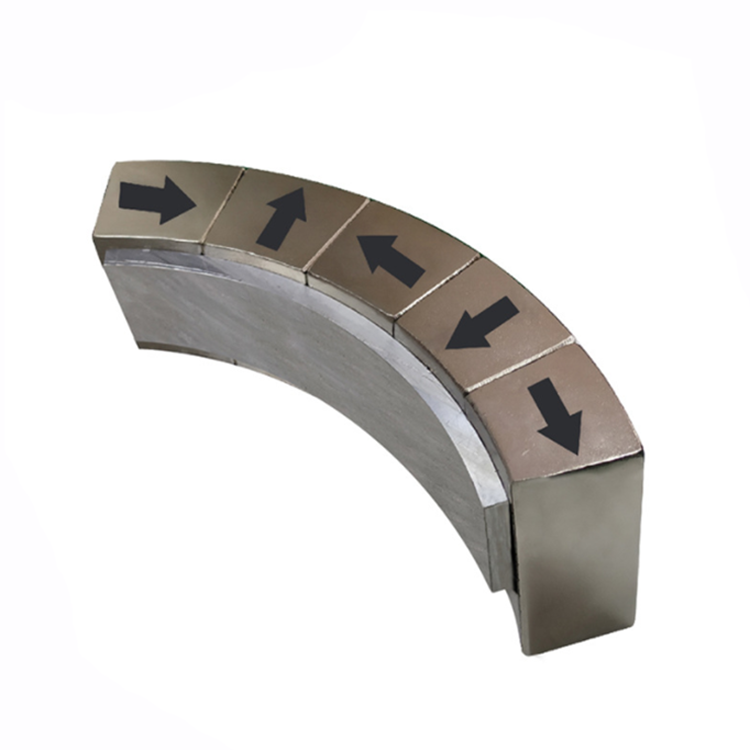
Linear Halbach arrays create a consistent, potent semi-sinusoidal magnetic field by concentrating the field on one side of the array using discrete, rectangle permanent magnets installed on a ferromagnetic backplate with various magnetic angles. You can also use linear (planar) arrays in a yoke arrangement to create a very strong sinusoidal field in the space.
In particle accelerators, free-electron lasers, incredibly powerful linear motors, and other devices for commercial, life science, R & D, and medicinal uses, we manufacture different kinds of linear (planar) Halbach arrays.
Linear Halbach Array Assembly for Maglev Train Specialized Project: Integrated Magnetics is pleased to have constructed the linear Halbach components for a Maglev test train based on the Inductrack under contract with General Atomics.
design which was developed by Lawrence Livermore National Laboratory under the guidance of the late Dr. Richard Post. Assemblies of linear Halbach arrays have also been constructed by us for a number of high-speed Hyperloop initiatives.
Magnetic Assemblies of the Halbach Style
Magnets of the Halbach Style for Catheter Guidance
We specially create and construct multi-level, Halbach type magnetic assemblies in multipole configurations with changeable magnetic orientation patterns for commercial, scientific, and medicinal uses in addition to linear and cylinder Halbach arrays. Extremely high magnetic field concentrations and great consistency are produced by these intricate structures.
Specialty Project: To create a powerful and concentrated field for a robotic catheter guidance application, we specifically developed and constructed a Halbach-type, high-field gradient magnetic assembly.
Several hundred individual magnets with various magnetic configurations made up this complicated magnet. More than 800 lbs were in the finished construction.
A Halbach array is a configuration of permanent magnets that increases the field strength on one side while decreasing it to almost zero on the other. The magnets are oriented to have their sides out of phase, usually by 90 degrees, to achieve this. By essentially rerouting the magnetic field from the plane below the structure (the “non-working” surface) to the plane above the structure (the “working” surface”), this orientation strengthens the working surface’s magnetic field while almost completely eliminating the field of the non-working surface.
Cluster of Halbach
The field intensity in a typical magnet (left) is equivalent on the top and bottom of the magnet. The field strength in a Halbach array (right) is centered on the upper edge, with a very weak
field at the base
Picture source: K&J Magnetics
One-sided flux, which is the result of rotating permanent magnets producing a powerful field on one side and a nearly negative field on the other, was first observed by John Mallinson in the 1970s and was thought to be a curious phenomenon. However, Klaus Halbach of Berkeley Labs found this occurrence in the 1980s and developed what are now referred to as Halbach arrays, using them to direct and concentrate particle accelerator beams.
Halbach arrays can also be set up in circular or cylinder designs, with the magnetic field centered at either the outer or interior diameter, in addition to linear or planar setups. A circular Halbach array can be used to build an electric generator,
with windings put into the magnetic field and the magnetic field aimed inside the cylinder. The windings of the Halbach array may rotate while remaining motionless, or the Halbach array itself may rotate while the windings remain immovable. The stator windings would be electrically commutated in the latter arrangement, which is sometimes referred to as a “inside out” construction, and the motor could be used as either a brushless DC (BLDC motor) or a brushless AC (BLAC) motor (also referred to as a permanent magnet synchronous motor or PMSM).
Cluster of Halbach
The magnetic field is concentrated at the interior diameter of the Halbach cylinder used in this case, and the Halbach array rotates around the windings.
Lawrence Livermore provided the photo.
Lawrence Livermore National Laboratory provided the photo.
Electric motors built on the Halbach array give quantifiable advantages over conventional designs, such as high power density and high efficiency, despite not yet being widely used. One of these advantages is made possible by the fact that a Halbach array motor is basically ironless because it doesn’t need laminations or back iron. Eddy current losses and hysteresis losses, also known as “iron losses” or “core losses,” are greatly reduced as a result. Eddy currents and their associated losses do, however, continue to exist in the windings because of their relative velocity to the magnetic field. Utilizing “Litz wire,” a particular kind of wire, can help to minimize these. Losing back iron or laminations also results in weight loss and
For extremely dynamic uses, the engine can start and halt more quickly and achieve maximum rates of 10,000 or more rpm.
Litz wire is made up of threads that are each independently insulated and are braided or knotted together to reduce losses.
Cost, more particularly the price of producing the Halbach array, is the main disadvantage of Halbach array engines. The assembly of the magnets and checking that the adhesive or fixing technique is adequate require comparatively labor-intensive processes because the magnets are organized so that each one repels its neighbor.