









Finite element simulation, also called FEA simulation
(Finite Element Analysis) is to use computers to simulate real physical systems using complex mathematical equations, models and formulas. Using simple and interacting elements (ie units), a limited number of The unknown quantity can approach the real system with infinite unknown quantity, and it has been widely used in the fields of temperature field, electric field, magnetic field, force field, seepage field, sound wave field and so on. Commonly used magnetic field simulation software includes ANSYS, ABAQUS, Comsol Multiphysics, JMAG-Designer, and EasiMotor.
It is not easy to get started with simulation software. In addition to overcoming problems in the use of new software, it is also necessary to understand the magnetic parameters of different materials in the material library, and because the magnetic field simulation is relatively small, almost all permanent magnetic materials and soft materials in the material library of the software The magnetic materials are not complete, and it also involves the establishment of new materials, the magnetic parameters of the new materials, and how to establish the demagnetization curve. These all need to be based on a thorough understanding of the material itself and the basic knowledge of magnetism.
Different FEA software may use different skills.
This article takes ANSYS software as an example to introduce the usual steps for finite element simulation of permanent magnet magnetic field:
1. Select the design type. ANSYS software has many design modules. Even the specialized electromagnetic field design module also includes design modules for high frequency, electric field, circuit, and static magnetic field. The static magnetic field module is usually selected for surface magnetic simulation.
2. Modeling. Similar to 2D and 3D modeling, draw the magnet shape, position, and test points to be simulated, or import the model through 2D and 3D drawing software.
3. Add materials. All materials must define the material properties, otherwise it will default to vacuum or an operation error will occur. It should be noted here that the permanent magnet needs to define the magnetization direction, and the magnetization direction is generally defined in a coordinate system.
4. Set the calculation domain. A suitable computational domain is very important. If you do not set a computational domain, it will default to the entire space as a computational domain. Although this is consistent with the actual situation, because there may indeed be no other interfering substances around the magnet, this will lead to a large error in the calculation results. And the operation is time-consuming.
5. Set the boundary conditions. Setting the boundary is to match the calculation domain setting and reduce the complexity of the problem. Setting a reasonable boundary can help us save a lot of time in the calculation. Different boundaries have different meanings. Usually, we choose the balloon boundary (balloon boundary) for static magnetic field simulation. .
6. Set the incentive source. Here, when the selected material is a permanent magnet, the system will automatically help us select the magnetostatic static magnetic excitation. If it is necessary to simulate the magnetic field of the coil, it is necessary to add a voltage or current as the excitation source.
7. Divide the grid. Meshing simply means connecting these finite element calculations to create a mesh structure, the software has its own meshing, the denser the mesh structure, the more accurate the results and the more time consuming it will be.
8. Add solution settings. Here you can set the error rate and the number of calculation steps, and the system also comes with default settings.
9. Add solution operation. It is what you want this simulation to help you get, whether to look at the direction of the magnetic force lines or the magnetic field data.
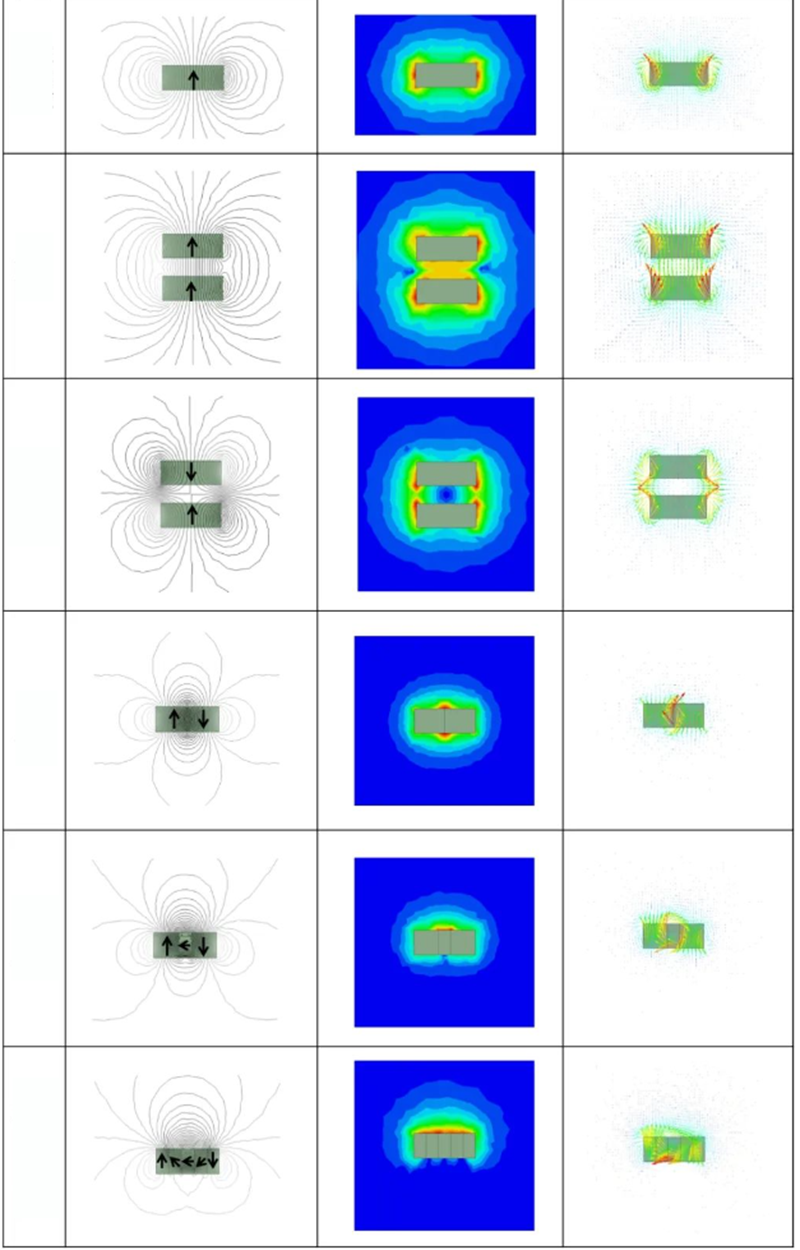
10. Post-processing. After the simulation is over, you can view the magnetic line diagram (scalar or vector), various cloud diagrams, the data and parameters that need to be simulated at the beginning of the period, etc.
The above introduces the steps of using the simulation software, and then shows some simulation diagrams of the magnetic field to help us understand the magnetic field distribution of different magnetic circuits.
Since the country proposed to achieve carbon neutrality by 2060, the term “carbon neutrality” has quickly changed from an unfamiliar term to a hot word.
In September 2020, my country announced that it will strive to peak carbon dioxide emissions by 2030 and strive to achieve carbon neutrality by 2060.
This year’s “Government Work Report” proposes to do a solid job in carbon peaking and carbon neutralization.
People in the industry pointed out that my country’s goal of achieving carbon neutrality by 2060 is an opportunity for the rare earth industry, because it will play an important role in increasing the demand for rare earth functional materials, especially the demand for rare earth NdFeB permanent magnets.
Carbon neutrality means that within a specified period, the anthropogenic removal of carbon dioxide is offset by anthropogenic emissions.
The most fundamental way for my country to achieve carbon neutrality before 2060 is to transform its energy structure and replace fossil energy such as coal, oil, and natural gas with clean energy such as renewable energy and nuclear energy.
At present, the more representative ones are replacing fuel vehicles with electric vehicles and wind power generation.
Whether it is new energy vehicles or wind power generation, they are inseparable from the application of rare earth NdFeB permanent magnets. Moreover, the carbon neutral policy will promote the accelerated penetration of rare earth NdFeB permanent magnets. NdFeB permanent magnets have obvious energy-saving advantages, and will mainly promote my country’s goal of carbon neutrality in two aspects: On the one hand, NdFeB permanent magnet motors have higher energy efficiency, and the increase in their penetration rate will reduce power consumption.
On the other hand, NdFeB permanent magnets will help the development of new energy. More than 40% of wind turbines use rare earth NdFeB permanent magnets, which will help the development of clean energy. At the same time, new energy vehicle drive motors mainly use rare earth NdFeB permanent magnets, which will help reduce the use of fossil energy and reduce carbon emissions in the future. With the increasing global awareness of the fossil energy crisis, the new energy vehicle industry has developed rapidly in recent years.
Whether it is the rapid growth of emerging car companies or the active transformation of traditional car companies, they all convey to the outside world the arrival of the era of electrification in the automotive industry. Governments of various countries have successively issued timetables for the cessation of sales of fuel vehicles, and my country has also proposed to fully “expel” fuel vehicles before 2050.
As of the end of 2020, a total of 10 million electric vehicles have been put into use around the world, and the registration of electric vehicles in 2020 will increase by 41% year-on-year. An increase of 0.8%. In the “New Energy Vehicle Industry Development Plan (2021-2035)” issued by the State Council, it is proposed that by 2025, the sales of new energy vehicles in my country will reach about 20% of the total sales of new vehicles. And by 2025, a complete electric vehicle power system technology system and industrial chain will be established to provide technical support for the realization of the number of new energy vehicles reaching 5 million by 2025. According to experts, a fully automatic limousine needs to consume about 0.5~3.5kg of rare earth NdFeB permanent magnets.
According to the demand of 5 million new energy vehicles for rare earth NdFeB permanent magnets, it will drive the development capacity of at least 25,000 tons of rare earth mines. Based on this calculation, 10 million new energy vehicles will drive at least 50,000 tons of rare earth mine development demand, which is equivalent to the current annual output of rare earths in the north. With the continuous implementation of my country’s carbon neutral policy, it is believed that the demand for rare earths will increase.
As the carrier of the country’s carbon neutrality policy, the rare earth industry should be the main pioneer, shoulder a greater mission, and make due contributions to my country’s carbon neutrality goal.
Produits apparentés