



Why do magnets need coatings?
Many magnets are coated with different materials because doing so offers significant benefits. The choice of coating material depends on whether the magnet’s intended use matches the properties of the coating material.
One reason magnets need coatings is to improve corrosion resistance. If the magnet you are using is likely to be exposed to humid environments, it’s best to add a coating to the magnet; otherwise, it may corrode. Corrosion can affect the magnet’s magnetic field, so it must be avoided at all costs.
Other reasons for coating magnets include ease of cleaning, improved conductivity, and increased durability. Coated magnets typically have a smoother surface and are easier to clean.
Additionally, some magnets have low conductivity. These magnets can be coated with materials that have good conductivity to improve their electrical properties.
There are many types of magnet coatings. Some common coatings include nickel-copper-nickel, black nickel, gold, rubber, parylene, plastic, and titanium nitride. Each coating has its unique properties. In the rest of this article, we will focus on rubber-coated magnets.
What are rubber-coated magnets?
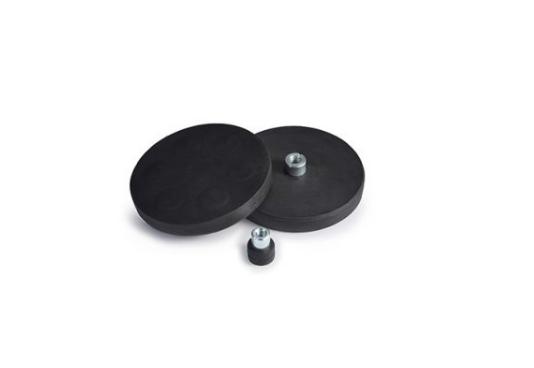
Rubber-coated magnets are magnets whose surface is coated with black isoprene rubber. They are among the most widely used magnets in various industries. Rubber-coated magnets are known for their high durability, excellent friction, and protective properties.
Furthermore, they are ideal for both indoor and outdoor use. Due to their high slip resistance, these magnets are commonly used in fastening and mounting applications. The coating thickness of rubber-coated magnets is typically around 0.3 inches. Rubber-coated magnets come in various designs, such as threaded studs, internal threads, countersunk holes, and screw holes.
Different Types of Rubber-Coated Magnets
Rubber-coated magnets mainly include the following types: 1. Threaded Stud Rubber-Coated Magnets 2. Screw Hole Rubber-Coated Magnets 3. Internal Thread Rubber-Coated Magnets 4. Countersunk Hole Rubber-Coated Magnets
Advantages of Rubber-Coated Magnets
–Corrosion Resistance
Rubber-coated magnets have high corrosion resistance because rubber itself does not corrode. Their coating is usually thicker than most other magnets. This ensures that they can be used in humid environments without any changes that might alter their magnetic field.
–High Slip Resistance
Rubber-coated magnets generally have higher friction than other types of magnets. This means they have high slip resistance. Therefore, rubber-coated magnets are suitable for fastening applications.
–Temperature Adaptability
Rubber-coated magnets function properly at temperatures up to 80°C and as low as 40°C.
–More Color Options
Rubber-coated magnets have more color options than other types of magnets. They are available in a variety of colors. These magnets can be blue, yellow, red, white, pink, and many more.
— Corrosion Resistance
Rubber-coated magnets have high corrosion resistance because rubber itself does not corrode. Their coating is typically thicker than most other magnets. This ensures they can be used in damp environments without any changes that might alter their magnetic field.
— High Slip Resistance
Rubber-coated magnets generally have higher friction than other types of magnets. This means they have higher slip resistance. Therefore, rubber-coated magnets are ideal for fixing applications.
— Temperature Adaptability
Rubber-coated magnets can function normally at temperatures up to 80°C and as low as -40°C.
— More Color Options
Rubber-coated magnets offer more color options than other types of magnets. They are available in a variety of colors, such as blue, yellow, red, white, pink, and many more.
— Physical Strength/Durability
Rubber-coated magnets are durable. Traditional magnets can be brittle or easily chipped. However, rubber-coated magnets have an added protective layer that protects them from damage that other types of magnets might encounter.
— Inertness
Rubber-coated magnets are generally less reactive with chemicals than other types of magnets. Therefore, they are suitable for applications where no chemical reaction of the magnet is desired. This also leads to a longer lifespan for the magnets, as they do not undergo destructive chemical reactions.
Applications of Rubber-Coated Magnets
— Fixing
Rubber-coated magnets are ideal for fixing objects to various surfaces. They are particularly useful for securing objects that are typically difficult to fix to surfaces, such as glass surfaces.
— Implants
Rubber-coated magnets are inert. Therefore, they are suitable for use as medical implants. Unlike some other types of implants, rubber-coated magnets do not react with bodily fluids or tissues when used as implants.
Other Types of Magnet Coatings
— Nickel
Nickel is the most commonly used magnet coating material. Nickel-coated magnets have a three-layer coating. They can operate at temperatures up to 513 K. These magnets are used in sensors, motors, medical devices, and generators.
— Gold
Gold-plated magnets are often used in the medical field. Gold is also used to coat magnets that require high conductivity. Gold-plated magnets have a maximum operating temperature of 473 K.
— Rhodium
Rhodium is another material commonly used to coat magnets. Rhodium-plated magnets are typically resistant to oxidation and corrosion. These magnets can be used in the medical, jewelry, and automotive industries. They perform best at temperatures below 473 K.
Magnets will adhere to steel surfaces, but they don’t generate lateral or sideways magnetic force. Only friction prevents refrigerator magnets from sliding to the ground.
With this in mind, we’ve introduced a series of rubber-coated mounting magnets designed specifically for hanging items on walls. Currently available in three sizes, they can be installed using standard screws or hardware.
If the friction between the magnet and the surface it’s attached to is limited, the magnet will often slide down a vertical surface (such as a wall or refrigerator door). The rubber coating on these magnets effectively solves this problem! We’ve discussed the importance of friction in previous articles:
How much weight can a magnet hold?
Hanging artwork on walls
Leverage and friction
Our advice is usually cautious and somewhat technical because it’s difficult to predict how a magnet will slide on a surface. Of course, if you just want to hang a picture frame, you probably don’t want to have an endless discussion about friction coefficients with our engineers. They can go on and on if you let them! What you really need is an effective solution. So: rubber mounting magnets.
How are these magnets different from simple block magnets?
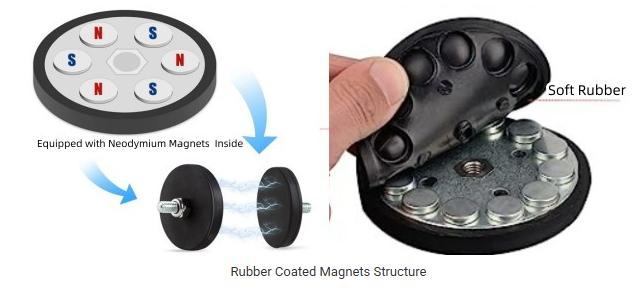
The cross-section shows the magnet inside the rubber coating.
A cross-section is clearly visible after cutting away half of the rubber coating surrounding the magnet with a blade.
These magnets are made from a thin steel plate with two strong neodymium magnets attached. There is a mounting hole in the center, and the entire magnet is encased in a rubber material to provide a high-friction surface. These magnets are specifically designed for vertical wall applications!
Their construction makes them easy to install with screws and provides significant magnetic force for the amount of magnetic material used.
How to use them to hang pictures?
Attach the rubber-mounted magnets to the wood with screws. Rubber-mounted magnets, nuts and bolts. Rubber-mounted magnets with bolts.
If you are hanging a thick wooden frame, you can use ordinary wood screws to screw one or more magnets directly to the back of the picture frame. Wood screws available at your local hardware or home improvement store will work.
What if your picture frame is thin? Or made of metal? What if you can’t screw into the back of the frame?
The simple eyelets on these magnets allow for a variety of common hardware fittings, providing multiple solutions. With a little creativity, you can find various ways to use these magnets.
To mount a picture frame that already has some kind of hanging mechanism on the back, you can assemble a nut and bolt onto the magnet. You can then hang the picture frame on the bolt on the magnet, just like you would hang it on a screw on the wall.
How strong are these magnets? How much weight can they hold?
As with any magnet, the weight you can hang depends on what you are attaching it to and how you are using it.
The pull force values we list refer to the force required to pull a single magnet vertically away from a large, thick steel plate. While this is a good indicator of magnet strength, it is not the same as the weight the magnet can hold when attached to your steel front door.
To get some more accurate estimates, we attached each magnet to some vertical surfaces. We applied a downward force, trying to make the magnet slide down the vertical surface. The results were less than the officially published pull force on a large steel plate, but provide a more realistic estimate of the magnet’s weight-bearing capacity on a wall.
These are our own tests using available materials. As the saying goes, your results may vary. We noticed that the results varied depending on the steel door we tested!
The Amazing Rubber Coating:
The rubber coating on rare earth magnets gives them a unique advantage over traditional magnets – their surface is covered with a protective layer of rubber. This rubber coating acts like a protective shield, preventing the magnets from scratching or damaging delicate items they come into contact with. The soft touch of the rubber-coated magnets ensures you can display valuable items, artwork, or photos on your refrigerator or magnetic board without leaving any unsightly marks. In a busy kitchen, they are a practical and safe tool for organizing metal utensils without causing any damage.
Rubber-Coated Magnets: Strength and Versatility Combined
Despite the protective coating, these powerful magnets lose none of their magnetic strength. They adhere firmly to metal surfaces, making them ideal for a variety of applications in both home and professional environments. Their versatility makes them suitable for a wide range of tasks, from holding lightweight objects to securing important notes to magnetic surfaces. Rubber-coated super magnets are a practical solution for everyday needs, ensuring items stay securely in place without slipping or falling.
Rubber-coated magnets play a crucial role in various fields:
-
Wire and Cable Management
We are often tired of dealing with messy wires and cables, having to use various hooks, ties, or wall fixtures to organize them. Now, we offer a revolutionary solution! Say goodbye to complicated installations and tangled wires; our innovative solution is simple and convenient. Simply place the rubber-coated magnet in the desired location, and then use our specially designed clips to easily guide the wires.
-
Mounting Work Lights and Warning Lights
Our innovative rubber-coated magnets provide a versatile and reliable solution for securely mounting work lights wherever you need them.
Thanks to the rubber coating, our magnets will not scratch or damage surfaces, making them suitable for delicate areas where drilling or welding is not allowed.
No need to adjust the position of the work light. Our magnets can be easily repositioned, giving you the flexibility to find the optimal lighting angle.
-
Commercial and Retail
From displaying promotional materials to securing product signage, China-made neodymium rubber-coated magnets play a vital role in retail environments, providing a secure and non-damaging solution.
Choosing the Right Rubber-Coated Neodymium Magnet
When selecting a rubber-coated rare earth magnet to meet your specific needs, consider factors such as size, holding force, and the type of surface it will be attached to. Ensure the magnet’s size matches the object you are securing, and choose the appropriate holding force based on the weight of the item. Additionally, check that the rubber coating is compatible with the materials it will come into contact with to avoid any adverse reactions.