




Bunting can provide permanent magnets in almost any shape and size, but one of the most popular shapes is the arc. Arc magnets are widely used in a variety of magnet assemblies, especially for surface mount motors.

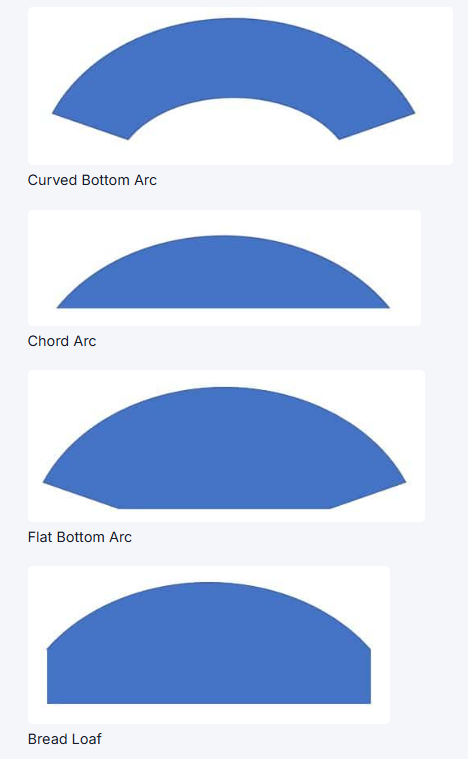
There are four main types of arc magnets:
Arc-bottom arc magnets
Chord arc magnets
Flat-bottom arc magnets
Bread-shaped magnets
Bread-shaped
Each arc type has its advantages and disadvantages when considering the impact on motor design. Selecting the best arc design is more important than production cost, because shape is the key to performance. The cost of magnet material is much higher than production cost, and magnet shape only becomes an issue when producing in large quantities.
Typical Arc Magnets
The following table is a simple guide to some arc characteristics;
Arc Magnet Characteristics
Assembly
During the design phase, the focus is on the magnetic properties of the permanent magnet rotor. Once the best magnetic design is determined, the design team will work with the production team to consider assembly (the process of fixing the magnets to the shaft). There are two options for assembly:
Assembly using a strap magnet: There are inherent difficulties with strap magnets as they are very brittle and the high magnetic field strengths present a serious safety hazard;
With the introduction of new production techniques, Bunting offers a post-assembly magnetization solution;
Assembly using a strap magnet
Flat-bottom magnets (contact flat surfaces) are the most controlled and lowest risk option for magnetizing magnets. However, this requires a more expensive and complex multi-faceted shaft to mount the magnet. In contrast, using a simple curved magnet with a circular inner diameter (ID) that matches the outer diameter (OD) of the optical shaft, the shaft is less expensive to machine.
Additionally, to facilitate assembly, the polygonal shaft may have a small recess in which the magnet is mounted. This adds to production costs, but ensures that the magnet does not hang loose on the polygonal shaft, thereby preventing the next magnet from being mounted.
Post-Assembly Operations
For curved magnet profiles, requiring tight concentricity tolerances or final OD tolerances can add additional assembly complexity.
“Bottom” curved magnets require no further machining and can be ground immediately.
“Flat Bottom” curved magnets require no further machining and can be ground immediately.
The grinding process for “chordal” curved magnets will present challenges. If the magnets travel across the width of a polygonal shaft with more than 4 faces, the shaft will begin to be exposed during the rotor grinding process, and the grinding operation will occur on two different metals.
Before and After Grinding of a chordal magnet mounted on a polygonal shaft
“Bread roll” curved magnets present the greatest manufacturing challenges. Once mounted on the shaft, the edges of the curved magnet are exposed and the transition around the rotor OD is no longer smooth. Because magnets are extremely brittle and easily damaged, the gaps created by the curved magnets must be filled with a material that is moderately hard and easy to machine. This material will fill the gaps before grinding and stay in place while spinning.

Bread loaf curved magnet on faceted shaft
Magnet constraint
Similar manufacturing considerations apply for any type of circumferential constraint, such as when using carbon fiber. Whether it is carbon fiber (wound or pressed) or heat-shrinkable metal tubing, the magnet rotor must have a smooth, round surface before winding.
Magnetización
To simplify the manufacturing process and increase safety, Bunting’s technical engineering team developed a post-assembly magnetization technique. A complex magnet assembly is then built, left in a non-magnetized state, and then magnetized.
Post-assembly magnetization has many advantages. Magnet assembly is easier and less time-consuming. There is also less risk of errors during assembly (such as wrong polarity orientation). Post-assembly magnetization means that the polarity and magnetic field of each magnetic component are exactly as required. The advantages of post-assembly magnetization are discussed in the technical article Post-assembly magnetization for the automotive industry.
Carbon Fiber Wrapped Magnet Rotor
However, for magnet rotors consisting of “curved bottom” and “flat bottom” arc magnets, post-assembly magnetization is not possible. This is because it is impossible for “curved bottom” and “flat bottom” arc magnets to be fully magnetically saturated.
When there is a small air gap between “chord” arc magnets and “bread” arc magnets, post-assembly magnetization is possible. However, when transition magnets are introduced and a surface mount Halbach rotor is created, magnetization becomes not only possible, but also greatly simplified.
Arc Magnetization
Related Technical Articles
Custom Pot Magnet Design for Oil and Gas Applications
Carbon Fiber Seals for Magnetic Rotors