



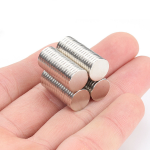
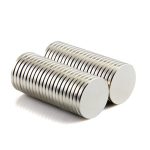
A disk neodymium magnet
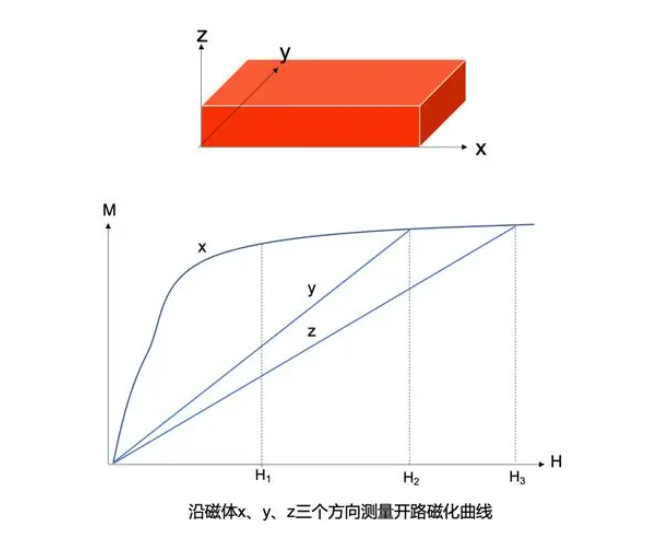
The permanent magnet is made into a certain shape. For example, if the magnetization curve in the open circuit state is measured along the x, y, and z directions of the Disk Neodymium Magnet, it can be found that along the x direction, only a lower magnetic field (H1) is needed to magnetize it to technical saturation, while along the y and z directions, higher magnetic fields are needed to magnetize it to technical saturation. This phenomenon is called the shape anisotropy of the permanent magnet.
The direction that requires a smaller magnetic field to magnetize it to technical saturation is called the easy magnetization direction; the direction that requires the largest magnetic field to magnetize it to technical saturation is called the difficult magnetization direction.

Demagnetization field Hd
Why does a permanent magnet of a certain shape (non-spherical) have shape anisotropy? This is related to the demagnetization field of the permanent magnet.
We know that a block or cylindrical permanent magnet will always have N poles and S poles. The presence of magnetic poles will generate a magnetic field around and inside the magnet. The magnetic field generated by the magnetic poles of a permanent Disk Neodymium Magnet is always from the N pole to the S pole, both around and inside the magnet.
The demagnetization field inside the permanent magnet is represented by Hd, and its direction is from the N pole to the S pole. The direction of the permanent magnet’s magnetic moment Mm or the direction of the magnetization intensity is from the S pole to the N pole. The Hd inside the permanent Disk Neodymium Magnet is opposite to the direction of the magnetization intensity M, and plays a demagnetization role, so it is called the demagnetization field.
How is the demagnetization field of a permanent magnet generated? We can regard a permanent Disk Neodymium Magnet as composed of two magnets, A and B. Magnet A is just in the magnetic field generated by Disk Neodymium Magnet B, and magnet B is also in the magnetic field generated by magnet A. These magnetic fields are just from the N pole to the S pole, so it is opposite to the magnetization intensity of the magnet, so it is called the demagnetization field.
The demagnetization field strength of the permanent Disk Neodymium Magnet is related to the shape and size of the permanent magnet. For example, the demagnetization field strength of the annular permanent magnet varies with the size of the gap of the annular permanent magnet (that is, the length of the permanent magnet).
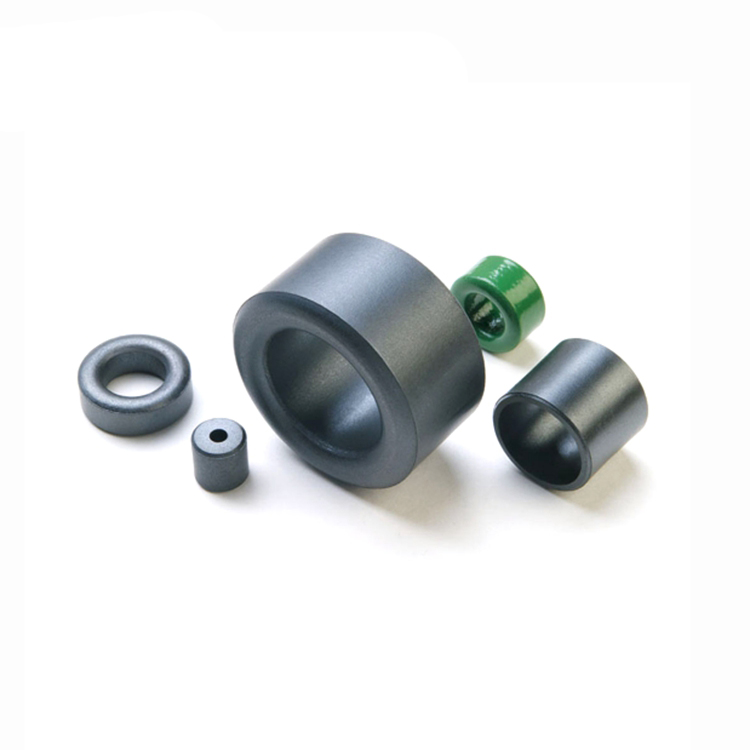
When magnetizing along the axis of the annular permanent magnet, no demagnetization field is generated; when the annular permanent magnet is cut in half, the demagnetization field of the half ring is Hd; the shorter the annular permanent Disk Neodymium Magnet is cut, the greater the absolute value of the demagnetization field Hd. The order of the gradual increase in the absolute value of the demagnetization field is Hd(e)>Hd(d)>Hd(c)>Hd(b)>Hd(a)→0.
Se puede deducir que cuando la fuerza coercitiva Hcj del imán permanente no es lo suficientemente grande, si el imán permanente se hace delgado, es posible que no pueda magnetizarse a lo largo de la dirección delgada porque el campo de desmagnetización es demasiado grande.

The above example shows that the size of the demagnetization field of a permanent magnet is related to the shape and size ratio of the magnet. Experimental and theoretical calculations can prove that the demagnetization field of a permanent Disk Neodymium Magnet Hd=-NM, where M is the magnetization intensity of the permanent magnet and N is the demagnetization factor. The negative sign in the formula indicates that Hd is in the opposite direction to M.
For an infinitely long round rod-shaped permanent Disk Neodymium Magnet, the demagnetization factor N1 along the length direction and the demagnetization factor Nd in the diameter direction can be expressed as follows, where k is the size factor, k=l/d, d is the diameter of the rod-shaped magnet, and l is the length.

The demagnetization factor of any permanent magnet in three mutually perpendicular directions (N1+Nd+Nd=1) is equal to 1.0. It can be seen that k=l/d=0, which is equivalent to a very thin plate, and its demagnetization factor N1→1.0; for a round rod-shaped permanent magnet, when it is magnetized along the axial direction, the change of its demagnetization factor along the length l is shown in the figure below. When the length l is equivalent to 200 times the diameter, its demagnetization factor can be ignored, and its demagnetization field can be considered.

Shape anisotropy, demagnetization field, and demagnetization factor are important concepts in understanding the magnetic behavior of permanent Disk Neodymium Magnet, including neodymium magnets. Here’s an explanation of each:
1. Shape Anisotropy
**Definition**: Shape anisotropy, also known as shape-induced anisotropy or magnetocrystalline anisotropy, refers to the tendency of a magnet to align its magnetic moments preferentially along certain crystallographic directions or axes due to its shape.
– **Origin**: It arises from the shape of the magnet itself, where certain shapes (such as elongated or disk-shaped magnets) can induce a preferred direction of magnetization alignment.
– **Effect**: This anisotropy influences the magnet’s overall magnetic properties, affecting parameters like coercivity (resistance to demagnetization) and remanence (the residual magnetization in the absence of an external magnetic field).
2. Demagnetization Field
**Definition**: The demagnetization field, often denoted as \( H_d \), is the magnetic field produced inside or outside a magnet that opposes its magnetization. It arises due to the magnet’s shape and can significantly affect its performance.
– **Calculation**: The demagnetization field can be calculated using Maxwell’s equations in magnetostatics, considering the Disk Neodymium Magnet’s geometry and magnetization distribution.
– **Consequences**: In high-magnetization materials like neodymium magnets, the demagnetization field can cause changes in the magnet’s overall magnetic flux and stability.
3. Demagnetization Factor (or Demagnetization Coefficient)
**Definition**: The demagnetization factor, often denoted as \( N \) or \( N_d \), quantifies the extent of demagnetization caused by the magnet’s shape. It is a dimensionless parameter that depends on the magnet’s geometry.
– **Value**: It ranges from 0 to 1, where:
– \( N = 0 \) corresponds to no demagnetization effect (spherical shape),
– \( N = 1 \) corresponds to complete demagnetization (infinite aspect ratio, like a needle).
– **Influence**: The demagnetization factor determines how much the magnet’s intrinsic magnetic field is reduced or altered due to its shape.
Practical Implications
– **Design Considerations**: Engineers and designers must consider shape anisotropy, the demagnetization field, and the demagnetization factor when selecting and designing permanent magnets for specific applications.
– **Optimization**: Proper shaping and magnetization orientation can minimize demagnetization effects and optimize the Disk Neodymium Magnet’s performance, enhancing efficiency and reliability in applications such as motors, sensors, and magnetic assemblies.
Understanding these factors helps in predicting and controlling the magnetic behavior of permanent Disk Neodymium Magnet, ensuring they meet performance requirements in various technological and industrial applications.
The demagnetization field and demagnetization factor are crucial concepts in understanding the magnetic behavior of permanent magnets, including neodymium magnets. Here’s a detailed explanation of each:
Demagnetization Field
**Definition**: The demagnetization field (\( H_d \)) is the magnetic field produced inside or outside a Disk Neodymium Magnet that opposes its magnetization. It arises due to the magnet’s shape and affects the overall magnetic flux distribution.
– **Origin**: The demagnetization field is a consequence of Maxwell’s equations in magnetostatics, where the magnet’s geometry influences the spatial distribution of magnetic fields.
– **Effect**: Inside the magnet, the demagnetization field opposes the internal magnetization, influencing the overall magnetic properties such as remanence and coercivity.
– **Calculation**: The demagnetization field can be calculated using advanced mathematical models considering the magnet’s shape and magnetization direction.
### Demagnetization Factor (or Demagnetization Coefficient)
**Definition**: The demagnetization factor (\( N \) or \( N_d \)) quantifies the extent of demagnetization caused by the Disk Neodymium Magnet’s shape. It is a dimensionless parameter ranging from 0 to 1.
– **Interpretation**:
– \( N = 0 \) corresponds to no demagnetization effect (spherical shape where the magnetization is unaffected by its shape).
– \( N = 1 \) corresponds to complete demagnetization (infinite aspect ratio, like a needle, where the magnetization is significantly affected by the shape).
– **Calculation**: The demagnetization factor depends on the magnet’s geometry, such as its aspect ratio (length/diameter for a cylinder) or other dimensional parameters.
– **Practical Use**: It helps in predicting how the magnet’s shape influences its magnetic performance, aiding in design considerations and optimizations.
Practical Implications
– **Design Considerations**: Engineers consider the demagnetization field and factor when designing Disk Neodymium Magnet for applications. Shapes with higher demagnetization factors (such as thin discs or long cylinders) may require special attention to minimize unwanted demagnetization effects.
– **Performance Optimization**: Proper shaping and magnetization direction can minimize the demagnetization effects, optimizing the magnet’s efficiency and stability in various applications such as electric motors, generators, sensors, and magnetic storage devices Disk Neodymium Magnet.
– **Experimental Verification**: Experimental techniques and simulations are often used to validate theoretical models and ensure magnets meet performance specifications under operational conditions.
Understanding these concepts is essential for leveraging the full potential of permanent magnets in technological applications, ensuring reliable and efficient operation across diverse industries.
The demagnetization factor (often denoted as \( N \) or \( N_d \)) is a dimensionless parameter that quantifies the extent of demagnetization caused by the shape of a permanent Disk Neodymium Magnet. Here’s a deeper look into what the demagnetization factor represents and how it is calculated:
### Definition and Interpretation
The demagnetization factor \( N \) indicates how the magnet’s shape affects its intrinsic magnetization. It is primarily influenced by the geometry of the magnet, such as its dimensions and aspect ratio. The demagnetization factor ranges from 0 to 1:
– \( N = 0 \): No demagnetization effect. This corresponds to a shape where the magnetization is not affected by its geometry. For instance, a sphere has \( N = 0 \) because its magnetization is uniformly distributed.
– \( N = 1 \): Complete demagnetization effect. This occurs when the magnet’s shape is such that it maximally opposes its own magnetization. An infinitely long thin cylinder (like a needle) has \( N = 1 \).
For most practical permanent magnets, \( N \) typically falls between 0 and 1, depending on their shape and aspect ratio.
### Calculation
The demagnetization factor \( N \) can be calculated for simple shapes using formulas derived from magnetostatic theory. Here are some common examples:
1. **Cylinder**: For a cylinder with radius \( R \) and height \( H \):
\[ N = \frac{H}{R} \]
– If \( H \gg R \), \( N \) approaches 1, indicating significant demagnetization.
– If \( H \ll R \), \( N \) approaches 0, indicating minimal demagnetization.
2. **Sphere**: For a sphere with radius \( R \):
\[ N = 0 \]
A sphere has no demagnetization effect because its shape does not favor any particular orientation of magnetization.
3. **Thin Disc**: For a thin disc with radius \( R \) and thickness \( T \):
\[ N = \frac{T}{R} \]
– If \( T \ll R \), \( N \) is small, indicating minimal demagnetization.
– If \( T \approx R \), \( N \) is closer to 0.5, indicating moderate demagnetization.
### Importance in Magnet Design
Understanding the demagnetization factor is crucial for designing permanent magnets for various applications:
– **Optimization**: Engineers can use \( N \) to optimize the Disk Neodymium Magnet’s shape and dimensions to minimize demagnetization effects.
– **Performance Prediction**: It helps predict the magnet’s magnetic properties, such as remanence and coercivity, under different operational conditions.
– **Manufacturability**: Shapes with lower demagnetization factors are preferred in applications where stable and consistent magnetic performance is crucial.
In summary, the demagnetization factor \( N \) is a key parameter in Disk Neodymium Magnet design, providing insights into how the shape of a permanent magnet influences its magnetic behavior and performance characteristics.