Using permanent magnets organized in a 90° orientation shift between magnetic elements, a Halbach array is most frequently used in industrial applications to create a magnetic field that increases the magnetic force applied. Both flat and circular Halbach Arrays generate magnetic fields that are comparable to those produced by powered solenoids (Electromagnets), but without the additional bulk, expense, or upkeep. A circular Halbach array focuses the magnetic field on the ID or OD, while a planar Halbach array confines the magnetic field to one edge of the array. Although “bucking magnets” provide a 45° angle between magnets rather than a 90° version, there are other iterations as well, and these can be referred to as “non-traditional” Halbach Arrays.
The most basic geometry for circular halbach arrays is a collection of wedge-shaped magnets with different magnetic orientations centered around a shared axis.
Halbach Hexa-Pole Arrangement
An unrolled Halbach cylinder can be compared to planar Halbach arrays. This variant does produce a very powerful magnetic field on one functional face, though it does not always produce a uniform field.
Halbach Planar Arrangement
ARRAY OF HALBACH APPLICATIONS
Standard applications for planar Halbach arrays include:
Holding\sFixturing
Applications for linear couplings
On the OD cycle, circular Halbach arrays are employed in:
Brushless DC motor rotors
Magnetic coupling rotors
Power production rotors
On the ID cycle, circular Halbach Arrays are employed to:
restrict plasma
Accelerate, organize, and steer charged ions in motion.
introduce waves
Cylinder Halbach
HALBACHER ARRAY DESIGN THOUGHTS
Practical Deficit
For a Planar arrangement, between the workpiece and the magnet array
In a Halbach Cylinder’s Number
Working Setting between a Halbach Rotor and a Stator
Speeds of rotation and temperature
fluids and gases
Regions of Exterior Demagnetization
Particularly in Halbach Arrays used for Rotors, this is significant.
Kosten
Necessary to Serve for Eternity
Amount of Space or Capacity the Arrangement Can Have
The array assembly’s size
Halbach Arrays rely on a collection of magnets that naturally attract and resist one another. The array’s girth makes its building more challenging.
HALBACHER ARRAY PERKS
A Halbach-style array’s very powerful field compared to other arrays with the same quantity of the magnet alloy is undoubtedly its most salient advantage. The design basically improves the magnetic circuit’s effectiveness.
There is only one functional surface, or “working face,” as a result of the construction. The magnetic field is concentrated on the one functional face, where it is very powerful, and it is almost completely absent on the other face. In effect, the working face receives the magnetic field that would typically be on the non-working face. Both circular and planar type arrays fit this description.
ADVANTAGES OF HALBACH ARRAYS The main drawback of the shape of the Halbach Array is that it is challenging to place
in comparison to other possible options, resulting in possibly higher manufacturing costs. This is caused by the Halbach Array’s entire collection of magnet components resisting one another. This can lead to a number of assembly-related problems, such as the need to join the magnets magnetized, contending with pressures while assembling, and making sure the assembly will “hold together” when it is being used.
Halbach Arrays may also experience problems in high heat situations because the array components apply a demagnetizing field to one another. A magnet is more prone to demagnetizing as the working temperature rises, and the demagnetization of nearby magnets is aggravated.
CONCLUSION
Not every application is a suitable fit for a Halbach array. The Halbach Antenna has been described, However, before adopting a Halbach Array, it is crucial to take into account the difficulty of planning and manufacture. A Halbach design has many chances to increase efficiency, but doing so will cost money. For your halbach array applications, working with a seasoned magnetic engineering firm is crucial to finding the best answer. To find out if a Halbach Array can improve your magnetic application and for help with magnet application for all array designs, get in touch with Dura Magnetics.
Twitter Halbach Arraysemail Post on Reddit, add a pin to, Post via Feeds on Facebook
How do Halbach groups work? Why might someone use one? In this piece, we focus on just a few fascinating methods for fabricating and applying these unusual magnet combinations.
A Halbach array is what?
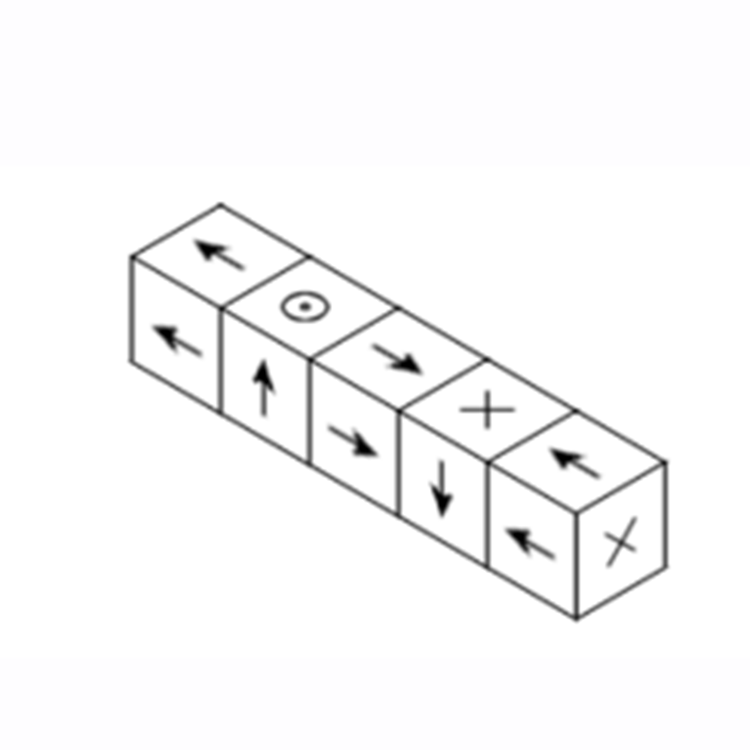
The north pole of a solitary magnet is always pointing up in the image on the left. The magnet’s top and bottom both have similarly strong fields, as shown by the color spectrum. The Halbach array, on the other hand, has a very powerful field on top and a feeble field at the bottom.
A unique configuration of permanent magnets called a Halbach array creates a magnetic field on one edge of.
the field on the opposite side to almost zero, making the matrix stronger. In comparison to the magnetic field created by a solitary magnet, this is very distinct. A single magnet creates an equal-power magnetic field on both sides, as seen in the illustration to the right.
Here, the solitary magnet is depicted as a 5-cube arrangement, akin to the Halbach array, but with the north poles all facing upward. This has the same magnetic properties as one solitary linear magnet.
John C. Mallinson first noticed the effect in 1973, and he originally thought of these “one-sided flux” formations as an oddity (IEEE paper link). The Halbach array was separately developed by scientist Klaus Halbach in the 1980s to concentrate particle beams, electrons, and lasers.
Why might you desire one? Where are they used in practice?
Citing Wikipedia One-sided flux distributions have a remarkable number of uses, from the refrigerator magnet to industrial ones like the brushless motor and magnetic coupling, despite their abstract appearance. They were initially created by Klaus Halbach to be used as wiggler magnets in particle accelerators and free electron lasers.
Halbach arrays are also an essential part of the Inductrack maglev train system. In this system, after the train has reached its maximum speed, the Halbach arrays repel the wire coils that make up the track, elevating the train.
Create a straight Halbach collection as an illustration.
Here, we demonstrate how to build a linear Halbach array using the magnets from our B888-2PA-N52 and B888-2PE-N52 series. These magnets have a 12″ square shape.
A long threaded shaft can be inserted through the hole in the center to keep them together. Compared to a standard B888 magnet, they are significantly simpler to put together.
The opening in the -2PA- magnets is situated parallel to the polarization axis. On sides where there is a cavity, the north and south poles are located. The opening in the -2PE- magnets is oriented perpendicular to the magnetization axis. On opposing sides without holes, the north and south poles are situated.
The assembly of a single 5-magnet array is demonstrated in the movie below.
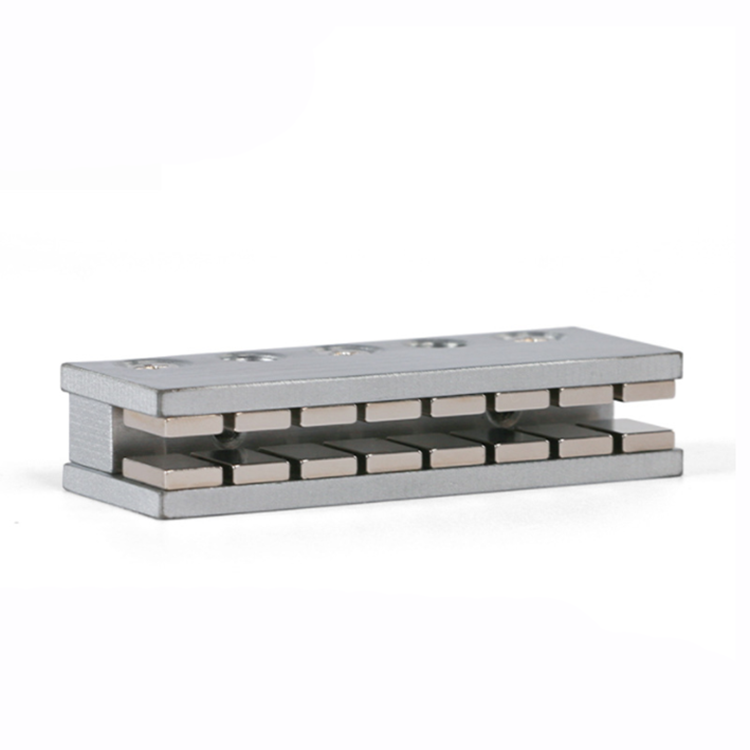
Halbach arrays are a precise arrangement of permanent magnets that directs the magnetic field in one region while canceling it to near zero on the other. We can create halbach arrays and halbach assemblies to order, but we keep the following assemblies in stock.
A Halbach Array is most typically used in industrial applications to generate a magnetic field by arranging permanent magnets in a 90° orientation change between magnetic components, which magnifies the magnetic force delivered. Halbach Arrays, both planar and circular, provide a magnetic field comparable to that produced by a driven solenoid (Electromagnet), but without the additional size, expense, and maintenance. A magnetic field is contained to one side of a planar Halbach array, whereas a magnetic field is concentrated on the ID or OD of a circular Halbach array. Other iterations exist, and while “bucking magnets” produce a 45° angle between magnets rather than a 90° iteration, they can be termed “non-traditional” Halbach Arrays.
The most basic design for Circular Halbach Arrays is an array of wedge-shaped magnets with varying magnetic orientations around a common axis.