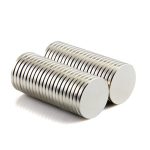
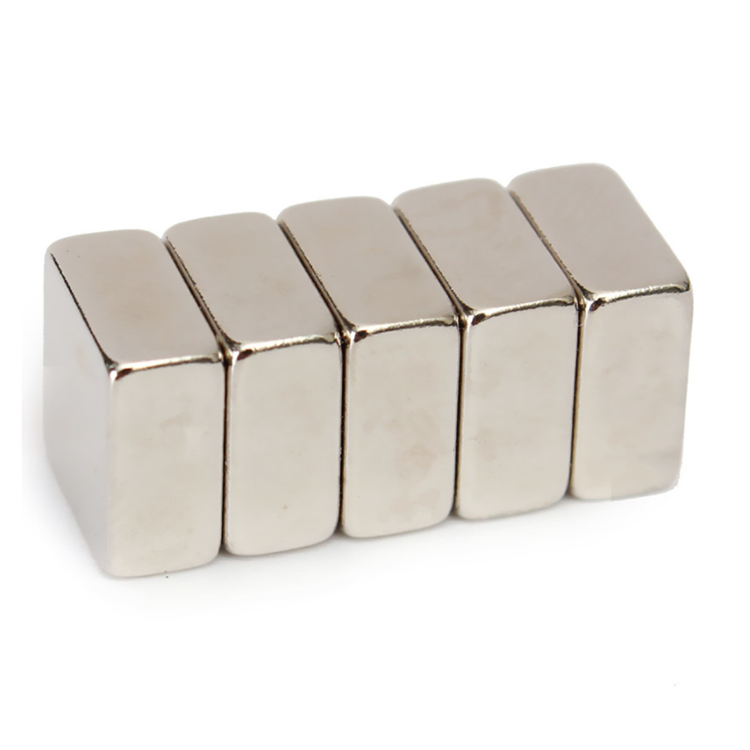
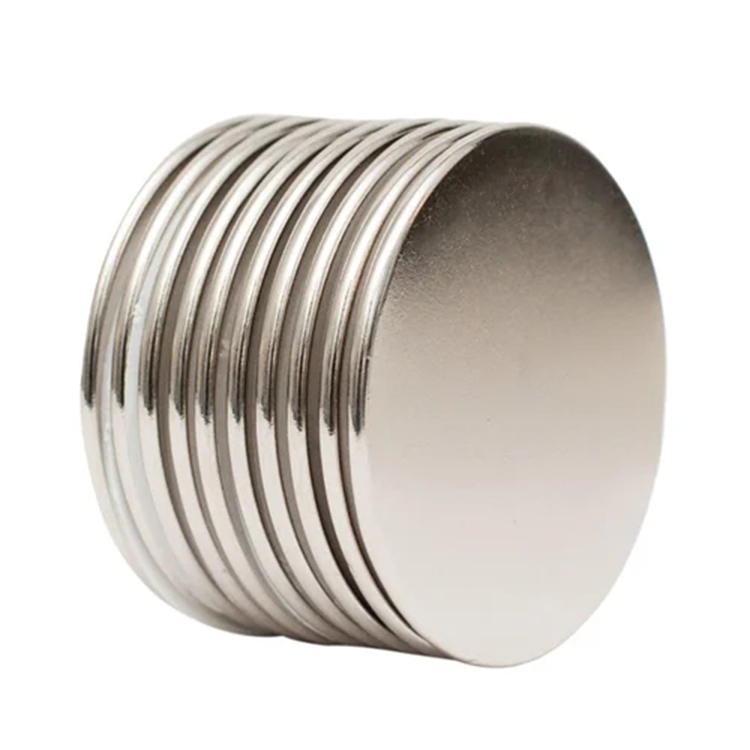
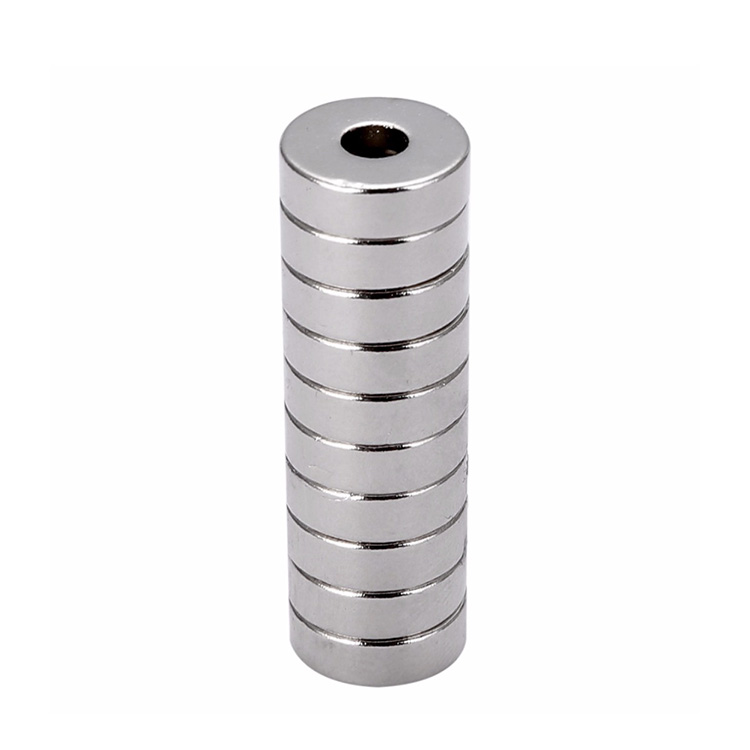
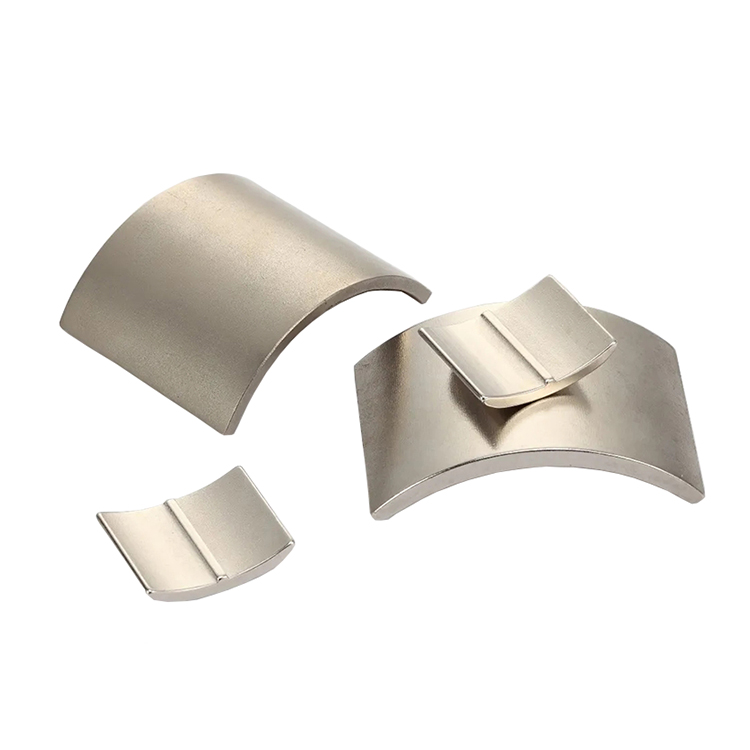
Nd-Fe-B-Magnete
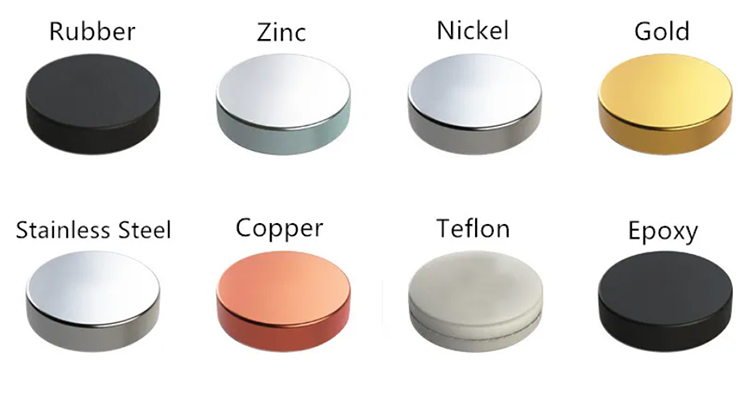
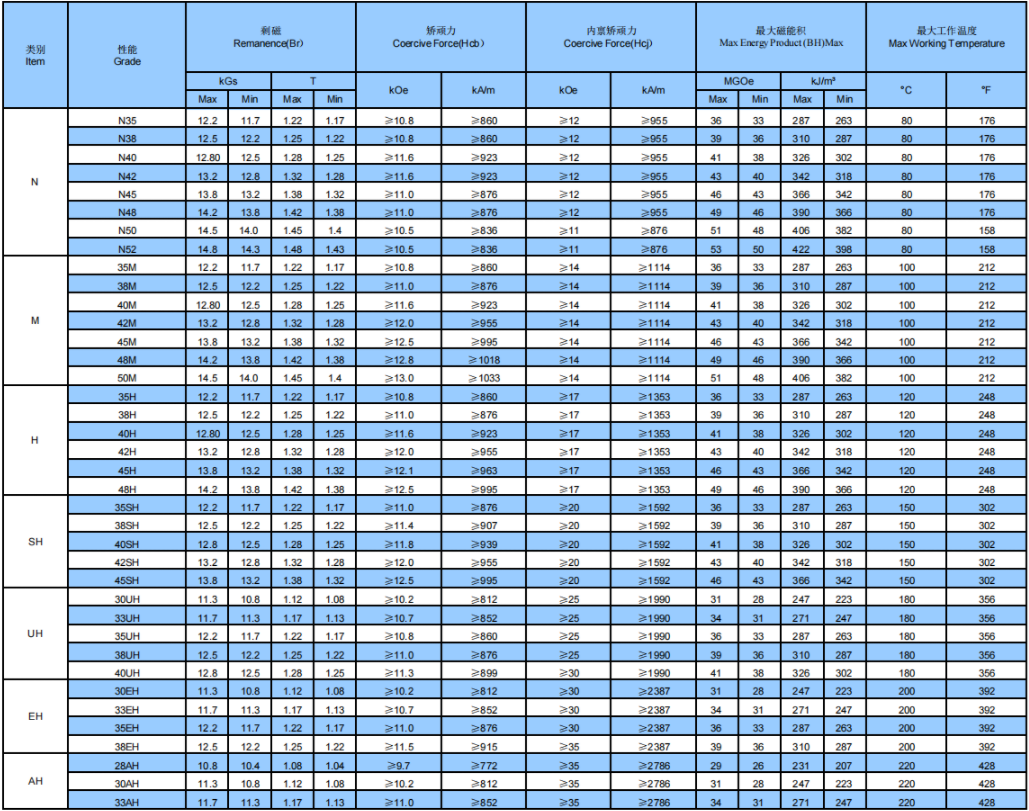
The strongest commercially available magnets are neodymium ones, which also have a high demagnetization resistance. A neodymium magnet is incredibly strong—it can support 1,000 times its own weight—but typical grades can only operate at temperatures up to 80 degrees Celsius, making them unsuitable for damp settings unless they are covered with a corrosion-resistant coating.
The orbital and spin movements of electrons, as well as how they interact with one another, are the source of magnetism. Explaining how materials react to magnetic fields is the greatest approach to present the many forms of magnetism. All matter has magnetic properties, which may surprise some people. Simply said, certain materials have significantly stronger magnetic properties than others. The major difference is that whereas in certain materials there is a very strong connection between atomic moments, in other materials there is no collective interaction of atomic magnetic moments.
The following five broad categories can be used to categorize magnetic behavior of materials:
Diamagnetism 1
Second, paramagnetism
Ferromagnetism 3.
Fourth, ferrimagnetism
Fifth, antiferromagnetism
Materials in the first two categories don’t have magnetic ordering and don’t show any collective magnetic interactions. Below a specific threshold temperature, the materials in the latter three categories display long-range magnetic ndfeb magnet strength order. We typically think of ferrimagnetic and ferromagnetic materials as being magnetic because they behave like iron. The latter three are typically regarded as “nonmagnetic” because of how weakly magnetic they are.
Diamagnetism
All matter has diamagnetism as a fundamental characteristic, albeit it is often quite weak. It results from orbiting electrons’ uncooperative behavior in the presence of an applied magnetic field. Atoms in diamagnetic materials have no net magnetic moments, meaning that all of their orbital shells are filled and there are no unpaired electrons. However, a negative magnetization is created when subjected to a field, and as a result, the susceptibility is negative.
Keep in mind that the magnetization is zero when the field is zero. The susceptibility of diamagnetic materials is also characterized by temperature independence. Several well-known diamagnetic materials.
Paramagnetism
Due to unpaired electrons in partly filled orbitals, some of the atoms or ions in this family of materials exhibit a net magnetic moment. Iron is one of the most significant elements having an unpaired electron. Similar to diamagnetism, the magnetization is zero when the magnetic field ndfeb magnet prices is withdrawn since the individual magnetic moments do not interact magnetically. There is now a partial alignment of the atomic magnetic moments in the field’s direction, leading to a net positive magnetization and positive susceptibility in the presence of the field.
The paramagnetic susceptibility is minimal at normal temperatures and in moderate fields, although it is more than the diamagnetic contribution. Paramagnetic susceptibility is independent of the applied field unless the temperature is extremely low (less than 100 K) or the field is quite strong. Under these circumstances, the relationship between paramagnetic susceptibility and the total iron concentration is linear. At normal temperature, several iron-bearing minerals exhibit paramagnetic behavior.
Ferromagnetism
Iron, nickel, or magnetite are most likely the first round neodymium magnet magnetic materials that come to mind. These materials’ atomic moments display extremely strong interactions, in contrast to paramagnetic materials. These interactions, which are brought about by electronic exchange forces, cause the atomic moments to align either parallel or antiparallel. The magnitude of the exchange forces is enormous, equal to a field of around 1000 Tesla, or roughly 100 million times that of the earth’s field.
The relative orientation of the spins of two electrons causes the exchange force, a quantum mechanical process.
Even in the absence of a magnetic field, ferromagnetic materials have parallel moment alignment that results in significant net magnetization.
Common ferromagnetic materials include numerous of its alloys as well as the elements Fe, Ni, and Co.
Ferromagnetic materials have two distinctive properties:
(1) Inspiring magnetization spontaneously and the existence of
(2) temperature for magnetic ordering
Automatic Magnetization
The net magnetism that is present in an evenly magnetized microscopic volume in the absence of a field is known as spontaneous magnetization. The spin magnetic moments of electrons determine the size of this magnetization at zero degrees Celsius.
Magnetic domains (we’ll talk more about domains later) play a role in the distinction between spontaneous magnetization and saturation magnetization. The inherent feature of saturation magnetization is temperature-dependent yet independent of particle size.
Between paramagnetic and ferromagnetic susceptibility, there is a significant distinction. under comparison to paramagnetic materials, ferromagnetic materials’ magnetization is saturated at high (room-temperature) temperatures and under moderate magnetic fields.
Even though ferromagnets have extremely strong electronic exchange forces, the exchange is eventually beaten by thermal energy, leading to a randomizing effect. The Curie temperature (TC), at which this happens, is a specific temperature. The ferromagnet is ordered below the Curie temperature and disordered above it. At Curie temperature, saturation magnetization becomes zero.
The Curie temperature is a diagnostic measure that may be used to identify minerals Ndfeb Magnet Specifications and is also an inherent attribute. It is not infallible, though, because many magnetic materials might theoretically have the same Curie temperature.
Hysteresis
Ferromagnets may remember an applied field even after it is withdrawn, in addition to the Curie temperature and saturation magnetization. A plot showing the change of magnetization with magnetic field is known as a hysteresis loop, and this phenomenon is referred to as hysteresis.
The coercivity of remanence (Hr) is another characteristic of hysteresis. This reverse field decreases the saturation remanence to zero when it is applied and subsequently withdrawn. It always exceeds coercive force in size.
The magnetization that is seen at low fields, on the order of the earth’s field (50-100 T), is the initial susceptibility (0).
The different hysteresis parameters rely on temperature, stresses, grain size, domain state, and other factors in addition to their inherent features. Hysteresis parameters are important for magnetic grain sizing of natural samples since they depend on grain size.
Ferrimagnetism
The crystal structure of ionic compounds, such as oxides, can lead to the occurrence of more intricate types of magnetic ordering. Ferrimagnetism is one kind of magnetic ordering. Here is a straightforward illustration of the magnetic spins in a ferrimagnetic oxide.
The two magnetic sublattices (A and B) that make up the magnetic structure are separated by oxygens. The oxygen anions operate as intermediaries in the exchange processes. When this occurs, the exchanges are referred to as superexchange or indirect interactions. The A and B sublattice’s spins align antiparallel due to the greatest superexchange interactions.
Ferrimagnets have a net magnetic moment because the magnetic moments of the A and B sublattices are not equal. Thus, ferromagnetism and ferrimagnetism are comparable. It displays spontaneous magnetization, Curie temperatures, hysteresis, and remanence, which are all characteristics of ferromagnetic activity. Ferro- and ferrimagnets, however, exhibit extremely distinct magnetic orderings.
Fe3O4 crystallizes as magnetite and has a spinel structure. Smaller Fe ions fill in the spaces created by the tight packing of the big oxygen ions in a cubic configuration. There are two types of gaps:
Tetrahedral location Four oxygen atoms surround the fe ion.
Octahedral location Six oxygen atoms surround the fe ion.
The two magnetic sublattices, A and B, are formed by the tetrahedral and octahedral sites, respectively. The A sublattice’s spins and the B sublattice’s spins are in opposition to each other. Due of the stark differences between the two crystal sites, there are intricate exchange interactions between and within the two types of sites.