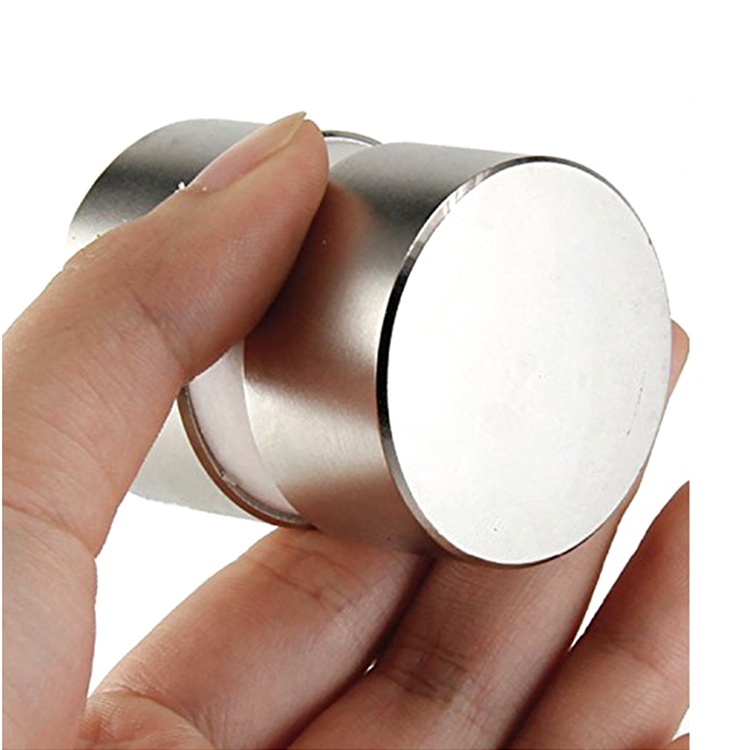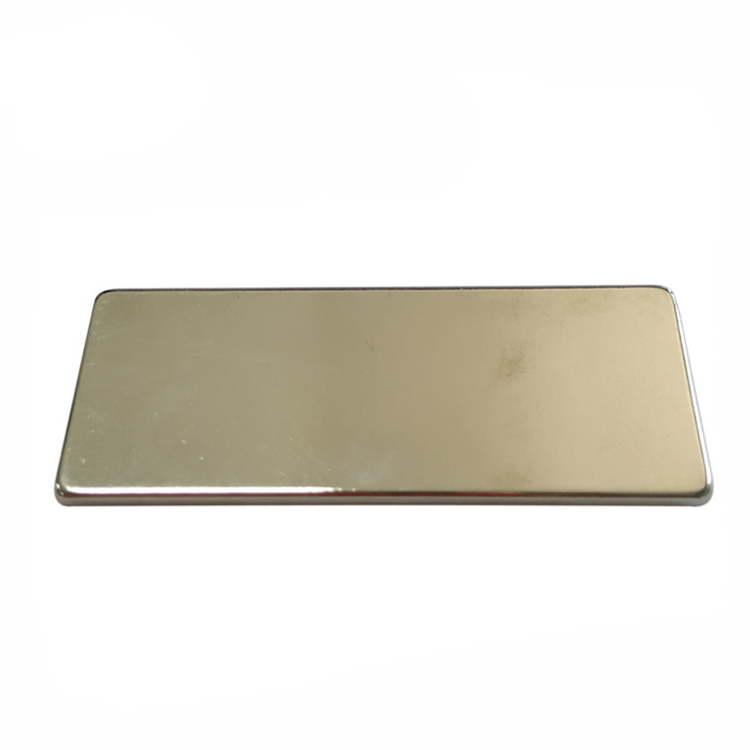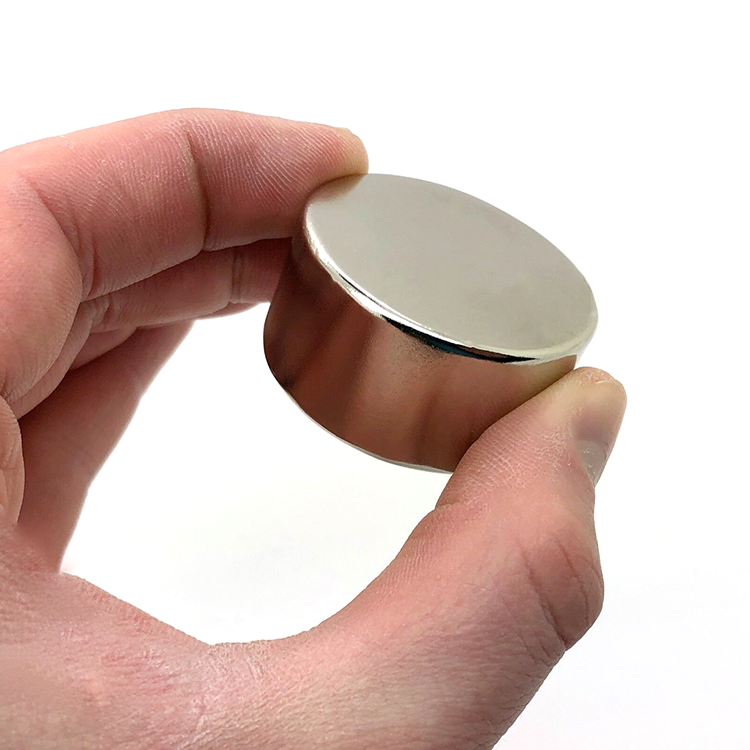



It is unimaginable that China’s magnet industry has a large volume and rapid development in the world’s permanent magnet field. At present, China is fully capable of accepting orders for permanent magnets from global users, not only in terms of quantity, but also in terms of quality, which was completely impossible more than ten years ago.
Although the sintered Sintered NdFeb Magnet technology has been developed for more than 40 years and has become increasingly mature, the obtained magnetic energy product is very close to the theoretical value (64MGOe), but the related technology research and development has not stopped. With the continuous improvement of the technical level, our country’s technical standards from generation to generation have also been updated and iterated. Let me give you a detailed introduction to the development and evolution of my country’s sintered NdFeB national standard and the main preparation process.
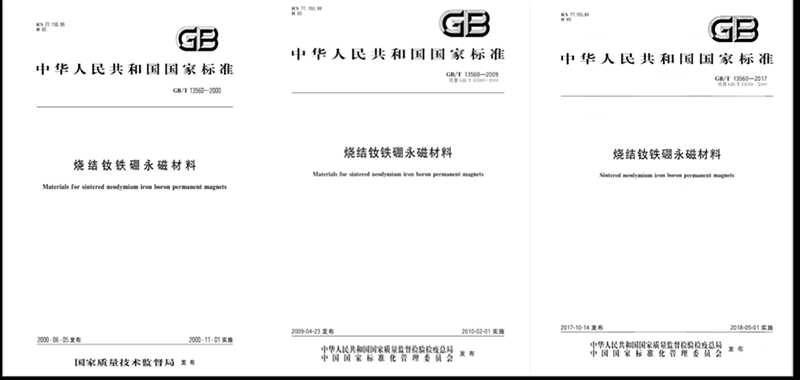
The successive national standards of sintered NdFeB in my country are as follows:
GB/T 13560-1992
GB/T13560-2000
GB/T13560-2009
GB/T 13560-2017
The current national standard for sintered NdFeB was promulgated by the General Administration of Quality Supervision, Inspection and Quarantine and the Standardization Committee on October 14, 2017. The standard was implemented in May 2018. Compared with GB/T 13560-2009, the new The version of the national standard adds rare earth technical terms, new character grade examples, test method regulations, and squareness parameter ranges, etc.
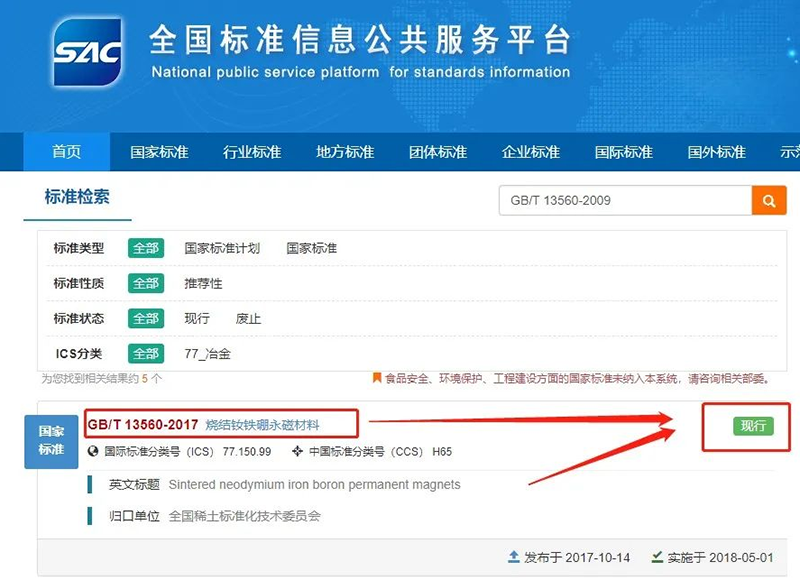
In fact, the development of the brand name of my country’s magnetic steel can be found from the update iteration of the national standard:
GB/T 13560-1992
The first generation of GB/T 13560-1992 was formulated in full reference to the then international standard IEC 404-8-1 (1986). Due to the limited technology at that time, domestic high-grade magnets were far from reaching the world’s advanced level, so there were certain technical limitations. , the same is true for the magnetic steel standard.
GB/T13560-2000
GB/T 13560-2000, the performance standard of magnetic steel is still in the backward stage. However, in the version of GB/T 13560-2000, my country began to have its own requirements for brand regulations. For example, the coercive force is divided into six gears of N, M, H, SH, UH, and EH.
GB/T13560-2009
In GB/T 13560-2009, the TH (ie: AH) gear is added. That is to say, from now on, our country’s standards will gradually outperform the international standard IEC 60404-8-1-2015. The coercive force reached 2786kA/m, and new related content such as character grade notes were added.
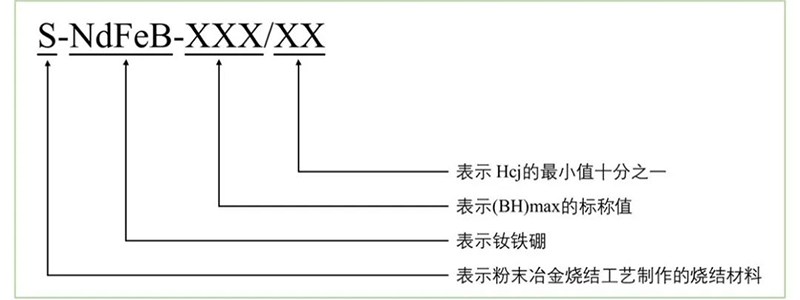
The requirements for intrinsic coercive force in GB/T 13560-2017 range from 875kA/m to 2786kA/m, while the international standard IEC 60404-8-1-2015 requires intrinsic coercive force Hcj, a key indicator of permanent magnet materials. The requirements are from 900kA/m to 2400kA/m. In terms of this technical index, the scope of my country’s national standards has fully covered international standards, and the scope is wider and more universal. my country’s national standard divides the coercive force into seven gears: N, M, H, SH, UH, EH, and TH. As far as the test method is concerned, GB/T 13560-2017 stipulates that N, M, H, SH, The detection method of UH magnetic steel shall be carried out according to GB/T 3217, and the detection method of EH and TH shall be carried out according to GB/T 29628. In addition, new technical means and test methods have been added to GB/T 13560-2017.
In fact, every update of technical standards and every iteration of project indicators is not only the fundamental guarantee for the quality of permanent magnets in my country, but also the proof of the hard work of generations of permanent magnets. The above is the development process of my country’s sintered NdFeB national standard, so what is the preparation process of sintered NdFeB permanent magnets?
At present, the commonly used preparation methods in the domestic sintered NdFeB industry include: single alloy sintering, double alloy powder sintering and grain boundary infiltration.
1) Single alloy method:
Fields such as 3C electronics, artificial intelligence, low-power motors, and electric bicycles generally use a single alloy method, that is, the raw materials are directly smelted and powder pressed and sintered. At present, the highest coercive force of a single alloy in the industry can reach the AH gear, but because the cost is too high, a large amount of heavy rare earth materials are required, so the double alloy method is generally used for such a high coercive force. Currently available grades for a single alloy: 56M (high remanence version), 20AH (high coercive force version).
2) Double alloy method:
Wind power, industrial motors and other fields generally adopt the double alloy method. These fields have higher requirements for coercive force and remanence, and the specifications are larger, which is not conducive to penetration. Therefore, the most important method used in the industry at present is the double alloy method and Prepared by a single alloy method. In 1990, researchers proposed a new double alloy process, that is, to prepare NdFeB magnets by melting two master alloys. The two alloys are crushed into coarse powder and mixed in a certain proportion, and the required particle size is obtained by jet mill or ball mill. Then carry out magnetic field orientation forming and sintering to make a magnet. At present, the grades that can be prepared by the double alloy method include: ultra-high coercive force UH grade, ultra-high coercive force SH grade, and the maximum magnetic energy product BH(max) can even reach 48MGOe.
3) Grain boundary infiltration method:
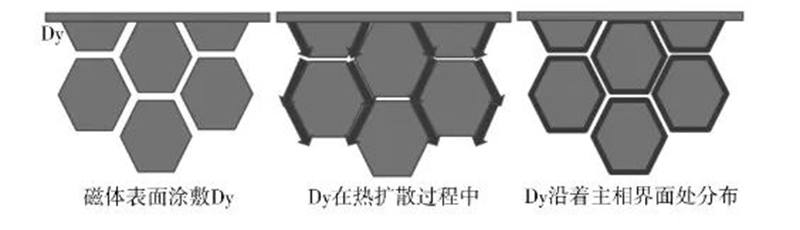
At present, the new energy automobile industry generally uses NdFeB permanent magnet materials as the preferred magnet for its engines and air-conditioning compressors. In addition, energy-saving elevators, electric bicycles and other fields will also use this method. The aim is to further save costs. The grain boundary infiltration method mainly uses the principle of element diffusion to allow elements (such as Dy and Tb) that are conducive to improving the anisotropy of the alloy magnetic crystals to enter the grain boundary and change the interface composition of the grain boundary phase, thereby increasing the local anisotropy field. Inhibiting the nucleation of reverse domains at grain boundaries can increase the coercive force of materials [8]. At present, the grades that can be achieved through grain boundary diffusion technology include: 54SH, 48UH, 38UH, 38SH, 38AH…etc.
Supplementary knowledge points:
1. In the national standard, the test method of material remanence temperature coefficient and intrinsic coercive force temperature coefficient shall be carried out according to the provisions of GB/T 24270; the test method of coating shall be carried out according to the provisions of GB/T 34491;
2. The maximum magnetic energy product of SmCo permanent magnets can reach 35MGOe, and the theoretical maximum magnetic energy product of NdFeB permanent magnets is 64MGOe.
What is different of Bonded NdFeB and Sintered NdFeb Magnet?
1. Bonded NdFeB
Bonded NdFeB, composed of Nd2Fe14B, is a synthetic magnet. Bonded NdFeB magnets are magnets made by mixing quick-quenched NdFeB magnetic powder and binder through “compression molding” or “injection molding”.
Bonded magnets have high dimensional accuracy, can be made into magnetic components with relatively complex shapes, and have the characteristics of one-time molding and multi-pole orientation. Bonded NdFeB has high mechanical strength and can be molded together with other supporting components during molding.
2. Sintering
Sintering, which refers to transforming powdery materials into dense bodies, is a traditional process. People have long used this process to produce ceramics, powder metallurgy, refractory materials, ultra-high temperature materials, etc.
Generally speaking, the dense body obtained by sintering after the powder is formed is a polycrystalline material, and its microstructure is composed of crystals, glass bodies and pores. The sintering process directly affects the grain size, pore size, and grain boundary shape and distribution in the microstructure, which in turn affects the properties of the material.
2. Different uses
1. Bonded NdFeB
NdFeB bonded permanent magnet material is made by adding NdFeB magnetic powder into binder. Since the successful development of this material in 1988, its development has been quite rapid, and its output has increased exponentially. As a high-performance permanent magnet material, it meets the requirements of short-term, small, light and thin development of contemporary electronic products. trend.
2. Sintering
Large-scale equipment and automation. Before the early 1970s, the largest sintering machine in my country was 75m2. In the early 1980s, my country introduced a 450m2 large sintering machine and its supporting equipment in Baosteel, and at the same time introduced the manufacturing technology of the sintering machine. By 2007, my country has successively built 72 sets of sintering machines of 180 m2 and supporting facilities in Baosteel, Anshan Iron and Steel, Wuhan Iron and Steel and other places.
The total sintering area reaches 221216 m2, and the average area of a single sintering machine is 295 m2. The technological equipment and automation level of large and medium-sized sintering machines put into production in my country since 1989 have been improved, and a relatively complete process detection and control has been realized, and a computer control system is used to automatically operate, monitor, control and laugh at the production process. manage.
3. Different performance
1. Bonded NdFeB
It can be formed at one time without secondary processing, and can be made into various complex shapes of magnets. It can greatly reduce the size and weight of the motor by using the duster.
2. Sintering
The temperature during sintering is called the sintering temperature, and the temperature range between the sintering temperature and the starting oversintering temperature is called the sintering temperature range. If the sintering temperature and the sintering temperature range continue to rise during the sintering process, the green body will begin to deform and soften. , Overheating expansion, resulting in sintering accidents.
المنتجات ذات الصلة