


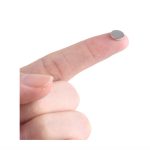
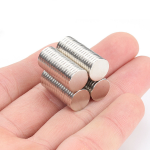
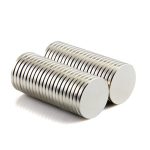
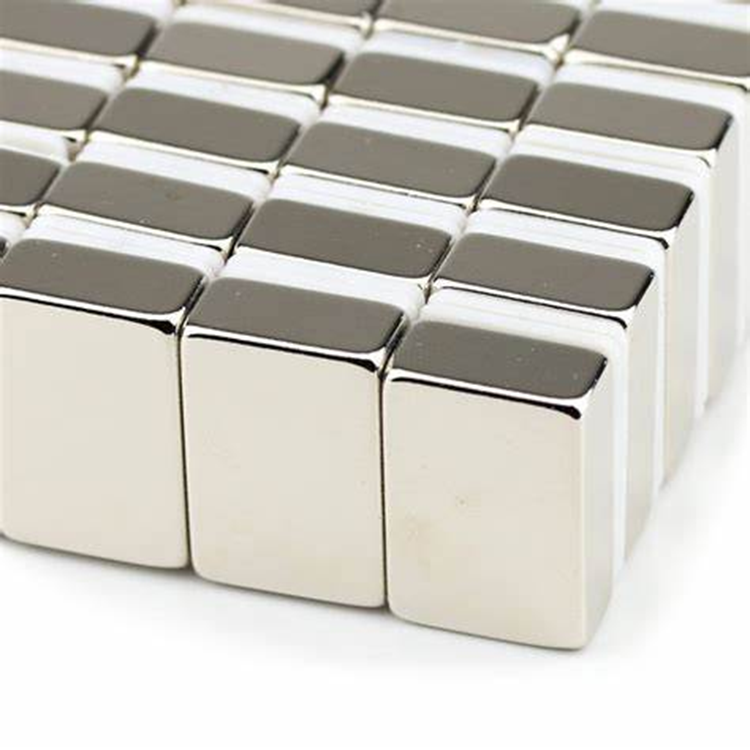
In the previous article, we briefly introduced ferrite magnets. This article will briefly introduce NdFeB magnets. NdFeB magnets are the world’s strongest permanent magnets. It is a tetragonal crystal composed of neodymium, iron and boron. This magnet is the most commonly used rare earth magnet today and is widely used in electronic products such as hard drives, mobile phones, headphones and battery-powered tools.

Classification of NdFeB
Depending on the production process, NdFeB can be divided into three types: sintered NdFeB, bonded NdFeB and hot-pressed NdFeB. Due to different production processes, there are great differences in product magnetic properties, post-processing processes and application fields.
1. Sintered NdFeB
Sintered NdFeB is the largest and most widely used product in the NdFeB family. It is produced by powder metallurgy and can be divided into seven series: N, M, H, SH, UH, EH and TH according to the different coercive forces of the products.
The remanence of the commercially produced sintered NdFeB magnets is as high as 1.45T and the inherent coercive force is as high as 2786kA/m. The operating temperature is between 80° and 200° depending on the coercive force. Sintered NdFeB magnets are prone to oxidation and corrosion, so surface treatment is required.
According to the different requirements of the use environment, surface treatment methods such as phosphating, electroplating, chemical plating, electrophoresis, and vapor deposition can be used. Common coatings include zinc plating, nickel plating, nickel-copper-nickel, epoxy resin, etc.
2. Bonded NdFeB magnets
Sintered NdFeB magnets are difficult to process into special shapes, are prone to cracking and breaking during processing, and are difficult to assemble. In order to solve these problems, people try to crush the permanent magnets and mix them with adhesives, and then press them into shape in a magnetic field. Therefore, bonded NdFeB magnets came into being.
It has the advantages of low cost, high dimensional accuracy, large shape freedom, high mechanical strength, and light specific gravity, and has been widely used in the market. At present, there are four main molding processes for bonded NdFeB magnets: calendering, injection molding, extrusion molding, and compression molding, among which calendering and injection molding are more mainstream.
Because a large amount of adhesive is added to bonded NdFeB magnets, their density is generally only 80% of the theoretical density, so the magnetic properties are weaker than those of sintered NdFeB magnets. Bonded NdFeB magnets are isotropic magnets with the same magnetism in all directions, so it is easy to manufacture multi-pole monolithic magnets. (Bonded NdFeB magnets can also be made into anisotropic magnets)
3. Hot-pressed NdFeB magnets
Hot-pressed NdFeB magnets can obtain magnetic properties similar to sintered NdFeB without adding heavy rare earth elements. They have the advantages of high density, good orientation, good corrosion resistance, and high coercivity, but poor mechanical properties. And due to patent monopoly and high processing costs, only a few companies in the market have achieved mass production of hot-pressed NdFeB magnets.
Due to the limitations of molding technology, the current hot-pressed NdFeB magnets can only be made into rings, and the scope of application is subject to certain restrictions. It is currently mainly used in the field of automotive EPS motors.
Hot-pressed NdFeB magnets have excellent magnetic properties, and the maximum radial magnetic energy product of the magnetic ring can reach 240~360kJ/m³. The magnetic ring is oriented in the radial direction, and the radial magnetic properties are uniform, which can make the motor run quietly and the torque output smooth. At the same time, it also has high heat resistance, and the operating temperature can reach 180℃-200℃.

الخاتمة
The three types of NdFeB magnets have their own advantages. Due to the huge differences in magnetic properties and molding processes, the intersection between bonded NdFeB magnets and sintered NdFeB magnets is not large. Bonded NdFeB magnets are mainly used in hard disk drive spindle motors, small power micro motors and other fields, while sintered NdFeB magnets are more used in high power drive motors and other fields. Due to shape limitations, hot-pressed NdFeB magnets are currently only used in automotive electric power steering systems (EPS).