



Does steel block the magnetic field or does it extend it further? It sounds like opposing results, so why is it sometimes one or the other? It can’t be both, right? Maybe it does…
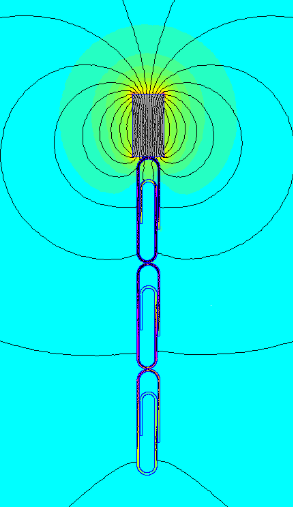
On the one hand, a string of steel paperclips clearly extends the attraction of a magnet. A paperclip stuck to a magnet temporarily becomes a magnet itself. The last paperclip in a row of steel paperclips can’t be attracted to the magnet from that far away without the other paperclips strung together. The useful magnetic field certainly extends farther from the magnet.
On the other hand, steel is said to shield, redirect, or block magnetic fields. A magnet stuck to a steel washer will not stick to the steel surface nearly as well as a steel washer would. The steel washer will block the magnetic field from reaching it, thus reducing the pulling force.
When asked this type of question, our response is often a frustratingly vague “it depends.” In this article, we’ll dig a little deeper and try to find a more specific answer to this type of question.
When you stick a magnet to a piece of iron or steel, the steel will temporarily act like a magnet. We can say it has north and south poles, just like the other magnets we sell.
We call this piece of steel a “temporary magnet” because when we remove the magnet, the effect goes away. That’s why neodymium magnets are called “permanent magnets.” The magnetization is permanent and does not require an external magnet or magnetic field to maintain it.

About Geometry
Let’s get straight to the point: if you have a specific setup, how do you know if a piece of steel will improve or degrade performance? When our engineers say the answer depends on the details, they’re really referring to geometry.
What are the size and shape of the magnets?
What are the size and shape of the steel?
How are they aligned with each other? What do they stick to?
What is their effect? Are you more interested in the pull of an object or the strength of the magnetic field that triggers the sensor?
To try to answer this question, let’s move away from the paper clip and consider a more general scenario.
Start with a simple cylindrical magnet, such as a D44 magnet that is 1/4″ diameter x 1/4″ thick. Next, affix a steel disk/cylinder on top of the magnet, with a diameter and thickness we can specify. We can choose these two sizes to consider a tall cylinder, a thin disk, or anything in between. How does the size affect the magnetic field strength or pull we see at the end of the steel disk? How do these results compare to what we see without the steel disk?
The selector below lets you try different sizes of steel cylinders placed on top of the magnet. It lets you estimate the magnetic field strength at the end of the steel disk or the pull at the surface of the steel disk.


Answering the Question
This is all fun and games, but let’s get back to the original question: If I put a piece of steel on top of this magnet, will it increase or decrease the magnetic field strength?
Let’s start with a baseline to compare our results to. Our baseline is when there are no steel parts at all. You can select this by selecting the diameter “None”. These results with no steel parts are the same as for a single magnet in free space, which is described in our “Surface Fields” article. We simply measured the magnetic field strength at different distances from the surface of the magnet. The magnetic field strength is strong near the surface of the magnet and then drops off rapidly as the distance increases.
In the graph below, we have plotted these baseline values as the thicker dark blue line. The results are the same as the selector tool above, just plotted on a graph.
Now, what happens if, instead of leaving an air gap between the magnet and the measurement point, we place a 1/4″ diameter steel disk or bar on top of the magnet? How do the measurements compare to if the bar is placed instead of an air gap? Depending on the height of the 1/4″ diameter steel disk, we get different answers.
If the height of the steel cylinder is 1/8″ or less, the field strength is weak. The steel disk reduces the field strength at the measurement point. We are better off leaving just an air gap.
If the height is 1/4″ or more, we expect the field strength to be stronger. The steel disk extends the strong field farther from the magnet.
In the figure, the green background shows where the field strength increases when the steel disk is used (compared to no steel disk at all). The red background shows where the field strength decreases. After all this research, we are back to our original answer – the results depend on the geometry!
Even more complicated – the pull force is different!

Field strength and pull force are not the same thing. While these numbers may seem vaguely related, there is no one-to-one relationship between the two. They are very different measures of the performance of a magnet.
The figure below shows the same set of results, but measuring the tensile force of a large steel plate instead of field strength. Although the shapes are similar, the results are different. Not all steel shapes that were weaker in the previous field strength analysis will give weaker tensile force. Some shapes can give strong tensile force but weaker field strength. In other cases, the opposite is true.
In our study of magnetic field strength, a disk or cylinder with a smaller diameter provided a stronger magnetic field than one with a larger diameter. But pulling force is not so simple. If you look at the diameter from small to large, you will see that the pulling force is weaker, reaches a maximum at a 3/16-inch diameter steel sheet, and then decreases again. It’s really complicated!
The performance of a magnet depends not only on the shape of the magnet and the surrounding steel object, but also on the performance metric you value.